Customize Your Trip




Need Help? Let's Talk
+977 985-1095800


10% OFF
Trip Duration 05 Days
Group Size 1-10 People
Maximum Altitude Gosaikunda Lake (4,380 m / 14,370 ft)
Difficulty Grade Moderate to Difficult
Start & End Point Kathmandu/Kathmandu
Best Seasons Mar–May, Sep–Nov
Private Treks with Daily Departures
Note: We can run a trip for solo travelers, couples, friends, and family with children. Our private trips run daily. For small group travel, please check the dates below. If the dates below do not suit you, please email us or WhatsApp us at +9779851095800 to travel on your preferred dates.
Small Group Trek Departure Dates for 2027 and 2028
September: 05,10,18,22,30
October: 02,05,08,12,16,20,24,30
November: 04,07,11,14,17,21,25,30
December: 03,07,12,17,21,24,30
January: 02,12,20
February: 08
March: 03,07,11,14,17,21,25,29
April: 02,06,10,13,16,19,22,28
May: 02,07,11,15,20,28
June: 05,10,15,20
Highlights of Gosaikunda trek
- See the worshiped Gosaikunda Lake located beneath the peak tops in snow.
- Opportunity to watch an incredible sunrise while facing the Langtang Himalayan peaks.
- Encounter the religious ambiance that dwells in the pilgrimage locations of Hindu and Buddhist traditions.
- Trek past rhododendron forest landscapes, alpine meadows, and a mix of rocky surfaces.
- Enjoy scenic mountain views along the Lauribina trail to Gosaikunda Lake.
- Discover Tamang villages alongside Sherpa communities to understand their cultural ways of life.
- Experience the religious significance of Gosaikunda Lake, with opportunities to observe Janai Purnima celebrations during the festival period.
- Explore habitats supporting Himalayan tahr, red pandas, and various bird species, although sightings are not guaranteed.
- Relaxing in tea houses, which provide welcoming hospitality and traditional Nepali food while offering relaxation opportunities.
- Enjoy unobstructed views toward Langtang Lirung, Ganesh Himal, and Manaslu ranges
Overview of Gosaikunda Trek
Starting on the Gosaikunda Trek, visitors can experience the holy Gosaikunda Lake, located 4,380 meters inside Langtang National Park. Along the trail you will find amazing sights of the Langtang Himalayan range and the views of Ganesh Himal and Manaslu while moving through wooded forests, agricultural territories and local settlements.
Thousands of Hindu and Buddhist pilgrims come to Gosaikunda Lake every August for the Janai Purnima festival because the location has religious importance for both faiths.
Beginning at Dhunche through stunning transportation from Kathmandu you will progress through oak and rhododendron forests towards the destination.
On your adventure, you will encounter two points, the significant Buddhist religious site Sing Gompa and the welcoming local settlements. When visiting Gosaikunda Lake, you will find its spiritual feel coupled with its sparkling lake water.
Novice and knowledgeable travelers can pursue the Gosaikunda Trek successfully. The trek remains short even though altitude adjustment plays a crucial role in achieving successful completion since the high elevation presents a challenge to most climbers.
How to Reach Gosaikunda Lake from Kathmandu
Our 5 days Gosaikunda Trek will start with a scenic tour of Kathmandu to Dhunche where the trek starts. The trip typically lasts 6-8 hours, which can vary based on the traffic, weather, and road. On the road, you travel through some beautiful hills, traditional villages, terraced farmlands as well as river valleys before reaching the Langtang region.
The trekking path, leaving Dhunche, cuts across rhododendron, oak, and pine forests to Sing Gompa, or Chandanbari. The trail proceeds upwards through Lauribina with amazing views of the Langtang Himalayas and Ganesh Himal on a sunny day.
Once we go through the high alpine terrain, we arrive at the holy Gosaikunda Lake, which lies at around 4,380 meters. You get to explore the lake, enjoy the mountain scenery around it and get to know how it is important to Hindu and Buddhist pilgrims.
We follow the same route through Lauribina and Sing Gompa to Dhunche in our usual itinerary. On the final day, we drive back to Kathmandu, completing the 5-day Gosaikunda Trek.
Langtang Valley with Gosaikunda Lake Trekking Video
Itinerary of Gosaikunda Trek
DAY
01
01
Day 01: Kathmandu Drive to Dhunche
Beginning from Kathmandu, the adventure leads travelers to Dhunche which exists at 2,030 meters above sea level. During the approximately 7-hour travel visitors pass through enchanting scenery that shows them the traditional village life alongside terraced agricultural fields.
Dhunche stands as the main town of Rasuwa district while it also functions as the main entrance to visit Langtang National Park. Trekkers arriving first stop at the local bazaar and have opportunities to meet the Tamang community before organizing their upcoming trek.
Bus
6-7 hrs
Accommodation
Guesthouse
Meals
Lunch, Dinner
Altitude
Dhunche (2,030m)
DAY
02
02
Day 02: Dhunche to Sing Gompa
The first 5 to 6-hour hike leads from Dhunche to Sing Gompa, also known as Chandanbari, at approximately 3,330 meters. During the spring season the forest trail becomes beautiful with numerous blooming rhododendron and pine and oak species.
Trekkers who traverse this route may spot langur monkeys together with many different bird varieties. The ancient temple of Sing Gompa in the elevation of 3,250 meters features a Buddhist monastery as well as picturesque vistas towards the Langtang Himalayas.
The village keeps its status as famous through its yak cheese factory operation which allows people to try and acquire handmade local cheese.
Walking Day
Approximately 5–6 hours, depending on your pace and trail conditions.
Accommodation
Teahouse
Meals
Breakfast, Lunch, Dinner
Altitude
Sing Gompa (3,330m)
DAY
03
03
Day 03: Sing Gompa to Gosaikunda Lake
On day three, travelers need to spend 6 to 7 hours trekking up to the sacred Gosaikunda Lake, which rests at 4,380 meters. The trail moves vertically uphill while taking hikers through alpine zones where they can admire views of Langtang Lirung and Ganesh Himal peaks.
Travellers walking towards Gosaikunda will find more than one pristine lake that holds religious importance for the group.
Gosaikunda functions as a spiritual destination visited by practitioners from both Hindu and Buddhist faiths because they believe Lord Shiva made the lake. Clear natural waters of Gosaikunda flow peacefully among mountainous terrain to create a serene exploration area.
Walking Day
Approximately 6–7 hours, depending on your pace, weather, and trail conditions.
Accommodation
Teahouse
Meals
Breakfast, Lunch, Dinner
Altitude
Gosaikunda Lake (4,380 m)
DAY
04
04
Day 04: Trek from Gosaikunda all the way down to Dhunche
Enjoy your breakfast at the highest lake before heading down to Dhunche. This is on the last day of our trek on foot. Our Gosaikunda Trek trails descend all the way to Sing Gompa.
We descend through Lauribina, enjoying mountain views along the way, and stop at Sing Gompa for lunch and a short rest.
The trails descend through pine, silver oak, and rhododendron forests. You can also see marijuana plants across the suspension bridge over the Sing Gompa Stream.
Now, the path stretches flat. Here, there is a mountain Mineral water factory and some human settlements. Overnight at Dhunche, the district headquarters of Rasuwa district.
Walking Day
Approximately 7–9 hours
Accommodation
Guesthouse
Meals
Breakfast, Lunch, Dinner
Altitude
Dhunche (2,030m)
DAY
05
05
Day 05: Dhunche Drive to Kathmandu
A trip from Gosaikunda back to Kathmandu signifies the conclusion of the Gosaikunda trek during the last day. At the end of the trekking adventure people remember stunning views along with meetings with the local population and the calm presence of Gosaikunda Lake.
The 5-day Gosaikunda Trek presents trekkers with both adventurous exercises and cultural and religious insights that create this wonderful trekking experience in Nepal’s heritage zones.
Bus
6-7 hrs
Meals
Breakfast & Lunch
Altitude
Kathmandu (1,400m)
Important Note:
The Gosaikunda Trek leads travelers through a powerful union of natural splendor and cultural tradition along with spiritual value that defines the Langtang region of Nepal.
During this five-day trek you will traverse different landscape types which include forests and alpine lakes while having a complete Langtang region experience.
Includes/Excludes
What's Included?
- A trekking guide certified and licensed by the government has training in high-altitude sickness and first aid.
- Local trekking porter for the trek, one porter for two trekkers basis.
- Trekking staff, food, accommodation, salary, equipment, insurance, and clothing.
- Local Tea houses, also called guest houses/ lodges, twin sharing during your journey.
- You can choose your daily meals (breakfast, lunch, and dinner) from the menu, which includes different types of food.
- Langtang National Park Trekking Permit.
- TIMS Card for the Gosaikunda Trek.
- Group medical supplies (Guide will carry essential medicines).
- Above the Himalayan duffel bag. ( If you need to, please let us know before you book the trip and remind us in our pre-meeting at our office)
- Kathmandu to Dhunche transfer by Local bus ( private land cruisers are also available by adding separate cost)
- Dhunche to Kathmandu transport by Local bus ( private land cruisers are also available by adding a separate charge)
- Comprehensive pre-departure information and trip dossiers
- Above the Himalayan Gifts and Trekking certificate after finishing your trek.
- All necessary papers work, office Service charges, and all Government Taxes
What's Excluded?
- Any service in Kathmandu.
- Alcoholic, hot ( tea & coffee), cold drinks, mineral water, and hot water.
- Personal expenses include laundry, telephone calls, snacks, dessert, beverages, bar bills, and battery charging.
- Travel Insurance should include emergency evacuation coverage while trekking.
- Tips for tour/ trekking staff and driver.
Flexible Booking and Cancellation Policy
At Above the Himalaya Trekking, we understand that travel plans may change. Our booking policy provides clear terms and flexible options to help you plan your Himalayan adventure with confidence.
A 20% non-refundable deposit is required to confirm your booking, with the remaining balance payable upon arrival in Kathmandu/Pokhara before your trek begins. Departure dates can be changed free of charge at least 30 days in advance, subject to availability.
If you postpone your trip at least 30 days before departure, your deposit can be applied toward another trip within one year, subject to availability and any price differences. Date changes are not permitted within 30 days of departure, and no refunds are provided for early departures or unused services once the trip has started.
For complete details, please read our Booking and Cancellation Terms.
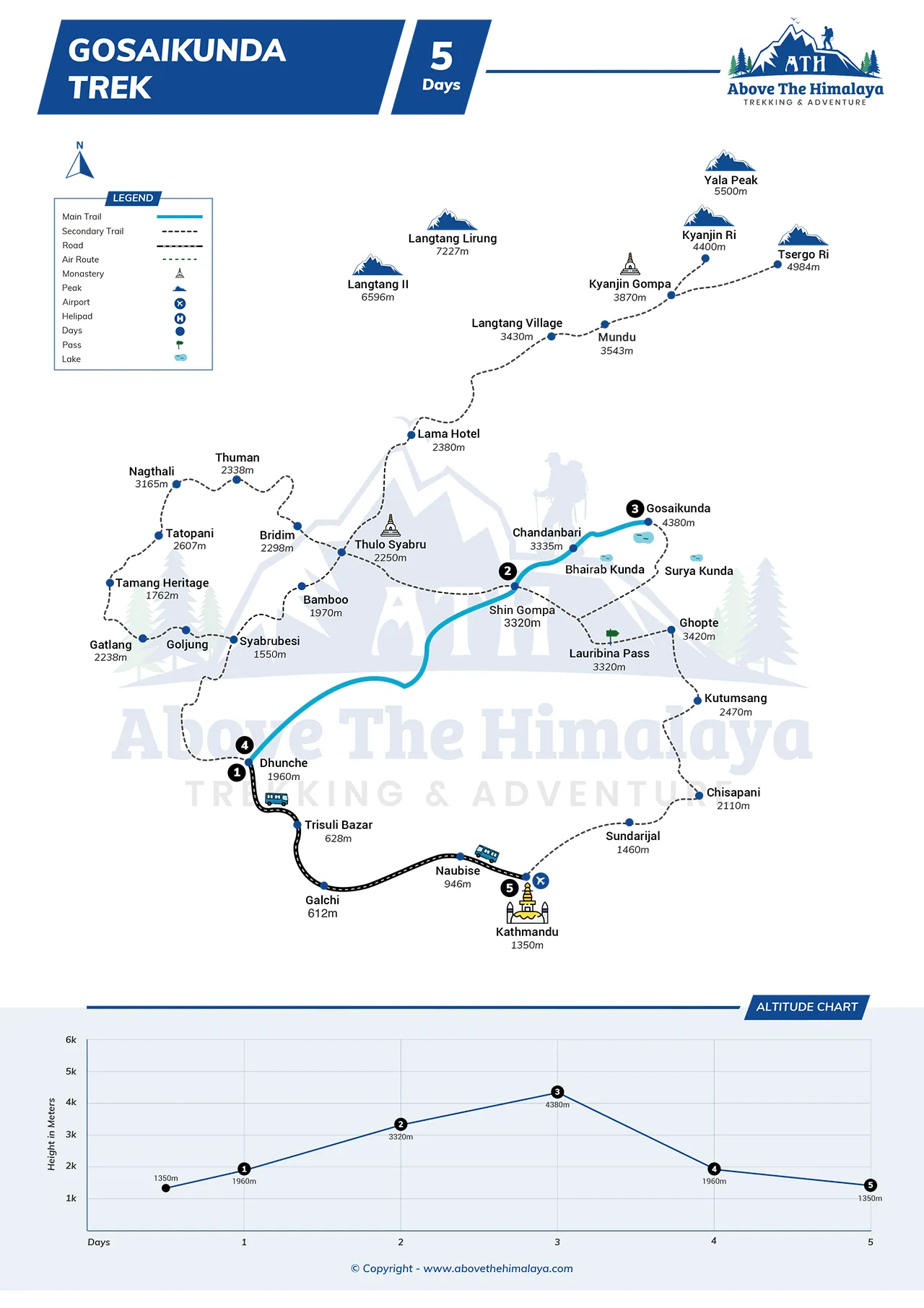
Route Map & Altitude Chart
Best Time for the Gosaikunda Trek
The best time for the Gosaikunda Trek is spring (March to May) and autumn (September to November). These seasons generally offer pleasant trekking conditions, clearer mountain views, and less rainfall.
Spring brings blooming rhododendron forests, while autumn offers excellent mountain visibility after the monsoon. Winter trekking is possible, but snow and ice can make the higher trails challenging. The summer monsoon brings rain and slippery paths, although the sacred Janai Purnima festival attracts many pilgrims to Gosaikunda Lake.
Spring (March to May)
From an aesthetic and climatic standpoint, Spring turns out to be the ideal period to undertake the Gosaikunda Trek. Spring provides perfect conditions for trekking because the area experiences balanced weather and pleasant temperatures, together with the clear blue sky.
Scarlet rhododendrons as well as magnolias and wildflowers, decorate the trails during this period, creating a stunning environment. All three mountain ranges including Langtang Lirung, Ganesh Himal, along Manaslu, appear spectacular.
Spring in this region brings temperatures between 10°C to 20°C at lower altitudes and between -5°C to 5°C at Gosaikunda. The climate during this period produces superb conditions for trekking because it brings wonderful sights alongside exciting cultural discoveries.
Due to its popularity, you will encounter an average number of people during this time period on the hiking trail.
Autumn (September to November)
Autumn forms a perfect time frame to undertake the Gosaikunda Trek because it provides stable meteorological conditions in combination with clear atmospheric conditions.
The new air after monsoon provides an exceptional experience because mountains stand out in full clarity. The climate during this season becomes gentle with lower areas averaging 10°C to 18°C while the Gosaikunda region maintains temperatures between -5°C to 5°C.
During August and early September, Janai Purnima attracts substantial Hindu and Buddhist adherents to the festivities. Regional climate during autumn remains dry so trekking becomes highly suitable.
The hiking trails receive many visitors yet remain non-crowded, while the forests continue to display their jungly appearance. This season offers some of the best photography opportunities, with crystal-clear views of the Himalayas.
Winter (December to February)
Chilly winter weather conditions and snowfall create an attractive but tough experience during the Gosaikunda trek. The frozen condition of the lake creates an enchanting sight.
At daytime, the region experiences a temperature range between -5°C to 10°C, but evenings bring temperatures that drop down to -10°C or lower in elevated areas.
Winter trekking suits people who already have trekking experience and appropriate equipment for dealing with both severe low temperatures. The paths are generally empty which creates a serene distant adventure.
Heavy snowfall can make the trail through Lauribina to Gosaikunda Lake icy, slippery, or temporarily inaccessible. Winter trekkers should check current trail conditions before departure. Because of seasonal closures the tea houses are unavailable while trekkers need to plan thoroughly to handle the extreme conditions.
Monsoon (June to August)
During monsoon season big rains transform the Gosaikunda Trek paths into risky conditions because of their dangerous slipperiness and the spread of leeches and confusing visibility. High humidity causes ongoing path obstructions by landslides that mainly impact the trail between Dhunche and Sing Gompa.
The trek maintains its attractiveness through its colorful waterfalls and abundant green growth despite weather difficulties. Thousands of pilgrims come to celebrate the Gosaikunda Festival in August, which brings a vibrant environment to the place.
During the monsoon the necessary requirements for trekking include waterproof gear coupled with effective planning and adaptable decision-making. Fewer people go trekking during the off-season, resulting in affordable room rates throughout the trail.
Gosaikunda Lake Significance
Gosaikunda Lake maintains great spiritual importance for Hindus together with Buddhist religious followers. Lord Shiva has chosen this sacred place situated at 4,380 meters inside Langtang National Park as his home.
The Hindu belief states that Lord Shiva formed Gosaikunda by using his trident to dig into the mountain as he sought to relieve his thirst after consuming poison during the ocean churning ceremony. Because of its creation myth the lake attributes holy and purifying properties to its water.
Hindu men take the opportunity of Janai Purnima to replace their sacred thread (Janai). The site holds religious value for Buddhist practitioners because they view the location as a holy space for meditation.
Despite its sacred religious value, Gosaikunda presents itself as a magnificent natural attraction that stands in the breathtaking union of stunning mountain peaks and peaceful surroundings. Gosaikunda lake shows its clear water surface up to the sky, enhancing the stunning vista.
The lake keeps its frozen state during the winter months, thereby boosting its captivating charm. People visit Gosaikunda Lake to achieve spiritual growth and investigate the region’s natural wonders, which combine worship with outdoor experience.
Gosaikunda Trek Difficulty
The Gosaikunda Trek presents moderate hurdles that include difficult terrain along with extreme heights and unsteady meteorological conditions. The 1,960-meter town of Dhunche starts the trek, which grows to reach Gosaikunda Lake at 4,380 meters during a few days of climbing,g thus causing significant risk of altitude sickness.
Breathing problems alongside headaches and exhaustion emerge when people travel to high elevations because of poor oxygen levels, so visitors need to adjust to the altitude.
The trekking path includes challenging elevations combined with rocky terrain and forested areas, which demands stamina and strong endurance from participants. The path between Sing Gompa and Lauribina requires a lengthy, steep elevation of massive height.
Weather conditions also affect difficulty. During the winter months, from December to February, the trails become hazardous due to heavy accumulation of snow. The June to August monsoon season creates uneven terrain paths, which become hazardous because of leeches.
During the spring and autumn seasons, between March to May and September to November, the weather remains steady while the paths stay visible.
A proper amount of preparation enables beginner trekkers to finish this trail, but experienced hikers will find it more suitable. Keeping moving at a controlled speed combined with hydration will minimize physical fatigue and escape altitude dangers.
Physical Fitness Requirement
Physical exertion at a moderate to good level is needed to undertake the Gosaikunda Trek because it includes demanding slopes and extended marches, and elevated terrain. Hikers must perform daily treks of five to seven hours duration on challenging terrain which features steep mountain climbs.
Trekking from Sing Gompa to Lauribina represents the most strenuous part, as trekkers need exceptional stamina and endurance because of its steep terrain.
The preliminary training for Gosaikunda Trek begins with cardio workouts involving running, cycling and swimming that need to start 2 to 3 months before the actual trek date.
Leg and core strength training enables better endurance during hikes, which involve uneven surfaces. Going on short backpack hikes imitates the demanding environment that trekking presents. The practice of yoga as a flexibility exercise helps prevent walking-related muscle strain.
Travelers who want to begin the trek need to exercise before attempting it yet medical consultations should occur for anyone dealing with heart-related or respiratory problems. Following a smooth pace and drinking enough fluids, and scheduling regular rest stops together provide conditions for a pleasurable trekking experience.
Essential Permits for Gosaikunda Trek
For the Gosaikunda Trek, trekkers must obtain both the Langtang National Park Entry Permit and the TIMS (Trekkers’ Information Management System) Card. The two essential permits provide both environmental protection and trekker safety for Gosaikunda Park.
Foreign nationals pay NPR 3,000 for the Langtang National Park entry permit, while SAARC nationals pay NPR 1,500 and Nepali citizens pay NPR 100. Children under 10 years old are exempt from the entry fee.
The permit directly supports conservation as well as the development initiatives operating in the Langtang region. The entry permits for both the Nepal Tourism Board office in Kathmandu and the checkpoint in Dhunche offer locations to obtain them.
All trekking individuals must possess a required TIMS Card entry. The TIMS Card costs NPR 2,000 for non-SAARC foreign trekkers and NPR 1,000 for SAARC nationals under the current agency-issued TIMS system.
For the Gosaikunda Trek, foreign trekkers must follow the current licensed-guide and agency-issued TIMS requirements. Our trekking company arranges the required permits before departure. Official tracking of trekkers becomes possible through the use of the TIMS Card, which functions in emergency situations.
Our standard 5 day Gosaikunda Trek does not cross Lauribina Pass. If you extend your trek toward Helambu or Sundarijal, additional park entry fees may apply depending on the route.
Accommodation and Meals during the Gosaikunda Trek
During the Gosaikunda Trek, all lodging options are limited to simple teahouses and accommodations. Each lodge supplies basic accommodations featuring two beds as well as blankets together with communal bathroom facilities.
The quality of facilities deteriorates as you climb higher, while hot shower services are available only at an extra cost. Attaining early reservation or booking ahead will secure accommodation space during busy holiday seasons in the trek.
Nepali traditional cuisine forms the basis of all meals served on the trail. Dal Bhat comprises three elements including rice, lentil soup together with vegetables to create a balanced diet with sufficient energy and nutrition.
People who visit can obtain meals from noodles to pasta as well as soups alongside Tibetan bread. The breakfast menu features porridge together with pancakes as well as eggs. Higher altitudes decrease food selection and increase costs because of the obstacles of transporting supplies into this altitude zone.
Teahouses serve their customers with tea, coffee and hot lemon beverages, but they charge high prices for water in bottles. The standard equipment for trekkers includes water purification tablets, which enable them to obtain clean water from natural water sources.
Availability of Drinking Water
Water sources exist throughout the Gosaikunda Trek, yet travelers must clean their drinking water because it cannot be consumed as is. Drinking water prices rise in relation to altitude because of transportation expenses at local teahouses.
Drinking water bottlers charge NPR 50 at lower heights but hike their prices to NPR 200 and above near Gosaikunda. Using a reusable bottle together with water purification procedures will help both minimize expenses and decrease plastic waste.
Natural water sources from streams as well as rivers and village taps deliver fresh water although they could hide bacterial contaminants or pollutants. Drinking purified water obtained through tablets, filters and UV purifiers remains safe for consumption. Visitors can access boiled water at tea houses at a minor cost as one of the dependable water sources.
Drink sufficient safe water throughout the trek, avoid alcohol at high altitude, and limit excessive caffeine intake. Trekkers should choose their water purification techniques prior to starting their trek because access to clean drinking water directly determines the success of the expedition.
Wildlife and Plants
During the Gosaikunda Trek, travelers pass through Langtang National Park where they can spot both various wildlife species and different types of vegetation.
From the base until the lower areas, the landscape comprises thick forests including rhododendron, oak and pine trees, which generate wonderful natural freshness. Rhododendron trees display their spectacular red, pink, and white blooms across the hillsides, which occur during spring.
Rising into higher altitudes reveals a transition from forested areas to mountain pastures and stone terrain. The mountain flora consists of juniper alongside dwarf rhododendrons found within these particular areas. Two important medicinal herbs found in higher elevations include yarsagumba and jatamansi whose traditional medicinal value is highly recognized.
The local wildlife population consists of Himalayan black bears alongside red pandas and along with the presence of both langurs and Himalayan tahr. Hikers have the chance to witness musk deer feeding within forested areas, and in rare chances, even the snow leopards.
Higher areas of this region house Nepal’s national bird Danphe (Himalayan monal), besides many other bird species. Visitors to the area are expected to protect nature by staying away from wildlife and to maintain cleanliness around all trails.
Altitude Sickness and Prevention during Gosaikunda Trek
Fitness challenges from altitude sickness frequently trouble travelers on the Gosaikunda Trek because the trail exceeds 4,380 meters. Patients who experience altitude sickness display headache symptoms together along with dizziness with nausea, and difficulty breathing.
Inadequate attention to symptoms can result in two dangerous medical conditions known as high-altitude pulmonary edema (HAPE) and cerebral edema (HACE).
Trekkers should optimize their height ascension process by climbing slowly because this strategy allows their bodies to adapt naturally. Water intake together with alcohol reduction alongside controlled walking speeds reduces altitude sickness risk.
Acclimatization is the primary solution to reduce altitude illness risk which lies in high-altitude exposures. People who take Diamox (Acetazolamide) for acclimatization need medical approval before using the medication.
The proper action when facing altitude sickness symptoms involves going to a lower elevation immediately. Progression of the trek should be halted when symptoms arise as it poses life-threatening risks.
Gosaikunda Trek Cost for 2027
The 5 day Gosaikunda Trek will cost you US 630 per head with Above the Himalaya Trekking. This package is the basic trekking package and so it is easy to plan your trip without having to worry about expenditures you will make along the path.
Our basic program covers the services of a qualified, certified trekking guide, a common porter, teahouse stay, three meals per day on the trek, necessary trekking clearance, and a local bus ride between Kathmandu and Dhunche.
What affects the Gosaikunda Trek cost?
The overall cost will be determined by a number of factors such as the group size, transportation, accommodation choice and other services. A group of friends or family members can make it cheaper per person since not all costs, like transportation fees and guide fees, are incurred individually.
In case you want to be more comfortable, we can also organize a jeep ride rather than a local bus. Single room accommodation can also be offered at a small extra charge, subject to availability of lodges.
What to pack for Gosaikunda Trek
Gosaikunda Trek requires multilayer clothing since it climbs through unexpected weather conditions at high elevations. Your combination of down jacket, fleece layers, and water-resistant base layers will provide proper warmth to your body. Travelers benefit from using a jacket that ensures both rain and wind protection , particularly above higher elevations.
Sturdy trekking boots offering solid ankle support become crucial because of the rugged terrain conditions. Trekking poles offer two main benefits in steep terrain by providing support against knee injuries on the way up and down.
The 30 to 40 Liter backpack functions as your portable base for carrying essential items involving food, water, medical tools and lightweight night illumination.
Protective coverings consisting of gloves and a beanie, together with sunglasses,s shield you from chilly temperatures and strong sunlight. Sunscreen together with lip balm protects against sunburns since ultraviolet rays become more intense at higher elevations.
When staying overnight in teahouses a subzero temperature rated sleeping bag will provide necessary warmth. Water purification tablets together with a filter system provide proper access to safe drinking water.
One can enhance their comfort during a trek by including personal necessities, including toiletries and wet wipe,s and additional socks. A power bank maintains device power supply because the electrical power might be scarce in certain locations.
Festivals in Gosaikunda Lake Trek
Both Hindu and Buddhist religious communities gather during the Gosaikunda Festival which occurs on the full moon day of August. Notable among the many devotees who visit Gosaikunda Lake are followers who come to worship Lord Shiva and perform their sacred water rituals.
The highlight of the performance is the Shamans team (Dhami-Jhakri) who conduct holy prayers and perform spiritual dances.
Water from Gosaikunda Lake continues to flow toward Kumbeshwar Temple which rests 60 kilometers southwest of Kathmandu. At this festival Hindu males conduct the Gayatri Mantra recitation and perform sacred thread changing rituals (Janai) through purification ceremonies.
Religious priests at the temple protect followers by placing a sacred red-yellow thread (Rakshya Bandhan) around their wrists. The spiritual powers of the lake are emphasized by an image of Lord Shiva that stands at its center.
Gosaikunda Trek vs Langtang Valley Trek
Two of the popular trekking routes in the Langtang region are the Gosaikunda Trek and Langtang Valley Trek which have a different experience.
Our 5-day Gosaikunda Trek focuses on sacred alpine lakes, mountain scenery, and Hindu and Buddhist pilgrimage traditions. It is a shorter hike with steep ascents and a quick increase in height.
The Langtang Valley Trek will lead you through traditional Tamang villages, forests, and picturesque mountain valleys toward Kyanjin Gompa. It also takes a general of more days and provides closer glimpses of Langtang Lirung and other surrounding mountains.
Select Gosaikunda in case you want a shorter lake trek with religious and cultural interest. Go to Langtang Valley to have a more extended trekking adventure exploring Himalayan villages and mountainous areas. We can also combine both routes into a customized Langtang Valley and Gosaikunda Trek.
| Features | Gosaikunda Trek | Langtang Valley Trek |
|---|---|---|
| Duration | 5 days | Typically 7–10 days |
| Maximum altitude | 4,380 m (Gosaikunda Lake) | 3,870 m (Kyanjin Gompa) |
| Difficulty | Moderate to challenging | Moderate |
| Main attraction | Sacred alpine lakes | Himalayan valleys and mountain views |
| Starting point | Dhunche | Syabrubesi |
| Trekking experience | Steep climbs and high-altitude lake | Forests, villages and mountain valleys |
| Cultural highlights | Hindu and Buddhist pilgrimage traditions | Tamang culture and Buddhist monasteries |
| Best season | Spring and autumn | Spring and autumn |
| Accommodation | Local teahouses | Local teahouses |
| Best for | Short lake trekking adventure | Longer cultural and mountain trek |
Note: The Langtang Valley altitude refers to Kyanjin Gompa, not optional higher viewpoints such as Kyanjin Ri or Tserko Ri. Difficulty varies with itinerary and fitness.
Travel Insurance for Gosaikunda Trek
Gosaikunda Trek demands travel insurance because the altitude reaches severe heights where possible dangers exist. Tourists must be cautious about altitude sickness because the trek extends beyond 4,300 meters in elevation.
An appropriate insurance policy must provide medical emergency coverage together with high-altitude sickness treatment facilities and emergency helicopter transportation when required.
Travel insurance becomes beneficial due to unexpected weather conditions that trigger trip postponements or service suspensions. The insurance plan needs to include protection for disrupted flights as well as lost items and accidental incidents.
The high cost of emergency helicopter evacuations becomes bearable when a person obtains travel insurance because it protects from financial hardship.
Choose travel insurance covering trekking at least up to 4,500 meters, including medical treatment and emergency helicopter evacuation. People engaged in high-altitude trekking need to verify their travel insurance coverage because basic plans often deny this activity.
Frequently Asked Questions About the Gosaikunda Trek
The trail quickly elevates to high altitude parts during its progression. Proper acclimatization combined with hydration and avoidance of alcohol will help prevent getting sick at high altitudes. The development of any headache together with dizziness requires immediate medical attention.
Reviews on Gosaikunda Trek
Posted on Tripadvisor 

H H
9 December 2025
 Verified
Thank you for the best tour we have ever had!
I planned to stay at the Everest View Hotel this time and travel there because I wanted to see Everest, the highest mountain in the world, slowly, but despite the short schedule due to my children's school, all I got was a response that it was difficult to contact several tour companies. The Himaraya Trekking, Above, has worked out a smooth and safe schedule and had the best experience for me and my family. I will never forget the view of Mount Everest. Thank you very much.
Posted on Tripadvisor

Mike F
26 November 2025
VerifiedAnother Amazing Trip with Above the Himalaya
This is my 3rd trip with Above the Himalaya and Puru. Each trip with Puru has exceeded expectation with the quality of the guides, porters and attention to detail. We were a team of 5 trekker and our ages were all above 67 years of age with the oldest being 73. We are all experienced hikers and trekker and our plan was to trek up the Khumbu Valley to the Cho La pass to Gokyo to the Renjo La pass to return to Lukla. However, the weather altered our plans as Cyclone Montha blanketed the country in rain at lower elevations and significant snowfall at the upper elevations. Due to the weather, no one was trekking and everyone was staying put in their current location during the storm. All the passes were closed due to the deep snow. We were in Namche when the storm was blanketing the country.This is where Above the Himalaya really shines is in the ability to adapt to the changing conditions and our safety. In conversation with our lead guide, we decided to alter our route to trek through the Gokyo valley to reach Gokyo and then do the Renjo La pass. Sitaram our lead guide and Dhurba our assistant guide was both attentive to the changing conditions and always kept a keen eye for how we were doing and feeling on the trek. The pacing was excellent as none of us had any hint of altitude sickness as we reached a maximum elevation of 5,365m.Having trekked and hiked all over the world with different tour companies, Puru’s company is simply the best. The communications, focus on safety, the guides and staff, the accommodations, and the food are all amazing. All you have to do is focus on the beauty of the mountains, enjoy the joyfulness of the Nepali people and have fun exploring the trails. I am planning my next trip with Puru for 2027 as there is no other trekking company to match Puru’s level of service.
Posted on Tripadvisor

Mie K. A.
25 November 2025
VerifiedTake a small step into the Himalayas
I went with Above The Himalaya Trekking’s Everest View Hike in November 2025 and can only recommend with my whole heart!I had never visited Nepal or the Himalayas before and had a life long dream of seeing Mt Everest. I had though, hiked a lot in various parts of the world, but never above 2000 m, so I went with the five day Everest View Trek to take a small step and see how I would handle the altitude. From first enquiry about dates and various questions, to my arrival back from the trip, Puru has been an invaluable help, always standby on mail and WhatsApp, pulling strings and making things happen.Also big shout out to the amazing guide I was teamed with, Kamal, who did everything he could to answer all my curious questions about vegetation, animal life, Nepalese culture and everything in-between :) Kamal was the perfect gentleman, offering little treats and reminding me to take breaks, and all in all I felt very safe and in good hands all the time. He also had good banter and jokes, which lifted the spirit of even the hardest climb.It was cold most nights and mornings and even though the tea houses provided heavy blankets (and I could borrow extra) I was glad I had the sleeping bag with me, which I rented through Puru. But I could definitely have survived without and saved the space in my pack.In total, I’m very pleased I’ve got to experience this lovely country with Above the Himalaya Trekking and if I ever come back for the big leap into the mountains, I’ll chose Kamal and Puru all over again :)
Posted on Tripadvisor

nameless
25 November 2025
VerifiedNepal trek-Gokyo
Second trek with Above the Himalaya, this time to Gokyo and over Renjo La. Our lead and assistant guides (Sitaram and Dhurba) were excellent. Due to several days of rain at lower elevations and snow higher we needed to change our plans while in the midst of our trek. Above the Himalaya accomplished this smoothly and flawlessly, which ultimately resulted in a better experience. We’ll be back!
Posted on Tripadvisor

Yu S
22 November 2025
VerifiedGreat Experience and Friendly people.
We had a great time with Above the Himalayas tour company in Oct. Ajay, the tour guide in Kathmandu is very friendly and knowledgeable. He took us to a lot of places that we can experience local authentic daily life. Puru, the owner, arranged and organized our trip in such way that we really feel comfortable and enjoyable. We are specially impressed by his quick action and management skills. Our flight to Pokhara got cancelled due to bed weather. Within minutes, Puru was able to arrange a car and a driver to drive us to Pokhara! It saved out trip.
Posted on Tripadvisor

Sally M
14 November 2025
VerifiedGlorious trekking experience - ABC
We had the most wonderful experience doing the Annapurna Base Camp trek with our fabulous guide, Tanka, and porter, Ravi. The trek was glorious, despite some rainy days, and although we weren't sure we would get to see the peaks at ABC, the weather cleared just in time and we had an amazing sunrise there. What made the whole trip so special, though, were Tanka and Ravi, who remained cheerful at all times and went out of their way to make everything as good as it could be. This included setting a pace with regular breaks which made the walking completely manageable, modifying the itinerary so we could visit additional villages, getting up in the middle of the night to see if the sky would be clear for sunrise, and bringing a sense of ease and humour to all our interactions. We just loved the whole thing and are keen to return to Nepal for another trek. It was magical!
Posted on Tripadvisor

Peter E
27 October 2025
VerifiedAbove the Himalayas goes above and beyond expectations!
From start to finish everything was perfect! Puru, the managing director, was always quick with his responses to my questions when I first contacted him about planning our trek, and he continued to check to see that everything was going well throughout.Our guide Tanka and porter Ravi were fantastic! Their friendly demeanor kept our experience lively and interesting the entire time and made sure that we were well taken care of. Even small details like Ravi coming in and double checking our rooms to see that we had left nothing behind before leaving each morning, and seeing that meals were prepared the way we liked them weren't overlooked. Tanka was also quite knowledgeable about the mountains, the people, and just about everything "Nepal". He enthusiastically shared stories about his family and Nepalese life in a general way.Although there was a clear itinerary each day, and for the whole trek, Tanka allowed for flexibility in terms of time and where to stay. He was even willing and able to make changes to same-day accommodation based on how far we anticipated hiking that morning. I can't say enough about how much we enjoyed our hike and I would definitely recommend Above the Himalayas for anyone considering a trek.
Posted on Tripadvisor

Akane U
25 October 2025
VerifiedAmazing tour
For me and my son, Pru thought of a four-day trekking tour.His interaction was very smooth.On the first day, I went with my son to Gandrouk, and on the second day, he went to a higher place (mulde view point, Poon hill) with his guide Ashok. Ashok was very kind and took me to various local places. The food was also very good.My guide, Tangka, was very kind and helped me a lot.I recommend this travel agency because it's great.
Posted on Tripadvisor

Daniel F
24 October 2025
VerifiedEverest Base Camp Trek
My friends and I just completed the EBC trek. From the time I met Puru at the Canada Place trade show in Vancouver BC, Canada I felt comfortable going to Nepal. His communications via WhatsApp were seamless answering all our questions. Everything went exactly according to plan. Our guide Suresh was amazing. He took very good care of us the whole time. From guiding us to making sure we had everything we needed to be happy. The food the whole way up and back was amazing! 5 ⭐️. Our 2 porters were great as well. I have a whole new respect and appreciation for what they do. They are the true hero’s to what we can do as a team. We chose the basic trek the lodging was to be expected. If I was to do again I would choose the luxury trek. The hotels in Kathmandu at the Hotel Aloft and the Hotel Lo Mustang were top notch as well as the buffets. Highly recommend this local company!
Posted on Tripadvisor

adrienne h
24 October 2025
VerifiedGreat tour, would recommend!
My friend and I completed the 10 day Annapurna circuit with Above Trekking Himalaya. Buddha our porter was a little mountain goat, pocket rocket. When I got altitude sickness he carried my bag, as well as mine and my friend’s big pack. He was friendly and loved to played cards with us, always with a cheeky smile on his face. Sitaram our guide was very knowledgeable of the area and quite serious. He was always available if we had any questions and went above and beyond to try get us the best/quietest rooms in the tea houses. Puru was fabulous working behind the scenes to ensure our trip was as smooth as possible. He was very quick to respond to any messages. It was a great experience to see Nepal with some locals and I certainly appreciated their support when I succumbed to altitude sickness. They stayed close to us the whole time and checked in frequently making us feeling safe and supported the entire time.
Verified by Trustindex
Trustindex verified that these reviews were published on Above the Himalaya Trekking - Private Day Tours's Tripadvisor profile. Learn more

Rafi Moran
Israel
Best porter and guide for Gosaikunda Trek

We had a great Gosaikunda trek with an excellent guide and porter.
His name is Sujan. The service we received from Puru included a transfer from the Airport. Kathmandu hotel and transport to the trek. Trekking guide and local Porter.
All service was good. Thanks
Rafi Moran
Israel
Shirly Cohen
Israel
Amazing experience in Gosaikunda trek, thanks to Puru!
We had a wonderful experience trekking in Gosainkunda, thanks to Puru!
Everything was exactly as he promised: the guide was excellent, experienced, very kind, and cared for us like family. The porter was also excellent and did a great job!
All the places we slept in during the trek and in Kathmandu were excellent!
We thank Puru for this great adventure and highly recommend him !!!
Shirly Cohen
Israel
David shakye
Israel
Gosaikunda trek - A great walk in Langtang region
We had a great experience with our guide, Sitaram, and our porter, Kumar. They arrange all the other accommodation and transportation. Puru manages the arrangements from the agency of Above the Himalaya Treking.
We had an excellent trek to Langtang and Gosaikunda lakes.
We recommend the Gosaikunda trek to anyone.
David Shakye
Israel
Simon Atley
U.K.
Gosaikunda trek- Great guide, best food, highly recommended local company
Hi All, lovely Mountain, superb food, guides, and lots of help. Good porter to carry our bag. Puru is an excellent help + sticks to his word; Min is a lovely porter.
To do the Gosaikunda trek from Kathmandu by bus to Dhunche. In return, we took a Private Jeep by adding cost, and it is more comfortable,
We will come back, sure.
Thanks, Puru
Simon Atley
UK
10% OFF
Book with Confidence
- Easy Booking: Secure your trip with just a 20% deposit.
- Flexible Date Changes: Free changes at least 30 days before departure.
- One-Year Deposit Credit: Use your deposit for an eligible postponed trip within one year.
- Private & Personalized: Flexible itineraries and group sizes.
- Experienced Local Guides: Professional guidance and support throughout your trek.
- Best Value: Competitive prices with clear package inclusions.
Your Trek Leader
 Enjoy Himalayan scenery with the help of Nepal’s best guides with Government license holders and got training in first-aid, our Trip Leaders, know where you’ll find the best photos, most fascinating wildlife, and the best stream crossings.
US$ 630 Per Person
Have Questions?Talk to Expert
Meet Mr. Purushotam Timalsena (Puru), Nepal's best trek and tour organizer, who has been working in the Himalayas for more than 24 years.
WhatsApp/Viber +977 98510 95 800



You May Like


Trips for All
Private Trip
Peaceful tour with your travel buddy and guide
Small Group Travel
Travel with people having similar adventure dreams
Trips for Kids
Calling all young adventurers - join us for a journey of a lifetime!
Trips for Adventurers
Climbing & mountaineering adventures for thrill-seekers