Customize Your Trip
 Need Help? Let's Talk
+977 985-1095800Bhairav Kunda Trek

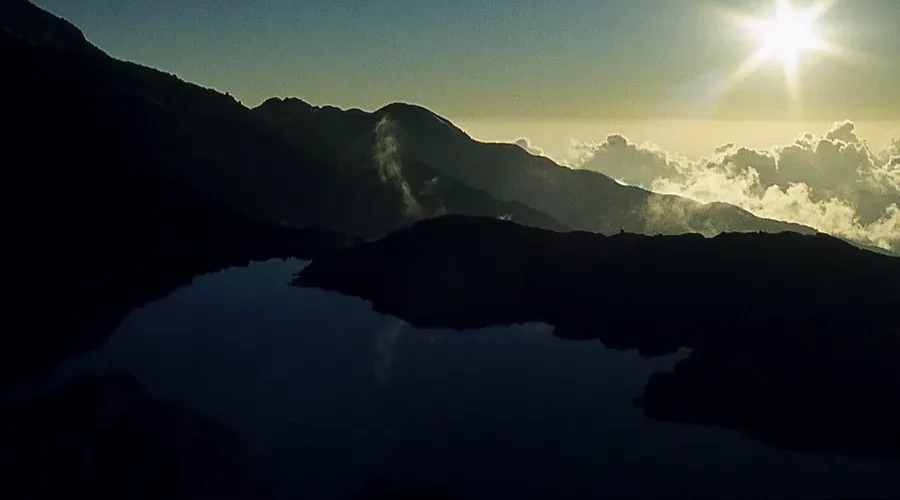
Bhairav Kunda Trek
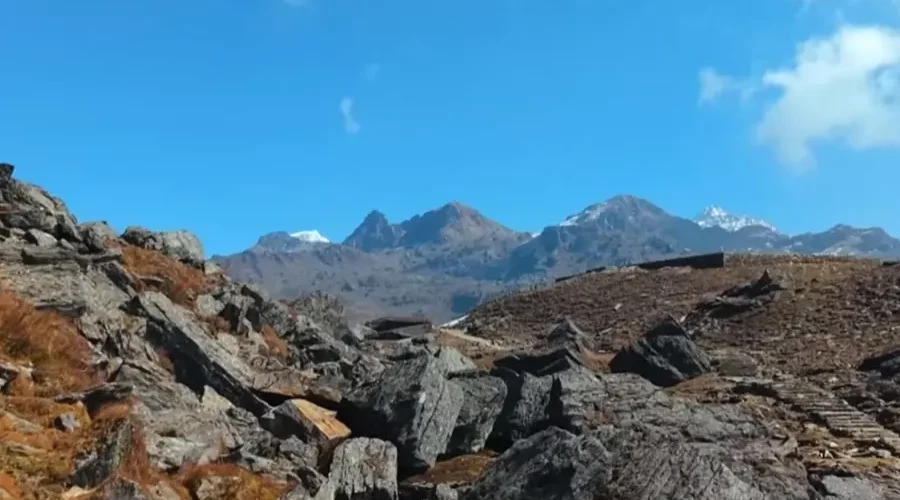
Vairab Kunda Trek
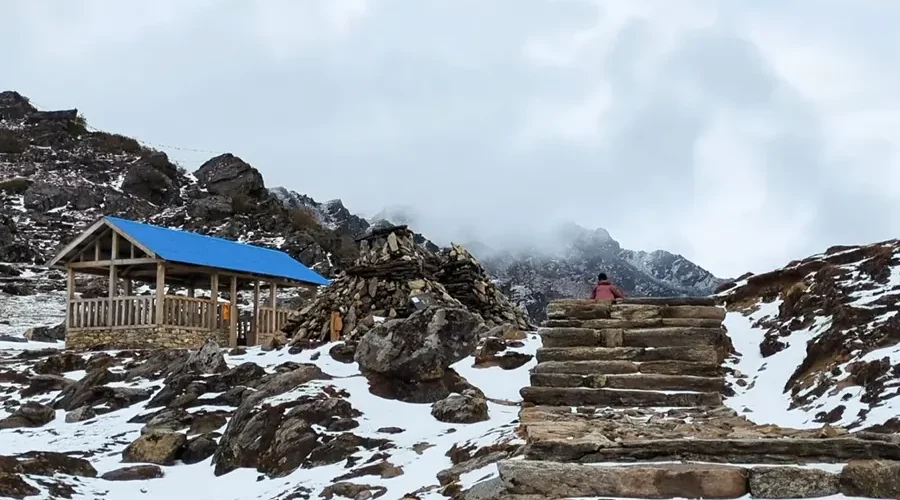
Bhairav Kunda Trekking
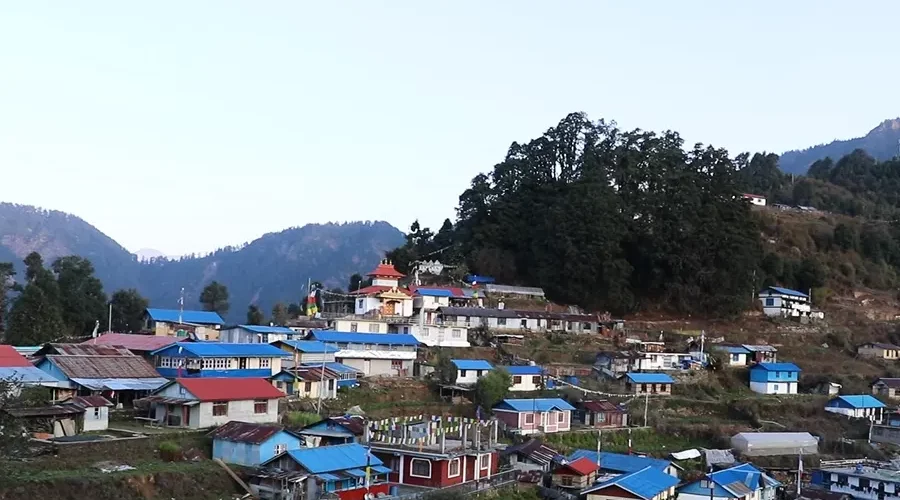
Bhairav kunda tour
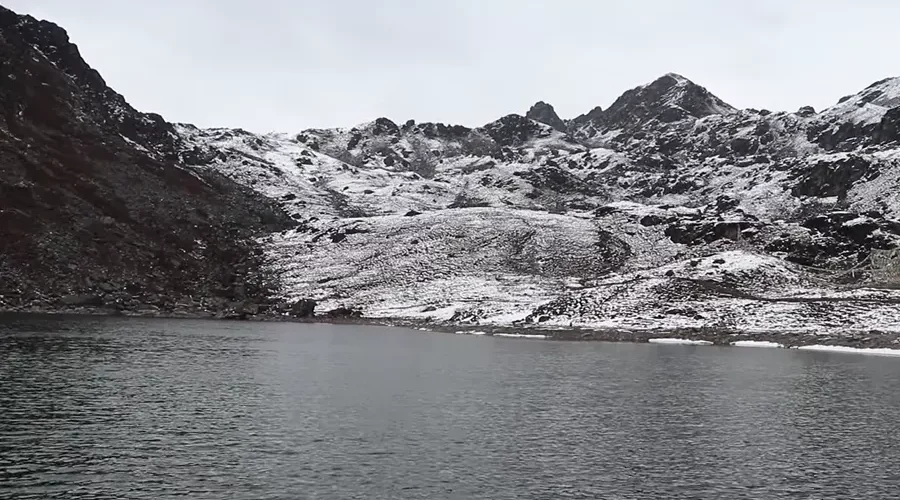
Bhairav Kunda Trekking Nepal
Trip Duration 2 Days
Group Size 1-16
Maximum Altitude 4250
Difficulty Grade Moderate
Start & End Point Kathmandu
Best Seasons Mar-May/Sept-Nov
Trip Highlights of Bhairav Kunda Trek
- Beautiful views of Rolwaling Range, Dorje Lakpa, Gaurishankar, and Jugal Himal.
- Peaceful trek through dense rhododendron and pine forests.
- Stunning Bhairav Kunda Lake at 4,250 meters, a sacred pilgrimage site.
- Cultural exchange in the Tamang and Sherpa villages.
- A challenging yet rewarding high-altitude trekking experience.
- Panoramic sunrises over the snow-capped Himalayan peaks.
- Opportunity to witness rare Himalayan wildlife.
- Traditional Nepali meals in remote teahouses.
- Clear night skies are perfect for stargazing and camping.
- Unique spiritual experience during the Janai Purnima festival
Overview of Bhairav Kunda Trek
Bhairav Kunda Trek is an exciting journey to the beautiful mountains of Nepal. This is a pilgrimage to Bhairav Kunda Lake, located at an altitude of 4,250 meters in the Sindhupalchok district, near the Tibetan border. Many Hindus and Buddhists visit the lake as they believe that the water of the lake is capable of washing sins away and granting peace.
The trip begins with a drive from Kathmandu to Chokar Mokar. On the way, you can see green forests, small villages, and farms. The trekking route passes through very tall rhododendron trees, and you may see the Himalayan Monal bird or even a Red Panda. As you ascend, you can enjoy the views of large snowy peaks, such as Dorje Lakpa, Gaurishankar, and Jugal Himal.
Compared to other popular and crowded treks such as Everest Base Camp, Bhairav Kunda is very silent and calm, which is why nature lovers will enjoy it. You can also have a conversation with friendly locals of the Tamang and Sherpa communities who are keeping their traditions alive. They welcome the tourists with a whole heart and tell them about their stories and culture.
Many pilgrims come to the lake to pray and have a holy dip during the Janai Purnima festival in August. Its water is believed to possess some special curing properties by many. It is not a very difficult trek, but you must be fit and prepared. The most recommended time to visit is during March-May (spring) or September-November (autumn) when the weather is good and the scenery is clear. The tea houses are small and basic, or you can camp out under the stars, which only adds to the uniqueness of the experience.
Bhairav Kunda Trek is excellent for all those people who love adventure, nature, and spirituality. It has beautiful scenery, culture, and a serene environment that helps you bond with nature. This trek is ideal for you when you want a unique and peaceful adventure.
Bhairav Kunda Trek lets you leave the busy city routine behind and relax in the pure mountain air. The trail also has beautiful sunrises and sunsets, and the sky is seen in the brightest colors of orange and pink. Hiking to greater heights is beneficial in enhancing not only the body stamina but also the mind, making the experience worthwhile. Bhairav Kunda is less popular, so you will feel more connected to the environment, and every moment of your trip will be remarkable.
Itinerary of Bhairav Kunda Trek
DAY
01
01
Day 01: Kathmandu to Chokar Mokar
Our trip begins early in the morning as we say farewell to the streets of Kathmandu and start our remote journey in the Sindhupalchok district. The journey will start with a drive that will pass through beautiful green hills, terraced agriculture fields and small villages and provide us with a view of rural Nepal. Further on our way we enter Jalbire, a small village, which is famous for its Newari culture. It is a busy village with villagers going about their farming business and other activities.
We drive for a few hours to our trekking starting point. The path starts by steadily climbing up and takes us through some thick rhododendron forests. We breathe in the fresh mountain air, walking on small paths, between tall trees. On the way, we enter the beautiful village of Chanaute, inhabited by the Brahmin and Chhetri communities.
The houses here might look ancient, the walls are of stone and the roofs of wood. We are welcomed by locals, and they tell us about their lives. You will have your lunch around Sukute between 12:00 PM to 1:00 PM.
As we go on trekking, the scene changes. We pass through small rivers and waterfalls, and this enhances the beauty of the trip. The path grows steep now (we are approaching Khani Gaun), a Newar village with a rich cultural background. The people here have managed to keep their ways through generations, and their hospitality is worth the journey. Now you will have a rest, enjoying the quiet atmosphere of the place and communicating with local people.
Everything seems like straight out of a fairy tale. After several hours of trekking, you finally reach Chokar Mokar, a quiet village surrounded by pine forests and hilly views.
The altitude of this place is 1,800 meters, and the evenings here are nice and cool. We make ourselves comfortable at night, and our hosts will prepare a warm local meal for us. It can be counted as ideal resting location; the night skies are clear, and the environment is peaceful. You can sit and take a look back at the day you had today, and look forward to the adventurous walk tomorrow.
Accommodation
Lodge
Meals
Breakfast, Launch, Dinner
Trek Duration
1hrs
DAY
02
02
Day 02: Hike to Bhairav Kunda and Return to Kathmandu
We will start our journey early in the morning before the sunrise, at 4:00 AM, we will start an early morning hike to Bhairav Kunda. The air is clear and chilly, and the sky gradually changes its color, ranging between dark blue and finally into orange, as we ascend.
The path takes you through zigzags up through rocks and alpine grassland, with the great Himalayan peaks all around. As we continue trekking up, the altitude rises up to 4,250 meters, and with every step we take, it becomes harder. But the beautiful scenery and the quiet morning air are worth the challenge.
It takes us five hours of trekking to get to Bhairav Kunda Lake at 9:00 AM. This provides a beautiful sight as the holy waters mirror the mountains, which seem to be touching the sky.
Pilgrims and trekkers stop to have some rest, absorb into the spiritual environment as well as the beauty of this undisturbed place. Some Visitors immerse into the freezing cold water as they believe that the water has purifying and healing power.
At 9:30 AM, we start to descend to Chokar Mokar, where our jeep is waiting to take us to Bagam. The trip provides us with new memories, as we walk through thick woods and winding hills, which gives us the opportunity to rest after the tiring morning walk.
At 10.30 AM, we reach Bagam, a small village where we have lunch. There is nothing like a nice hot meal after several hours of hiking. It is a dinner of typical Nepali food, which will give us the strength we need to make the last part of our journey. An hour later we rest, eat, and get ready to proceed on our journey back to Kathmandu.
At 12.00 PM, we depart in a jeep back to Kathmandu. The journey lasts approximately six hours, through beautiful mountainous roads and villages, and beautiful scenery. The air grows warmer as we go down, and gradually the houses begins to appear.
We arrive in Kathmandu at around 6:00 PM, and this marks the completion of an incredible trek. Bhairav Kunda Trek has been an ideal mix of adventure, nature, and spirituality and we could ask no more as we have some amazing memories to cherish throughout our lives
Accommodation
Hotel
Meals
Breakfast, Launch
Altitude
1350
Trip Extension
Suppose you have more time in Nepal after this trip. In that case, we can help you to extend your trip by running different treks in Nepal, tours in Bhutan and Tibet, Jungle safari tours at Chitwan, Bardia, and other National parks, Nepal luxury hotel booking, Rafting, Ultra-light flights, or any other travel-related services. You can get more information here.
Includes/Excludes
We are updating the contents.
We are updating the contents.
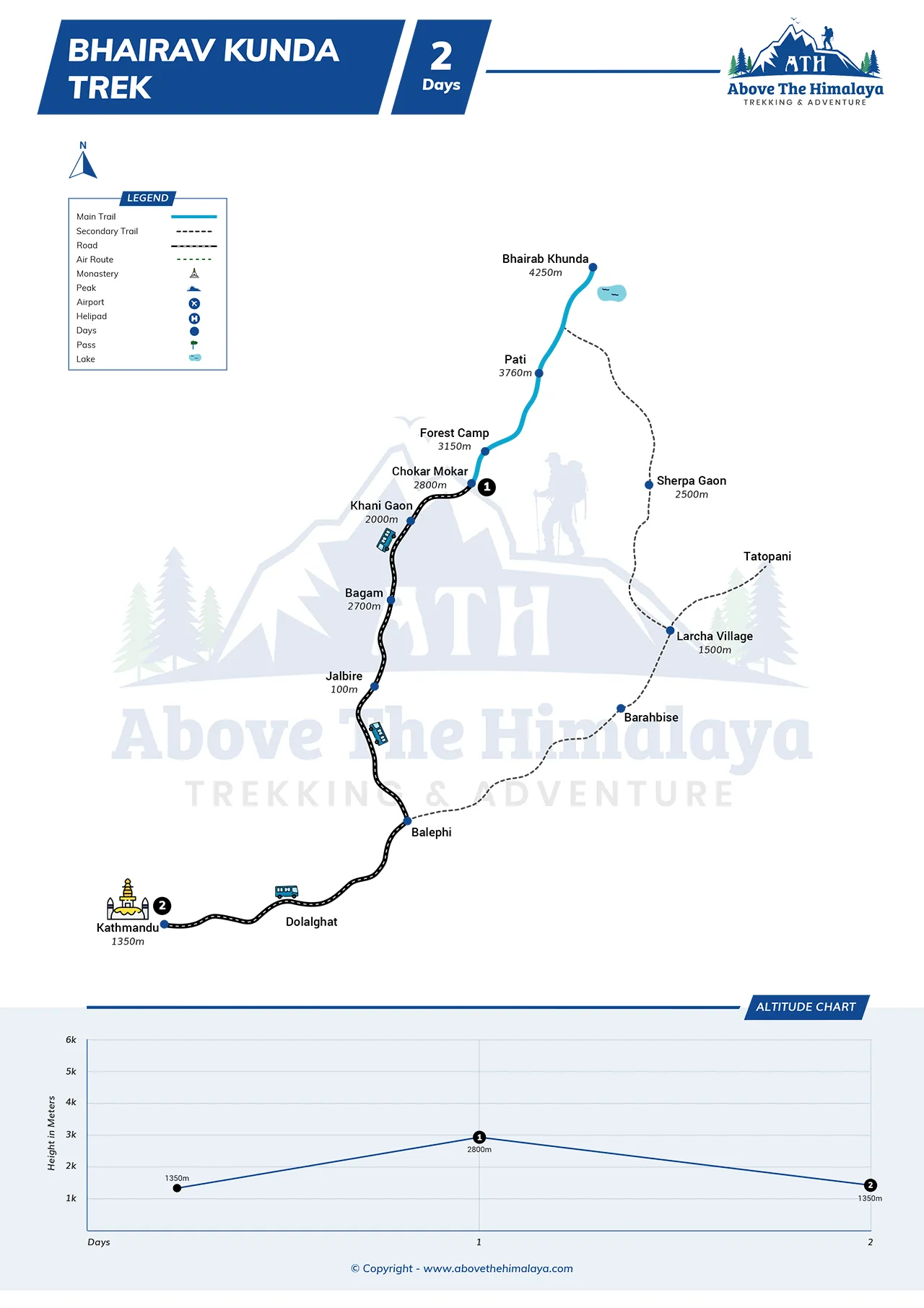
Route Map & Altitude Chart
What is the history of the Bhairav Kunda Trek?
Bhairav Kunda is a sacred lake situated in the high mountains of Nepal. It is located in Sindhupalchok district, close to the Tibet border, and at 4,250m above sea level. The local people think that this is a sacred lake and it possesses some magical powers which can wash away all the bad things and grant good fortune.
Many centuries ago, Hindus and Buddhists began to visit this place due to their belief that the lake had some relationship with Lord Bhairav, a fierce and powerful manifestation of Lord Shiva. It is said that Lord Shiva was feeling thirsty and hence, he struck the ground with his trident (trishul), water appeared and formed Bhairav Kunda.
Janai Purnima festival (August-September), each year, several pilgrims make the walk to the lake. They bathe in the freezing water and think that in this way they can cleanse their souls. The residents refer to it as Ama Chhemen (Mother’s Pond) as they believe that the lake guardians nurture them.
Bhairav Kunda trek passes through ancient villages, dense forests, and high hills where one can observe magnificent mountains, endangered animals, and exotic flowers. The inhabitants of the region are primarily Tamang and Sherpa, and they are eager to share their culture and traditions with the outsiders. This is a treasure of a lake, with its history, beauty, and spirituality.
What is the trekking cost for Nepalis and foreigners?
Bhairav Kunda Trek Cost for Nepali
The cost of trekking to Bhairav Kunda for Nepali travelers depends on the type of transportation, accommodation, and number of days. As per our standard package, the trek cost starts from NPR 7,500 per person.
- Standard Package Price: NPR 8,000 per person (includes jeep transportation)
- Special Offer: NPR 7,500 per person (available on recent departures)
- Group Discounts: Available for groups of 7 to 8 people, making it more affordable for larger teams.
The package covers transportation from Kathmandu to Chokar Mokar and back, basic accommodation, and meals. However, additional costs may apply for extra services like personal snacks, porter assistance, and gear rental.
Bhairav Kunda Trek Cost for Foreigners
For foreign travelers, the Bhairav Kunda Trek typically ranges from USD 200 to 400 per person for a standard package. This package includes:
- Transportation from Kathmandu to Chokar Mokar and back
- Accommodation in teahouses or camping setups
- Meals (breakfast, lunch, and dinner)
- Trekking permits
- Guide and porter service
All of these costs are covered under your package. Budget packages range from USD 150 to 250, offering shared transportation, simple meals, and basic guide services. Additional costs may include:
- Travel insurance: USD 50−100
- Tips for guides and porters: USD 20−30
- Personal expenses: USD 20−50 (snacks, souvenirs, etc.)
- Gear rental: USD 10−20 per item (sleeping bags, trekking poles, etc.)
Compared to other Himalayan treks, Bhairav Kunda Trek is a bit affordable, making it a great choice for budget-conscious travelers. Booking through a reliable local agency and traveling in a group can help reduce costs further.
Best season for the Bhairav Kunda trek
The best time to trek to Bhairav Kunda is in spring (March-May) and autumn (September-November). These are the best seasons, which present clear skies, moderate temperatures, and spectacular views of the surrounding Himalayan peaks.
In the spring, the trail is filled with the rhododendron in full colour and the trip is even more worthwhile. The climate is favourable with temperatures varying between 10°C and 20°C during the day, and nights are cold but bearable. The wildlife is more active, and trekkers can see Himalayan Monals, Red Pandas, and other species.
Another perfect time to visit is during autumn; the monsoon rains would have washed away the dust, and there is clear air and beautiful scenery in the mountains. The temperatures resemble those of spring, and trekking is comfortable. The season is also the time of year when there are festivals such as Dashain and Tihar, so trekkers get to enjoy local celebrations and culture in the neighboring villages.
Summer (June-August) welcomes you with greenery, but it is also accompanied by rains and slippery trails, making the trek a bit difficult. This is, however, the period when pilgrims come to Bhairav Kunda to celebrate the Janai Purnima festival, which makes it a colorful scene.
The coldest season is winter (December-February), when the temperature can fall below -10°C in the higher altitudes. The trail is covered with snow, which makes it hard to trek, but provides an untouched and peaceful scenery to those who are experienced adventure seekers.
To have an amazing time, spring or autumn trekking is recommended as the weather is comfortable, the views are clear, and one can experience the culture as the Bhairav Kunda Trek is really worth remembering.
What is the difficulty level of the Bhairav Kunda trek?
The difficulty of the trek is determined by the altitude, the terrain, the weather conditions and the physical fitness of the individual. The Bhairav Kunda Trek is moderate to challenging, which shows that it is not simple and demands a moderate amount of fitness, though it can be done by a majority of the trekkers.
The trek is on a steep, uphill, rocky trail and long walking days, especially on Day 2, which takes 8 hours of trekking to get to Bhairav Kunda Lake at 4,250 meters. The elevation may bring shortness of breath and fatigue, so it is recommended to walk at a slow pace and drink water.
The weather is a large factor in the challenge. Spring (March-May) and autumn (September-November) have clear skies and moderate temperatures, which make trekking a bit easier. Winter (December-February) is covered with snow and freezing weather, whereas monsoons (June-August) make the trails slippery and muddy.
People who have experience in hiking will find the trek easier, although first-timers can do it with adequate preparation. Stamina can be developed through training by taking frequent walks, hikes, and doing endurance training. It is also possible to make the trip more comfortable by hiring a guide and porter.
In general, the Bhairav Kunda Trek is a bit difficult yet satisfying experience that provides amazing views, cultural immersion, and a feeling of accomplishment. Anyone can enjoy this adventure with proper preparation and attitude!
Food and Accommodation during the Bhairav Kunda Trek
You can get basic tea houses and camping facilities during the Bhairav Kunda Trek. The accommodation is on a shared basis, in a small teahouse or lodge, where several beds are in the same room. These teahouses offer basic bedding and blankets and facilities, but lack modern conveniences such as hot showers or internet (Wi-Fi). If these facilities are available, then you also need to pay extra for them.
Food available on the trail is the typical Nepali food, dal bhat (rice and lentils), noodles, soups, and seasonal vegetables. Teahouses additionally offer chapati, fried rice, and simple snacks such as biscuits and tea. The trek is located in a remote region and the variety of food will not be available, so trekkers need to be ready to eat basic and home-cooked meals instead of restaurant service.
If you choose camping, the trekking team prepares meals, which most often include boiled potatoes, instant noodles, and dehydrated foods. It is advisable to carry energy bars and dry fruits as an additional nutrition.
Is drinking water available in the Bhairav Kunda Trek?
Yes, drinking water can be found all along the trek; however, trekkers should take care of its purity. The Water sources are natural streams, village taps, and teahouse supplies; however, it is strongly advised to purify the water before consuming.
To make the water safe, trekkers can take water purification tablets or portable filters, or simply boil the water. Some teahouses have bottled water, which is costly and not necessarily in stock. The price of water bottles also increases as you ascend because it is difficult to take those bottles in that remote area. The most sustainable manner of maintaining hydration during the trek is to carry a refillable water bottle and employ purification techniques.
Why should you go for the Bhairav Kunda Trek?
Bhairav Kunda Trek is an isolated trek in Nepal and provides the ideal combination of adventure, religion, and superb mountain scenery. This is in contrast to the busy trekking areas; so, the trail is quiet and clean and is best for the person who wants to find peace with nature.
A major highlight to do the trek is the holy Bhairav Kunda Lake at an elevation of 4,250 meters. The pilgrims consider its waters to possess spiritual and curative effects, and in the Janai Purnima festival in August, faithful people start to assemble to take a sacred bath. The trek also offers a brilliant view of the Rolwaling Himalayan Range, which includes Dorje Lakpa, Gaurishankar, and Jugal Himal.
The trek will lead you through rhododendron forests, isolated villages, and high-altitude meadows, amid which trekkers can witness the true Tamang and Sherpa cultures. Local people are very hospitable, and they share their culture and lifestyle.
To those who love adventure, the trek has got strenuous but fulfilling routes, as one climbs up steep mountainous terrain, rocky roads that open up to facilitate viewing of the spectacular scenery below. The fine weather during spring (March-May) and autumn (September-November) makes it the best time to visit.
So, regardless of whether you want to find spirituality, experience the culture or just want to have an adventure of a lifetime, Bhairav Kunda Trek will not disappoint.
Is AMS a concern in Bhairav kunda trek? How to control it?
Yes, Altitude Mountain Sickness (AMS) can be a problem in the Bhairav Kunda Trek, since the trek goes up to 4250 meters. The air is thinner at this altitude, and the amount of oxygen in the air decreases, complicating the ability of the body to adapt. Among the trekkers, there might occur a headache, dizziness, nausea, shortness of breath, and fatigue.
To avoid AMS, trekkers are advised to climb at a slow pace to enable the body to acclimatize to the altitude. Avoiding smoke and alcohol, taking a lot of water, and staying hydrated are beneficial to maintain the oxygen level in the body. The risk can also be minimised by eating light yet nutritious meals and taking frequent rests during the trek.
Trekkers should rest, hydrate, and avoid further ascent in case symptoms are experienced. To accelerate the process of acclimatization, it is possible to carry some medications such as Diamox. When the symptoms become severe, the only solution is to move down to a lower altitude.
Bhairav Kunda is a moderate to difficult trek, so one should be physically prepared. Stamina can be enhanced through training by taking frequent walks, climbing hills, and performing endurance training prior to the trek. To make the trip more comfortable, it is also possible to hire a guide and a porter, who will provide trekkers with the needed support in case AMS symptoms appear.
AMS is manageable with proper preparation and awareness, and with it, the trekkers can safely enjoy the spiritual experience and the magnificent sight that the Bhairav Kunda Trek has to offer.
Is Permit and Travel Insurance required for the Bhairav Kunda Trek?
Foreigners are required to get a Langtang National Park Entry Permit that costs USD 25 per person. This permit contributes to the conservation and serves to preserve trekking routes. Local permissions may be necessary for the Nepali trekker,s but they do not normally need official permits.
The permits are available at the Nepal Tourism Board office in Kathmandu or at checkpoint stations on the way. It is always advisable to carry a printout of the permit.
Travel insurance is not compulsory but strongly advised, because Bhairav Kunda goes up to 4,250 meters, where trekkers are likely to get Altitude Mountain Sickness (AMS), injuries, or delays. It is recommended to get a policy that covers medical emergencies, evacuation, and lost items. To make your trek safe and stress-free, correct permits and travel insurance will allow you to enjoy the adventure, hassle-free.
Do You Need Guides and Porters, or Can You Trek Solo?
It is possible to trek to Bhairav Kunda alone, but it is strongly advised that a guide and a porter be hired to ensure safety and ease of the journey.
Solo trekking is free and tends to be flexible, yet it is accompanied by difficulties. The path goes through remote trails, where guidance is needed. It just has few tea houses and some parts are very steep and rugged. In case of an emergency, the presence of a guide or a porter means alot for the help.
A guide assists with the navigation along the routes, cultural knowledge, and helps to secure permits, which makes the journey easier. Porters help in carrying heavy bags, which reduces the burden and makes the trekkers enjoy the moment. Employing local guides is also a way of benefiting the community and a safer trekking experience.
As the Bhairav Kunda Trek goes up to 4,250 meters, altitude sickness may become a factor to be considered. A guide can keep track of the symptoms and offer assistance when necessary.
Solo trekking can be done by those experienced trekkers who have the right preparation, GPS navigation, and emergency contacts. But if you are new to trekking, then the best option is to take a guide and porter to enhance your safety and enjoyment.
How can one prepare for the Bhairav Kunda trek?
The essential preparations to make before the Bhairav Kunda Trek include good physical shape, proper equipment, required permits, and taking note of altitude-related issues. If you want to have a comfortable trek, then begin your training by taking frequent walks and hiking uphill to improve stamina. Cardiovascular training, such as running or cycling will increase stamina, and lunges and squats to strengthen leg muscles will be beneficial when ascending sharp hills.
It is significant to pack the appropriate equipment. Jackets, gloves, thermal layers, and other warm clothes will prevent the cold in higher altitudes. On the rough terrain, one will need comfortable trekking boots that have a good grip. You will need a sleeping bag when camping, and trekking poles are helpful. Having water purification tablets will guarantee clean drinking water, and energy-giving snacks such as nuts and protein bars will keep one strong.
The trekkers are required to buy the Langtang National Park Entry Permit, which costs foreigners USD 25. It is strongly advised that you carry travel insurance, because the trek will take you to an altitude of 4,250 meters, where altitude sickness and emergencies are a possibility. An excellent insurance policy must include medical evacuation, accidents, and high-altitude trekking insurance.
The slow pace of trekking enables the body to acclimate in case one is caught by altitude sickness. Oxygen levels are enhanced by remaining hydrated and avoiding alcohol or cigarette use. It is good to carry some simple medications like headache, nausea, and altitude-related problems.
One can make the trek easier by hiring a guide and porter. Guides help with directions and cultural knowledge, and porters carry heavy luggage, leaving less to be physically concerned about. Bhairav Kunda Trek can be a fine trip with proper planning and attitude!
Most Asked Questions by Travellers
It is in Sindhupalchok district, near the Tibetan border, at 4,250 meters.
The trek usually takes 2 to 5 days, depending on the itinerary.
Spring (March-May) and autumn (September-November) are the best seasons for the Bhairav Kunda Trek
It is a moderate to difficult trek, requiring good fitness due to steep climbs.
Yes, foreigners need a Langtang National Park Entry Permit, but Nepali trekkers do not.
Yes, but hiring a guide and porter is recommended for safety and navigation.
Yes, basic teahouses are available, but accommodation is on a shared basis.
Mostly Nepali meals like dal bhat, noodles, soups, and tea.
Yes, but water purification is needed for safety.
Yes, it is a sacred lake linked to Lord Bhairav, and pilgrims visit during Janai Purnima.
Reviews on Bhairav Kunda Trek
Be first to post a review in this trip.
Posted on Tripadvisor
 H H9 December 2025
Verified
Thank you for the best tour we have ever had! I planned to stay at the Everest View Hotel this time and travel there because I wanted to see Everest, the highest mountain in the world, slowly, but despite the short schedule due to my children's school, all I got was a response that it was difficult to contact several tour companies. The Himaraya Trekking, Above, has worked out a smooth and safe schedule and had the best experience for me and my family. I will never forget the view of Mount Everest. Thank you very much.Posted on Tripadvisor Mike F26 November 2025Another Amazing Trip with Above the Himalaya This is my 3rd trip with Above the Himalaya and Puru. Each trip with Puru has exceeded expectation with the quality of the guides, porters and attention to detail. We were a team of 5 trekker and our ages were all above 67 years of age with the oldest being 73. We are all experienced hikers and trekker and our plan was to trek up the Khumbu Valley to the Cho La pass to Gokyo to the Renjo La pass to return to Lukla. However, the weather altered our plans as Cyclone Montha blanketed the country in rain at lower elevations and significant snowfall at the upper elevations. Due to the weather, no one was trekking and everyone was staying put in their current location during the storm. All the passes were closed due to the deep snow. We were in Namche when the storm was blanketing the country.This is where Above the Himalaya really shines is in the ability to adapt to the changing conditions and our safety. In conversation with our lead guide, we decided to alter our route to trek through the Gokyo valley to reach Gokyo and then do the Renjo La pass. Sitaram our lead guide and Dhurba our assistant guide was both attentive to the changing conditions and always kept a keen eye for how we were doing and feeling on the trek. The pacing was excellent as none of us had any hint of altitude sickness as we reached a maximum elevation of 5,365m.Having trekked and hiked all over the world with different tour companies, Puru’s company is simply the best. The communications, focus on safety, the guides and staff, the accommodations, and the food are all amazing. All you have to do is focus on the beauty of the mountains, enjoy the joyfulness of the Nepali people and have fun exploring the trails. I am planning my next trip with Puru for 2027 as there is no other trekking company to match Puru’s level of service.Posted on Tripadvisor
 Mie K. A.25 November 2025Take a small step into the Himalayas I went with Above The Himalaya Trekking’s Everest View Hike in November 2025 and can only recommend with my whole heart!I had never visited Nepal or the Himalayas before and had a life long dream of seeing Mt Everest. I had though, hiked a lot in various parts of the world, but never above 2000 m, so I went with the five day Everest View Trek to take a small step and see how I would handle the altitude. From first enquiry about dates and various questions, to my arrival back from the trip, Puru has been an invaluable help, always standby on mail and WhatsApp, pulling strings and making things happen.Also big shout out to the amazing guide I was teamed with, Kamal, who did everything he could to answer all my curious questions about vegetation, animal life, Nepalese culture and everything in-between :) Kamal was the perfect gentleman, offering little treats and reminding me to take breaks, and all in all I felt very safe and in good hands all the time. He also had good banter and jokes, which lifted the spirit of even the hardest climb.It was cold most nights and mornings and even though the tea houses provided heavy blankets (and I could borrow extra) I was glad I had the sleeping bag with me, which I rented through Puru. But I could definitely have survived without and saved the space in my pack.In total, I’m very pleased I’ve got to experience this lovely country with Above the Himalaya Trekking and if I ever come back for the big leap into the mountains, I’ll chose Kamal and Puru all over again :)Posted on Tripadvisor
 nameless25 November 2025Nepal trek-Gokyo Second trek with Above the Himalaya, this time to Gokyo and over Renjo La. Our lead and assistant guides (Sitaram and Dhurba) were excellent. Due to several days of rain at lower elevations and snow higher we needed to change our plans while in the midst of our trek. Above the Himalaya accomplished this smoothly and flawlessly, which ultimately resulted in a better experience. We’ll be back!Posted on Tripadvisor
 Yu S22 November 2025Great Experience and Friendly people. We had a great time with Above the Himalayas tour company in Oct. Ajay, the tour guide in Kathmandu is very friendly and knowledgeable. He took us to a lot of places that we can experience local authentic daily life. Puru, the owner, arranged and organized our trip in such way that we really feel comfortable and enjoyable. We are specially impressed by his quick action and management skills. Our flight to Pokhara got cancelled due to bed weather. Within minutes, Puru was able to arrange a car and a driver to drive us to Pokhara! It saved out trip.Posted on Tripadvisor
 Sally M14 November 2025Glorious trekking experience - ABC We had the most wonderful experience doing the Annapurna Base Camp trek with our fabulous guide, Tanka, and porter, Ravi. The trek was glorious, despite some rainy days, and although we weren't sure we would get to see the peaks at ABC, the weather cleared just in time and we had an amazing sunrise there. What made the whole trip so special, though, were Tanka and Ravi, who remained cheerful at all times and went out of their way to make everything as good as it could be. This included setting a pace with regular breaks which made the walking completely manageable, modifying the itinerary so we could visit additional villages, getting up in the middle of the night to see if the sky would be clear for sunrise, and bringing a sense of ease and humour to all our interactions. We just loved the whole thing and are keen to return to Nepal for another trek. It was magical!Posted on Tripadvisor
 Peter E27 October 2025Above the Himalayas goes above and beyond expectations! From start to finish everything was perfect! Puru, the managing director, was always quick with his responses to my questions when I first contacted him about planning our trek, and he continued to check to see that everything was going well throughout.Our guide Tanka and porter Ravi were fantastic! Their friendly demeanor kept our experience lively and interesting the entire time and made sure that we were well taken care of. Even small details like Ravi coming in and double checking our rooms to see that we had left nothing behind before leaving each morning, and seeing that meals were prepared the way we liked them weren't overlooked. Tanka was also quite knowledgeable about the mountains, the people, and just about everything "Nepal". He enthusiastically shared stories about his family and Nepalese life in a general way.Although there was a clear itinerary each day, and for the whole trek, Tanka allowed for flexibility in terms of time and where to stay. He was even willing and able to make changes to same-day accommodation based on how far we anticipated hiking that morning. I can't say enough about how much we enjoyed our hike and I would definitely recommend Above the Himalayas for anyone considering a trek.Posted on Tripadvisor
 Akane U25 October 2025Amazing tour For me and my son, Pru thought of a four-day trekking tour.His interaction was very smooth.On the first day, I went with my son to Gandrouk, and on the second day, he went to a higher place (mulde view point, Poon hill) with his guide Ashok. Ashok was very kind and took me to various local places. The food was also very good.My guide, Tangka, was very kind and helped me a lot.I recommend this travel agency because it's great.Posted on Tripadvisor
 Daniel F24 October 2025Everest Base Camp Trek My friends and I just completed the EBC trek. From the time I met Puru at the Canada Place trade show in Vancouver BC, Canada I felt comfortable going to Nepal. His communications via WhatsApp were seamless answering all our questions. Everything went exactly according to plan. Our guide Suresh was amazing. He took very good care of us the whole time. From guiding us to making sure we had everything we needed to be happy. The food the whole way up and back was amazing! 5 ⭐️. Our 2 porters were great as well. I have a whole new respect and appreciation for what they do. They are the true hero’s to what we can do as a team. We chose the basic trek the lodging was to be expected. If I was to do again I would choose the luxury trek. The hotels in Kathmandu at the Hotel Aloft and the Hotel Lo Mustang were top notch as well as the buffets. Highly recommend this local company!Posted on Tripadvisor
 adrienne h24 October 2025Great tour, would recommend! My friend and I completed the 10 day Annapurna circuit with Above Trekking Himalaya. Buddha our porter was a little mountain goat, pocket rocket. When I got altitude sickness he carried my bag, as well as mine and my friend’s big pack. He was friendly and loved to played cards with us, always with a cheeky smile on his face. Sitaram our guide was very knowledgeable of the area and quite serious. He was always available if we had any questions and went above and beyond to try get us the best/quietest rooms in the tea houses. Puru was fabulous working behind the scenes to ensure our trip was as smooth as possible. He was very quick to respond to any messages. It was a great experience to see Nepal with some locals and I certainly appreciated their support when I succumbed to altitude sickness. They stayed close to us the whole time and checked in frequently making us feeling safe and supported the entire time.Verified by TrustindexTrustindex verified badge is the Universal Symbol of Trust. Only the greatest companies can get the verified badge who has a review score above 4.5, based on customer reviews over the past 12 months. Read more
Best Price Guaranteed, Easy to change Date, Instant Confirmation
Book This TripBook with Confidence
- Flexible bookings and easy trip date changes
- Personalized service and customized group sizes
- Safe travels with owner-operated services and highly experienced guides
- Best price guarantee for the most value for your money
- Secure & easy online booking
Your Trek Leader
 Enjoy Himalayan scenery with the help of Nepal’s best guides with Government license holders and got training in first-aid, our Trip Leaders, know where you’ll find the best photos, most fascinating wildlife, and the best stream crossings.
Have Questions?Talk to Expert
Meet Mr. Purushotam Timalsena (Puru), Nepal's best trek and tour organizer, who has been working in the Himalayas for more than 24 years.
WhatsApp/Viber +977 98510 95 800



Trips for All

Private Trip
Peaceful tour with your travel buddy and guide
Small Group Travel
Travel with people having similar adventure dreams
Trips for Kids
Calling all young adventurers - join us for a journey of a lifetime!
Trips for Adventurers
Climbing & mountaineering adventures for thrill-seekers