Customize Your Trip



Need Help? Let's Talk
+977 985-1095800Upper Mustang Motorbike Tour – 12 Days


Trip Duration 12 Days
Group Size 1-16 People
Maximum Altitude Approximately 3,840 m (12,598 ft)
Difficulty Grade Difficult
Start & End Point Kathmandu / Kathmandu
Best Seasons March–May and September–November
Trip Highlights of Upper Mustang Motorbike Tour – 12 Days
- Adventurous upper mustang motorbike ride through high rugged desert Nepal
- Take a Mustang tour on a motorcycle between Kathmandu and Pokhara through Annapurna valleys
- Visit old temples in Kathmandu and peaceful lakes in Pokhara
- Cross the deep Kali Gandaki valley having panoramic Himalayan views
- Explore the old walled city of Lo Manthang and the Chhoser cave complex
- See sacred Muktinath Temple and natural hot springs of Tatopani
- Get immersed in the Tibetan Buddhist culture and Gurung mountain culture
Overview of Upper Mustang Motorbike Tour – 12 Days
Nestled in the rain-shadow of Annapurna and Dhaulagiri, the Upper Mustang motorbike tour is an adventurous 12-day journey through Nepal’s “Forbidden Kingdom”. Offered by Above the Himalaya, this off-road motorcycle adventure takes riders across high mountain passes and arid valleys, weaving through Tibetan Buddhist villages and pristine Himalayan landscapes.
For adventurous riders, a Mustang motorcycle tour in Nepal’s high desert is as thrilling as it sounds, and this journey does not disappoint. Over nearly two weeks, participants ride sturdy Royal Enfield bikes from Kathmandu to Pokhara and into Mustang’s remote desert region. The route passes through winding mountain roads, deep river valleys, and high-altitude landscapes, with views of the Annapurna and Dhaulagiri ranges in suitable weather.
Travelers explore the ancient walled city of Lo Manthang and nearby villages, where monasteries and the hidden Chhoser cave complex reveal the region’s rich heritage. The adventure begins in Kathmandu with cultural city tours and a bike test-ride before heading out to Pokhara’s lakeside charm. From Pokhara, the trail climbs steadily along the Kali Gandaki valley.
Riders travel through the Kali Gandaki Valley, passing settlements such as Kalopani, Jomsom, Kagbeni, and Samar before reaching the walled town of Lo Manthang. The route includes paved roads, gravel tracks, and rocky mountain sections.
The journey visits Muktinath Temple before continuing into Upper Mustang toward Lo Manthang. After exploring the monasteries and Chhoser caves, riders return through the Kali Gandaki Valley to Tatopani. Finally the journey returns along mountain roads to Pokhara and Kathmandu.
Throughout this trip, guests experience local Tibetan and Gurung cultures. Accommodation includes hotels in Kathmandu and Pokhara and basic mountain lodges or guesthouses along the Mustang route. An experienced motorcycle guide leads the tour, accompanied by a mechanic and support vehicle for luggage and technical assistance.
Such a combination of wild nature and tradition makes the trip unique. The Upper Mustang motorbike tour is one trip that the motorbike rider will not forget to experience the Himalayan motorcycle trek like no other.
Itinerary of Upper Mustang Motorbike Tour – 12 Days
DAY
01
01
Day 01: Arrive in Kathmandu
We will welcome you to Tribhuvan International Airport with a warm namaste, and transfer you to your hotel in Thamel. We will have a little walk after the check in to stretch and get used to the city. We may take you on a walk through the old lanes, in case you like to see temples and little courtyards. During the evening, we can go to a local restaurant where you may enjoy dal bhat or momo at your own expense.
You may sit back and have a cup of tea and make a plan for tomorrow. Our team will provide a briefing on the route, safety, and clothing for the ride. We will verify permits, insurance, and bike delivery time the following day.
After the briefing, you can rest at your hotel before the following day’s sightseeing and motorcycle test ride.
Accommodation
Hotel
Altitude
1,400m (Kathmandu)
DAY
02
02
Day 02: Kathmandu Sightseeing & Test Ride
Before the test ride, we will check your motorcycle’s brakes, tires, clutch, lights, mirrors, and controls. We will also review your helmet, riding equipment, and basic road safety procedures. We will take the bike on bends and light traffic by riding slowly to Nagarkot (2,175 m). During sunny days the scenery is broad and the highway builds confidence. We will go back to the city after lunch to visit one or two major sites such as Pashupatinath and Boudhanath, depending on time.
We will park in a safe place, walk to every location and talk about the core customs. You are allowed to spin prayer wheels, make pictures and relax. Later in the afternoon, we will ride back to Thamel. We will check hand signals, spacing and tomorrow start time. You can enjoy a traditional dinner at your own expense before taking a rest. Today is an easy day to help you feel comfortable on the bike and get ready for the highway. All ride times and distances are approximate and can vary with weather, roadworks, and checkposts.
Multiple
Accommodation
Hotel
Meals
Breakfast
Altitude
Approximately 1,400 m (4,593 ft) – Kathmandu
DAY
03
03
Day 03: Kathmandu to Pokhara (200–220 km)
We will make an early start to avoid traffic and use Prithvi Highway. The Prithvi Highway includes paved sections, busy traffic, and areas affected by road construction. We will maintain safe distances between motorcycles and adjust our riding speed to road conditions. There will be frequent tea breaks, refueling and photography stops by the Trishuli River. We will have a lunch at noon at a roadside cafe where we will have simple Nepali food.
During the afternoon, we will cross green hills, which have a glimpse of Manaslu and Machhapuchhre on clear days. We will reach Pokhara in the evening and stay in a hotel by the lake. You can walk around by Phewa lake or have a coffee at a cafe. We will have a short bike check up, fill fuel for tomorrow, and go with the mountain road tips. You can choose your own dinner tonight and rest well for tomorrow’s adventure.
Multiple
7–8 hrs
Accommodation
Hotel
Meals
Breakfast
Altitude
825m (Pokhara)
DAY
04
04
Day 04: Pokhara to Tatopani (110km)
After breakfast, we will ride west to Beni. We can take a short break at Sarangkot for sunrise (optional) to have a glimpse of the view, then get back to the route. The Beni road can be described as scenic and paved with terraced fields and suspension bridges. After Beni, road conditions become more variable, with paved, gravel, and rough sections along the Kali Gandaki Valley.
We will ride slowly, keep loose arms, and stand on pegs where needed. The track follows the Kali Gandaki, with waterfalls and narrow cliff sections. By midafternoon, we will reach Tatopani and check in to a lodge. You may relax in the natural hot springs to loosen your muscles. We will have a simple Thakali meal in the evening and organize our ride tomorrow. We will sleep early, which will help on the high-altitude routes ahead.
Multiple
5-6 hrs
Accommodation
Lodge
Meals
Breakfast, lunch, dinner
Altitude
1,190 m Tatopani
DAY
05
05
Day 05: Tatopani to Muktinath (64 km)
After breakfast we will enter drier land. The highway gets better now and then, but we will go slow and steady. We will stop for lunch in Marpha, where you can explore the village’s traditional whitewashed houses and try locally produced apple products.
As we ride further, we will see Nilgiri and the high Mustang terrain. We will show permits at Kagbeni and have a small stroll around the old village.
The last ride leads to the heights of Muktinath. We will park at the temple area and stroll quietly inside. You can visit the 108 water spouts and the little flame shrine. The air is cold at this altitude, so we will wear multiple layers of clothes and consume water regularly.
The ascent from Tatopani to Muktinath involves a significant increase in sleeping altitude. Riders should report headaches, dizziness, nausea, or unusual fatigue immediately. The guide will assess symptoms and arrange descent or medical assistance when necessary.
We will stay the night in a warm lodge and check everyone’s condition. We will take a simple and healthy dinner and go to sleep.
Multiple
5–7 hrs
Accommodation
Lodge
Meals
Breakfast, lunch, dinner
Altitude
3,760m (Muktinath)
DAY
06
06
Day 06: Muktinath to Lo Manthang (85 km)
We will start early to climb steadily into Upper Mustang. The road consists of both gravel and small inclines and broad plateaus. We will have a snack and photo stop at a pass viewpoint. Keep your visor down in dust, please, and allow space to see. We will ride past little hamlets with mani walls and chortens. The scenery becomes red and brown cliffs and large skies.
We expect to reach Lo Manthang later in the day, depending on road conditions, permit checks, and rest stops. After check in, we will rest and then take a light walk in the lanes. You may have a taste of butter tea or a plain noodle soup. Before dinner we will check bikes, chains and brake pads. Altitude is high here, so we will keep the evening quiet and encourage good hydration.
Multiple
6–8 hrs
Meals
Breakfast, lunch, dinner
Altitude
Approximately 3,840 m (12,598 ft) – Lo Manthang
DAY
07
07
Day 07: Explore Lo Manthang
Today we will park the bikes and walk around. We will explore the palace grounds and the major monasteries, including Thubchen and Chode. At this altitude, we will explore at a comfortable pace, take regular breaks, and monitor for symptoms of altitude sickness. Your guide will tell you about local practices and the explanation of the paintings and prayer flags.
We can organize a simple home-style lunch with Tibetan noodles or barley meal in case you want it. Later in the afternoon, we will take a stroll to an overlook of town to take pictures of the walls and the expansive plateau. There is also the opportunity to sit in a courtyard and see everyday life. Before sunset, we will go back and have a leisurely dinner. A relaxing day aids acclimatization and will allow you time to experience the unique culture of Lo Manthang.
Meals
Breakfast, lunch, dinner
Altitude
3,840m (Lo Manthang )
DAY
08
08
Day 08: Chhosar Caves and Upper Mustang Villages
After breakfast, we will ride a few miles to Chhoser. The highway is dusty yet smooth, and the landscape is exciting. An additional ride toward Mui La Pass may be considered if road conditions, local access permissions, and the group’s riding experience allow.
This route is optional and is not guaranteed. We will park our bikes and walk to the cliff carefully with the help of stairways and ladders, yet we will proceed at a slow pace and remain safe. Your guide will explain the history of these cave dwellings and how they are connected to trade and faith.
We will have lunch and leisure time back to Lo Manthang. During the afternoon you can take a nap, take photographs or go on a short walk around the mani walls. At this time we will check our bikes, tighten bolts, and prepare to return. Tonight we will keep dinner simple and sleep early for a fresh start south.
Meals
Breakfast, lunch, dinner
Altitude
3,840m
DAY
09
09
Day 09: Lo Manthang to Tatopani (160–180 km)
We will go back the same path, but you will see the new light on the cliffs and the villages. The descents may be dusty and loose, and we will maintain some distance and take some breaks. We will stop at outlooks and a teahouse for hot drinks. The more we get down the warmer and the easier the air becomes to breathe.
We will pass familiar villages, and meet easier passage. The return journey to Tatopani is one of the longest riding days of the tour. Arrival time depends on road conditions, weather, traffic, and necessary stops.
The hot springs are a wonderful place to rest sore arms and shoulders. We will eat a simple dinner and check our gear requirements. It’s a beautiful day, and we have completed our journey through Upper Mustang and returned to a more pleasant region.
Multiple
8–10 hrs
Meals
Breakfast, lunch, dinner
Altitude
1,200m (Tatopani)
DAY
10
10
Day 10: Tatopani to Pokhara (110km)
We will follow the Kali Gandaki down-valley to Beni, carefully on mixed roads till we reach the blacktop. At tea time we will take a light snack, and then resume on the highway, with easy riding. The hills become green and the river is expanded. We will arrive at Pokhara by mid afternoon and get into a hotel by the lake. The rest of the day is free.
You may walk around the Phewa Lake, have coffee, shop around to get some small souvenirs or even have a brief boat ride. Our mechanic will inspect the motorcycles, check chain condition and lubrication, and arrange refueling before the return ride to Kathmandu.
You can choose from many relaxing lakeside restaurants for dinner. Enjoy your meal and have a peaceful night’s rest. The ride to Kathmandu is long, and it will be easy and pleasant when you take a good rest.
Multiple
5-6 hrs
Meals
Breakfast
Altitude
825m (Pokhara)
DAY
11
11
Day 11: Pokhara Kathmandu (210 km)
We will leave after breakfast and ride along the Prithvi Highway east. Traffic may be busy in some areas, so we’ll keep our group small and move smoothly. We will take short breaks approximately every 60–90 minutes and stop for lunch along the route. If time permits we may stop at Bandipur junction and ride up to take a little walk in the old bazaar.
Views are wide on clear days. At the end of the afternoon we will arrive at Kathmandu and get into the hotel. We will exchange bikes, complete our paperwork, and share some high trail memories. In the evening, you can enjoy a final Nepali dinner at a local restaurant. Please pack your belongings and prepare your travel documents for tomorrow. Thank you for being a safe and courteous rider.
Multiple
6-7 hrs
Meals
Breakfast
Altitude
1,400m (Kathmandu)
DAY
12
12
Day 12: Departure from Kathmandu
Your airport transfer will be arranged according to your flight schedule. When you have some spare time, we can take you to a couple of shops to buy some light souvenirs: pashmina, singing bowls, or little prayer flags. After leaving the hotel, we will pack your bags and take you to the Tribhuvan International Airport.
Our team will assist with baggage and send you off safely. Thank you so much for a ride to Upper Mustang with us. We wish you smooth journeys, clear skies, and many smiling faces along the way. We are pleased to invite you back to new routes in Nepal.
Meals
Breakfast
Altitude
1,400m (Kathmandu)
Includes/Excludes
What's Included?
- Airport pick-up and drop-off in Kathmandu by private vehicle
- Twin-sharing accommodation in Kathmandu and Pokhara with breakfast
- Twin-sharing accommodation in mountain lodges/guesthouses during the ride
- Daily meals (breakfast, lunch, and dinner) on riding days
- Experienced, government-licensed English-speaking guide
- Professional mechanic with basic spare parts and repair tools
- Support/backup vehicle for luggage and technical assistance
- Royal Enfield or comparable motorcycle rental for the scheduled riding days, with the model confirmed before booking.
- Motorcycle fuel for the scheduled tour itinerary, including the Kathmandu test ride.
- All required entry fees and permits for Upper Mustang (ACAP & Restricted Area Permit)
- First-aid kit and basic medical support carried by the guide
- Pre-departure safety briefing and practical riding orientation
- All applicable government taxes and official service charges
- Company t-shirt, trip completion certificate, and group photo
What's Excluded?
- International flights to/from Nepal
- Nepal entry visa fee (obtainable on arrival in Kathmandu)
- Lunches and dinners in Kathmandu and Pokhara (unless specified)
- Personal travel insurance with medical and emergency evacuation coverage
- Motorcycle damage charges arising from accidents, negligence, or misuse, subject to the rental agreement and applicable insurance terms.
- Personal motorcycle riding gear, including a certified helmet, gloves, protective jacket, riding pants, and boots. Rental arrangements and additional charges must be confirmed before departure.
- Personal expenses: bar bills, snacks, beverages, hot/cold drinks, desserts, laundry, etc.
- Optional activities (e.g., paragliding, boating, cultural shows)
- Tips/gratuities for guide, mechanic, and drivers
- Extra hotel nights caused by flight delays, weather, or other unforeseen events
- Anything not specifically listed under “What’s Included”
Flexible Booking and Cancellation Policy
At Above the Himalaya Trekking, we understand that travel plans may change. Our booking policy provides clear terms and flexible options to help you plan your Himalayan adventure with confidence.
A 20% non-refundable deposit is required to confirm your booking, with the remaining balance payable upon arrival in Kathmandu/Pokhara before your trek begins. Departure dates can be changed free of charge at least 30 days in advance, subject to availability.
If you postpone your trip at least 30 days before departure, your deposit can be applied toward another trip within one year, subject to availability and any price differences. Date changes are not permitted within 30 days of departure, and no refunds are provided for early departures or unused services once the trip has started.
For complete details, please read our Booking and Cancellation Terms.
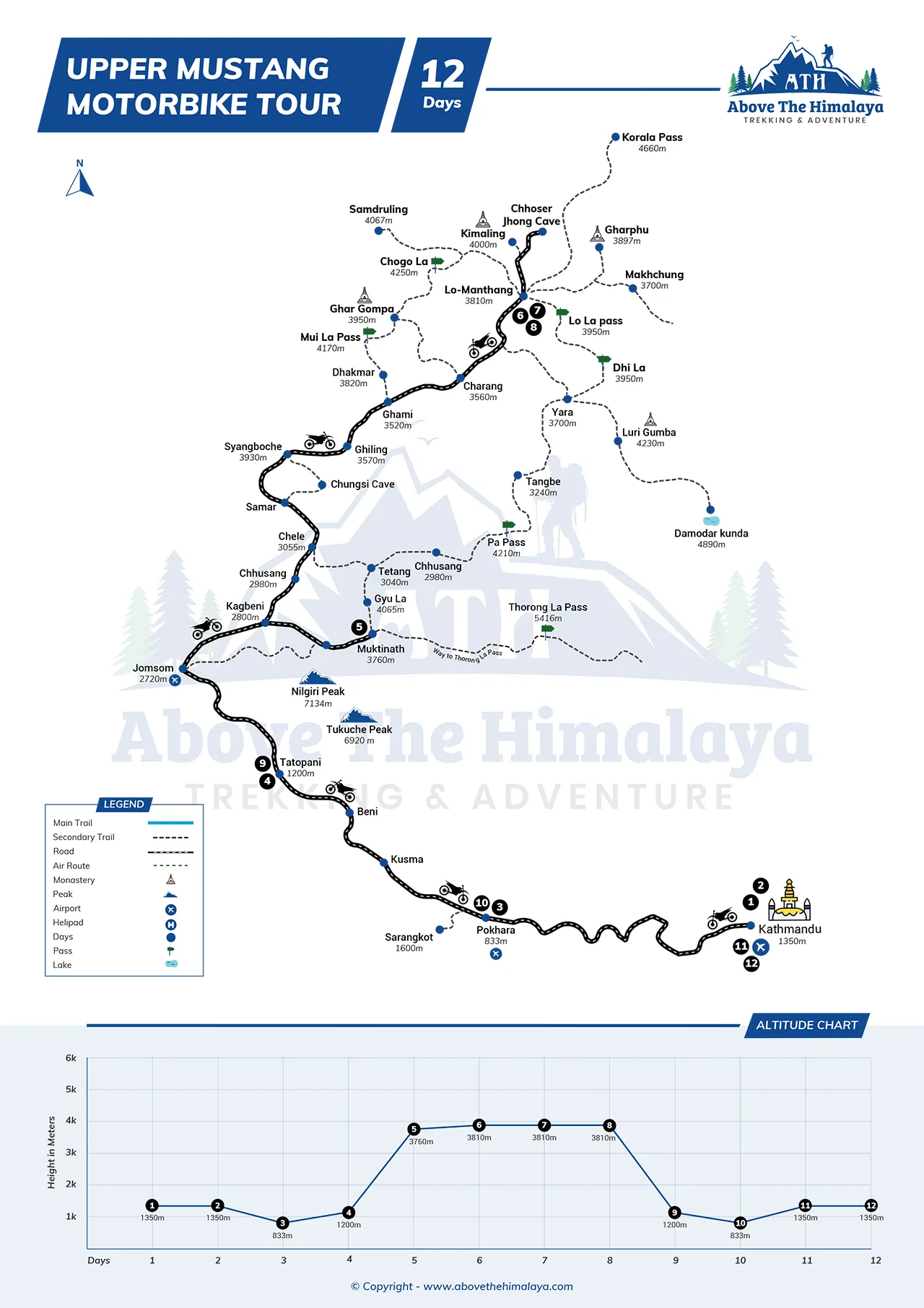
Route Map & Altitude Chart
Upper Mustang Motorbike Tour Difficulty
This motorbike tour is physically demanding. Riders face long days (5–8 hours) on unpaved mountain roads with steep climbs and rocky sections. The route covers hundreds of kilometers at high altitude. For example, we ascend to around 4,200 m on Mui La Pass and also cross other passes near 3,800–3,900 m, and then descend back to lower valleys. This can tire your legs and lungs. The combination of altitude change and rough terrain requires strong stamina and constant concentration.
Unpredictable weather (wind, dust, cold mornings) can add to the challenge, so layered clothing is needed. Riders should train (cardio and leg strength) beforehand. Even fit riders usually feel muscle soreness on the first few days; however, careful pacing (regular breaks) and following the guide’s advice help manage the strain. By staying active and accustomed to long hours of biking, most travelers handle the trip and enjoy it as a thrilling challenge.
Acclimatization & Altitude Strategy
Upper Mustang Motorbike Tour climbs rapidly, but we start low to help acclimatize. The tour begins with two nights in Kathmandu at approximately 1,400 m, followed by a night in Pokhara at approximately 825 m and a night in Tatopani at approximately 1,190 m. On Day 3 we actually drop to 900 m in Pokhara. Day 4 is 1,190 m (Tatopani), Day 5 3,760 m (Muktinath), and Day 6 3,840 m (Lo Manthang). After that we descend steadily.
The itinerary includes sightseeing and reduced motorcycle activity in Lo Manthang, but this does not eliminate the risks associated with the rapid ascent to Muktinath and Upper Mustang. Drinking plenty of fluids and eating high carbohydrate meals helps your body adjust. If anyone feels symptoms (headache, dizziness, nausea) above 3,000 m, the group will stop or descend immediately. Avoid alcohol and smoking.
Consult a qualified medical professional before traveling about altitude sickness prevention and whether acetazolamide is appropriate for you. Medication should not replace proper acclimatization, medical assessment, or descent when symptoms require it. We encourage short walks each morning at height instead of strenuous exercise.
Drink regularly according to your activity level and conditions, avoid dehydration, and allow sufficient time for rest. Drinking excessive amounts of water does not prevent altitude sickness. Our guide will monitor everyone’s condition. Altitude sickness can worsen rapidly. Riders experiencing symptoms should stop ascending and inform the guide immediately. Severe or worsening symptoms require urgent medical assessment and descent when appropriate. By pacing yourself, listening to your body, and following the guide’s instructions, most traveler manage the altitude safely.
Accommodation and Meals during the Upper Mustang Motorbike Tour
Accommodation is twin sharing. You stay in 3-star hotels in Kathmandu (3 nights) and Pokhara (2 nights) with private bathrooms. On the ride, lodging is in simple mountain lodges or teahouses along the route. Mountain lodges provide basic accommodation, with facilities varying by location. Rooms may have shared bathrooms, and heating, hot showers, Wi-Fi, and charging services may be limited or available at an additional cost. Hot showers are available at many lodges (usually for a small fee).
Every morning starts with a buffet breakfast (included). During the riding days, all three meals (breakfast, lunch, and dinner) are included. Lodge owners can accommodate vegetarians and most other dietary needs if informed. If you prefer Western food, Kathmandu and Pokhara have pizza and cafes, but remote villages offer only local cuisine. Lunches are included on all riding days, while in Kathmandu and Pokhara only breakfast is provided.
Tap water is unsafe in the mountains, so drink bottled or boiled water provided by lodges. Carry a water bottle and refill it at lodges. We recommend bringing energy bars and snacks for long rides. Also bring any special foods or supplements you need (e.g. protein bars, hot tea bags). Overall, the meals are hearty and give fuel you for the ride, but we suggest carrying some extra cash for occasional treats or unexpected hunger. ATMs and card facilities are limited beyond Jomsom—carry sufficient cash from Pokhara/Jomsom.
Altitude Sickness
Altitude sickness can affect anyone above 3,000 m. Symptoms include headache, nausea, dizziness or fatigue. We reach up to 3,860 m at Lo Manthang, so monitor yourself each morning. Drink lots of water and move slowly. Our guide carries a first-aid kit and oxygen for emergencies. If someone feels very ill, they will descend to a lower altitude immediately.
Over the counter medication (acetazolamide) or natural remedies (ginger candy) can reduce mild symptoms. Avoid sleeping pills or alcohol at night as they mask symptoms. Keep warm at night with proper clothing. Majority of the riders experience only slight headache or discomfort, which generally disappears after a night or two.
Nevertheless, in case of acute severe symptoms (severe headache, confusion, breathlessness), the only remedy is a drop below 3,000 m and medical assistance. Remaining wary, open communication and adherence to the recommendations of the guide are instrumental in the avoidance of grave problems at altitude.
Best Time to visit
Spring (March–May) and autumn (late September–November) are the best seasons. The weather is usually pleasant and clear during these months, with clear sky views giving great mountain views. During autumn, the days are sunny and warm and the fields are harvest colored. Spring brings blooming rhododendrons and mild temperatures. The monsoon (June–August) often brings mud and landslides that can delay riders and close tracks.
Both seasons avoid the heavy monsoon rains (June–Aug) which make dirt roads muddy, and the freezing winter (Dec–Feb) when high passes can snow over. Daytime temperatures in these seasons are comfortable (15–20°C in the valleys), but nights (especially above 3,000 m) can be very cold (around 0–5°C). Light rain or dust can occur in shoulder months, so pack a rain shell just in case.
Peak trekking seasons (Oct/Nov and Apr/May) are popular and fill up quickly, so plan early. In summary, late spring or early autumn offers the safest, most comfortable riding conditions in Mustang. Road closures due to landslides or snow may force reroutes or extra nights; your guide will adjust the plan for safety.
Health and Travel Insurance
Comprehensive travel insurance is essential. Your policy must cover emergency medical treatment, helicopter evacuation, and high-altitude trekking or biking. A mountain rescue flight can cost several thousand dollars, so ensure your plan includes mountain rescue. Proof of insurance covering Nepal is required before departure. Trip cancellation and baggage insurance are also recommended.
Motorcycle rental insurance and personal travel insurance provide different types of coverage. Riders should confirm that their travel insurance covers motorcycle riding, the supplied engine capacity, medical treatment, and emergency evacuation. Motorcycle damage resulting from accidents, negligence, or misuse may be charged according to the rental agreement and applicable insurance terms.
Keep copies of your insurance information and emergency contacts. Healthwise, consult a doctor about regular vaccinations (typhoid, hepatitis A, tetanus) before travel and bring any regular medicine. A basic first-aid kit is in the support vehicle. In remote Mustang, medical facilities are basic, so evacuation might be needed for serious issues. With strong insurance and health preparation, you can focus and enjoy the ride. All flights and rides are subject to weather and civil aviation or road safety rules; reroutes or delays may occur.
Fitness and Preparation for the Upper Mustang Motorbike Tour
Physical fitness will make this tour better. We suggest at least 2-3 months of training: endurance (cardio: cycling, running) and strength training (legs and core) to be able to use the bike. Practice riding long hours if possible. The long days on uneven terrain can be tough. Also, break in your riding gear before the trip (wear your jacket and gloves on practice rides to avoid discomfort). Basic familiarity with your motorcycle (gear shifting, clutch control) helps.
If possible, do some off-road or gravel practice to adjust to slippery sections. Even hiking or stair-climbing exercises can simulate the steep inclines and build lung strength. Finally, mentally prepare for dust, wind and rough roads. Sleeping well and staying hydrated in the weeks prior will also help. By arriving fit and prepared, you’ll find the long days manageable and reduce soreness on the trip.
Guide and Staff
Your adventure is supported by an experienced local team. An English speaking professional guide leads the ride; our guides are seasoned riders who know the Mustang region well. They provide route navigation, cultural insights and safety briefings each day. The group is accompanied by a trained mechanic who maintains and repairs Royal Enfield bikes where necessary.
Our mechanic carries basic tools and selected spare parts to handle routine maintenance and minor mechanical problems. Major repairs may require additional equipment, replacement parts, or transport to a workshop. We also have a support vehicle trailing the group. It has your luggage, some spare fuel, water and a first aid kit. If anyone needs a break or cannot ride a section, they can sit in the vehicle. All staff are first-aid trained and look after your needs on the road.
Together with friendly lodge hosts, this crew ensures you are safe, comfortable and on schedule. Feel free to ask the guide about Nepal, culture or the route – they are there to help make your journey smooth and enjoyable. Our licensed guide also fulfills the legal requirement for entering the Upper Mustang Restricted Area.
Foreign travelers entering Upper Mustang require a Restricted Area Permit (RAP) arranged through a registered Nepal travel agency. The tour also includes the Annapurna Conservation Area Permit (ACAP). Above the Himalaya arranges the required permits before departure, subject to current government regulations and group requirements. Travelers must provide valid passport and visa details for permit processing. Permit fees are included in the package cost.
Solo travelers can inquire about joining an eligible scheduled departure. Restricted area permit applications are subject to current government requirements, including applicable group and guide arrangements. We will confirm permit eligibility before accepting a booking.
The Upper Mustang Restricted Area Permit currently costs US$50 per person per day in the restricted area. Above the Himalaya arranges the required permits before the tour, and the permit duration must cover all days spent inside the restricted area.
Is this trip beginner-friendly?
No, this is not a beginner-friendly tour. The rugged conditions and the covering of long distances necessitate skill and stamina. The less experienced riders will struggle with quite a number of sections. At least medium motorcycle experience is necessary before considering this route. New riders are advised to begin by taking easier day rides or shorter tours initially.
This tour is not recommended for beginner riders. Participants should have previous multi-day motorcycle touring experience and be comfortable handling gravel, rocky surfaces, steep gradients, and long riding days. While the support vehicle can help if needed, safe completion depends mostly on your skill. In summary: prior multi-day riding experience is strongly advised. Those who arrive well-prepared usually find the trip tough but incredibly rewarding.
Most Asked Questions by Travellers
 General
Yes, solo travelers are welcome. You ride your own bike. If you prefer, we can arrange a private group with your own dates. Otherwise you will join the group of riders.
The support vehicle will carry you and your bike if needed. The mechanic can assist you as well. The guide will ensure no one is left behind – your safety comes first.
Tipping is not compulsory but customary. As a guideline, Many riders tip USD 8–12 per rider per day for the guide and USD 5–8 per rider per day for the mechanic; adjust according to service and group size. Supporting staff share these tips.
Nepalese rupees (NPR) are used. Have enough cash to cover personal costs (drinks, snacks, tips, etc.). ATMs are available in Kathmandu, Pokhara, and Jomsom, but not in small villages.
Mustang roads are remote but generally safe. Follow the guide’s instructions and always wear a helmet. The roads can be narrow and dusty, so ride at a comfortable speed. Good travel and health insurance add extra security.
Yes. You can upgrade the Kathmandu or Pokhara hotel to a higher star level at extra cost if available. In Mustang itself, all lodges are basic and cannot be upgraded.
Group size is usually 12–14 riders per lead guide (larger bookings are split into multiple groups).
Contact Above the Himalaya through our site or Email. You will deposit to reserve your position and the remainder in the future. We will provide you with a comprehensive itinerary and payment instructions.
Yes. You must possess a valid full motorcycle license (or equivalent) in your country. An International Driving Permit (IDP) matching your home motorcycle license is recommended and may be requested at checkpoints.
Absolutely. Women of all ages and backgrounds are welcome on this tour. We’ve had many female riders complete it successfully.
We only ride in safe conditions. If roads are blocked by landslides or heavy snow/rain, the itinerary may change. We might stop, reschedule or delay portions of the trip. Safety is our top priority.
Transporting a personal bike is possible but costly and complicated. It’s far easier to rent the reliable Royal Enfields we provide. They are well-serviced and suited to this terrain.
Reviews on Upper Mustang Motorbike Tour – 12 Days
Be first to post a review in this trip.
Posted on Tripadvisor 

H H
9 December 2025
 Verified
Thank you for the best tour we have ever had!
I planned to stay at the Everest View Hotel this time and travel there because I wanted to see Everest, the highest mountain in the world, slowly, but despite the short schedule due to my children's school, all I got was a response that it was difficult to contact several tour companies. The Himaraya Trekking, Above, has worked out a smooth and safe schedule and had the best experience for me and my family. I will never forget the view of Mount Everest. Thank you very much.
Posted on Tripadvisor

Mike F
26 November 2025
VerifiedAnother Amazing Trip with Above the Himalaya
This is my 3rd trip with Above the Himalaya and Puru. Each trip with Puru has exceeded expectation with the quality of the guides, porters and attention to detail. We were a team of 5 trekker and our ages were all above 67 years of age with the oldest being 73. We are all experienced hikers and trekker and our plan was to trek up the Khumbu Valley to the Cho La pass to Gokyo to the Renjo La pass to return to Lukla. However, the weather altered our plans as Cyclone Montha blanketed the country in rain at lower elevations and significant snowfall at the upper elevations. Due to the weather, no one was trekking and everyone was staying put in their current location during the storm. All the passes were closed due to the deep snow. We were in Namche when the storm was blanketing the country.This is where Above the Himalaya really shines is in the ability to adapt to the changing conditions and our safety. In conversation with our lead guide, we decided to alter our route to trek through the Gokyo valley to reach Gokyo and then do the Renjo La pass. Sitaram our lead guide and Dhurba our assistant guide was both attentive to the changing conditions and always kept a keen eye for how we were doing and feeling on the trek. The pacing was excellent as none of us had any hint of altitude sickness as we reached a maximum elevation of 5,365m.Having trekked and hiked all over the world with different tour companies, Puru’s company is simply the best. The communications, focus on safety, the guides and staff, the accommodations, and the food are all amazing. All you have to do is focus on the beauty of the mountains, enjoy the joyfulness of the Nepali people and have fun exploring the trails. I am planning my next trip with Puru for 2027 as there is no other trekking company to match Puru’s level of service.
Posted on Tripadvisor

Mie K. A.
25 November 2025
VerifiedTake a small step into the Himalayas
I went with Above The Himalaya Trekking’s Everest View Hike in November 2025 and can only recommend with my whole heart!I had never visited Nepal or the Himalayas before and had a life long dream of seeing Mt Everest. I had though, hiked a lot in various parts of the world, but never above 2000 m, so I went with the five day Everest View Trek to take a small step and see how I would handle the altitude. From first enquiry about dates and various questions, to my arrival back from the trip, Puru has been an invaluable help, always standby on mail and WhatsApp, pulling strings and making things happen.Also big shout out to the amazing guide I was teamed with, Kamal, who did everything he could to answer all my curious questions about vegetation, animal life, Nepalese culture and everything in-between :) Kamal was the perfect gentleman, offering little treats and reminding me to take breaks, and all in all I felt very safe and in good hands all the time. He also had good banter and jokes, which lifted the spirit of even the hardest climb.It was cold most nights and mornings and even though the tea houses provided heavy blankets (and I could borrow extra) I was glad I had the sleeping bag with me, which I rented through Puru. But I could definitely have survived without and saved the space in my pack.In total, I’m very pleased I’ve got to experience this lovely country with Above the Himalaya Trekking and if I ever come back for the big leap into the mountains, I’ll chose Kamal and Puru all over again :)
Posted on Tripadvisor

nameless
25 November 2025
VerifiedNepal trek-Gokyo
Second trek with Above the Himalaya, this time to Gokyo and over Renjo La. Our lead and assistant guides (Sitaram and Dhurba) were excellent. Due to several days of rain at lower elevations and snow higher we needed to change our plans while in the midst of our trek. Above the Himalaya accomplished this smoothly and flawlessly, which ultimately resulted in a better experience. We’ll be back!
Posted on Tripadvisor

Yu S
22 November 2025
VerifiedGreat Experience and Friendly people.
We had a great time with Above the Himalayas tour company in Oct. Ajay, the tour guide in Kathmandu is very friendly and knowledgeable. He took us to a lot of places that we can experience local authentic daily life. Puru, the owner, arranged and organized our trip in such way that we really feel comfortable and enjoyable. We are specially impressed by his quick action and management skills. Our flight to Pokhara got cancelled due to bed weather. Within minutes, Puru was able to arrange a car and a driver to drive us to Pokhara! It saved out trip.
Posted on Tripadvisor

Sally M
14 November 2025
VerifiedGlorious trekking experience - ABC
We had the most wonderful experience doing the Annapurna Base Camp trek with our fabulous guide, Tanka, and porter, Ravi. The trek was glorious, despite some rainy days, and although we weren't sure we would get to see the peaks at ABC, the weather cleared just in time and we had an amazing sunrise there. What made the whole trip so special, though, were Tanka and Ravi, who remained cheerful at all times and went out of their way to make everything as good as it could be. This included setting a pace with regular breaks which made the walking completely manageable, modifying the itinerary so we could visit additional villages, getting up in the middle of the night to see if the sky would be clear for sunrise, and bringing a sense of ease and humour to all our interactions. We just loved the whole thing and are keen to return to Nepal for another trek. It was magical!
Posted on Tripadvisor

Peter E
27 October 2025
VerifiedAbove the Himalayas goes above and beyond expectations!
From start to finish everything was perfect! Puru, the managing director, was always quick with his responses to my questions when I first contacted him about planning our trek, and he continued to check to see that everything was going well throughout.Our guide Tanka and porter Ravi were fantastic! Their friendly demeanor kept our experience lively and interesting the entire time and made sure that we were well taken care of. Even small details like Ravi coming in and double checking our rooms to see that we had left nothing behind before leaving each morning, and seeing that meals were prepared the way we liked them weren't overlooked. Tanka was also quite knowledgeable about the mountains, the people, and just about everything "Nepal". He enthusiastically shared stories about his family and Nepalese life in a general way.Although there was a clear itinerary each day, and for the whole trek, Tanka allowed for flexibility in terms of time and where to stay. He was even willing and able to make changes to same-day accommodation based on how far we anticipated hiking that morning. I can't say enough about how much we enjoyed our hike and I would definitely recommend Above the Himalayas for anyone considering a trek.
Posted on Tripadvisor

Akane U
25 October 2025
VerifiedAmazing tour
For me and my son, Pru thought of a four-day trekking tour.His interaction was very smooth.On the first day, I went with my son to Gandrouk, and on the second day, he went to a higher place (mulde view point, Poon hill) with his guide Ashok. Ashok was very kind and took me to various local places. The food was also very good.My guide, Tangka, was very kind and helped me a lot.I recommend this travel agency because it's great.
Posted on Tripadvisor

Daniel F
24 October 2025
VerifiedEverest Base Camp Trek
My friends and I just completed the EBC trek. From the time I met Puru at the Canada Place trade show in Vancouver BC, Canada I felt comfortable going to Nepal. His communications via WhatsApp were seamless answering all our questions. Everything went exactly according to plan. Our guide Suresh was amazing. He took very good care of us the whole time. From guiding us to making sure we had everything we needed to be happy. The food the whole way up and back was amazing! 5 ⭐️. Our 2 porters were great as well. I have a whole new respect and appreciation for what they do. They are the true hero’s to what we can do as a team. We chose the basic trek the lodging was to be expected. If I was to do again I would choose the luxury trek. The hotels in Kathmandu at the Hotel Aloft and the Hotel Lo Mustang were top notch as well as the buffets. Highly recommend this local company!
Posted on Tripadvisor

adrienne h
24 October 2025
VerifiedGreat tour, would recommend!
My friend and I completed the 10 day Annapurna circuit with Above Trekking Himalaya. Buddha our porter was a little mountain goat, pocket rocket. When I got altitude sickness he carried my bag, as well as mine and my friend’s big pack. He was friendly and loved to played cards with us, always with a cheeky smile on his face. Sitaram our guide was very knowledgeable of the area and quite serious. He was always available if we had any questions and went above and beyond to try get us the best/quietest rooms in the tea houses. Puru was fabulous working behind the scenes to ensure our trip was as smooth as possible. He was very quick to respond to any messages. It was a great experience to see Nepal with some locals and I certainly appreciated their support when I succumbed to altitude sickness. They stayed close to us the whole time and checked in frequently making us feeling safe and supported the entire time.
Verified by Trustindex
Trustindex verified that these reviews were published on Above the Himalaya Trekking - Private Day Tours's Tripadvisor profile. Learn more
Enjoy the best prices, flexible date changes, and instant booking confirmation.
Book This TripBook with Confidence
- Easy Booking: Secure your trip with just a 20% deposit.
- Flexible Date Changes: Free changes at least 30 days before departure.
- One-Year Deposit Credit: Use your deposit for an eligible postponed trip within one year.
- Private & Personalized: Flexible itineraries and group sizes.
- Experienced Local Guides: Professional guidance and support throughout your trek.
- Best Value: Competitive prices with clear package inclusions.
Your Trek Leader
 Enjoy Himalayan scenery with the help of Nepal’s best guides with Government license holders and got training in first-aid, our Trip Leaders, know where you’ll find the best photos, most fascinating wildlife, and the best stream crossings.
Have Questions?Talk to Expert
Meet Mr. Purushotam Timalsena (Puru), Nepal's best trek and tour organizer, who has been working in the Himalayas for more than 24 years.
WhatsApp/Viber +977 98510 95 800



Trips for All

Private Trip
Peaceful tour with your travel buddy and guide
Small Group Travel
Travel with people having similar adventure dreams
Trips for Kids
Calling all young adventurers - join us for a journey of a lifetime!
Trips for Adventurers
Climbing & mountaineering adventures for thrill-seekers