Need Help? Let's Talk
+977 985-1095800
Private Treks with Daily Departures
Note: We can run a trip for solo travelers, couples, friends, and family with children. Our private trips run daily. For small group travel, please check the dates below. If the dates below do not suit you, please email us or WhatsApp us at +9779851095800 to travel on your preferred dates.
Small Group Trek Departure Dates for 2027 and 2028
Highlights of the Pikey Peak Trek
- Spectacular sunrise and panoramic Himalayan views from the summit of Pikey Peak
- Gentle 8-day trek suitable for beginners, families, and seniors
- Genuine Sherpa villages and old Buddhist monasteries along the way
- Escape the crowds on the Pikey Peak trek route; an off-the-beaten-path alternative to Everest Base Camp trek
- Scenic road journey through rolling hills to the trek start (Dhap)
- Lush rhododendron forests and varied mountain landscapes
- Cultural immersion with friendly Himalayan locals & cozy teahouses
Overview of Pikey Peak Trek – 8 Days
The Pikey Peak Trek is an 8-day Himalayan adventure in Nepal’s lower Solukhumbu region, offering spectacular views of Mount Everest and the surrounding mountains without the busy trails of Everest Base Camp.
Starting with a scenic drive from Kathmandu to Dhap, the journey follows peaceful mountain trails through traditional Sherpa villages, rhododendron forests and Buddhist monasteries. The main highlight is an early-morning hike to Pikey Peak (4,065 m), where trekkers can enjoy a panoramic Himalayan sunrise on clear days.
Our 8-day itinerary includes visits to Jhapre, Pikey Base Camp, Junbesi and Taksindu before returning to Kathmandu from Phaplu. The trek is suitable for reasonably fit beginners and experienced hikers who prefer a quieter Himalayan experience.
Above The Himalaya Trekking offers privately guided Pikey Peak treks with flexible departure dates, experienced local guides, porter support and meals during the trek. We can also customize the itinerary to suit your available time and preferred walking pace.
Pikey Peak Trek for Families, Seniors and Beginners
The Pikey Peak Trek can be a rewarding choice for families with children and reasonably fit seniors. The route does not require technical climbing, but it includes steep climbs, uneven paths, and a summit reaching 4,065 meters. Most trekking days involve 4–7 hours of walking, while the summit day may take 6–8 hours, depending on your pace and trail conditions.
Family-run teahouses provide hot meals, simple accommodation, and welcoming Sherpa hospitality. Rooms are basic and generally unheated, with shared bathrooms. Bring a suitable warm sleeping bag, especially for nights at higher elevations.
Porters carry your main luggage, while you carry a daypack with water, extra layers, and personal essentials. Your guide stays with you, helps manage the pace, and provides support along the trail.
We can customize the itinerary with shorter walking days or additional overnight stops to suit your family’s needs. Please discuss these arrangements before booking, as extra days may increase the trip duration and cost.
Why Choose Pikey Peak Instead of Everest Base Camp?
Pikey Peak Trek is a unique alternative to overcrowded Everest region treks. Unlike Everest Base Camp, this trek can be accomplished in a week’s time on a low budget. You still get the awe-inspiring views of Everest, but enjoy peaceful trails and authentic culture. The route for the Pikey Peak trek is relatively uncrowded, and there is plenty of opportunity for solitude in nature.
Rich Buddhist culture and Sherpa villages come along the way, giving a sense of real local life. It is also generally more affordable, and there is less travel planning involved. This value and relative solitude make the Pikey Peak trek route a good choice for many trekkers.
The Pikey Peak Trek reaches a lower altitude than the Everest Base Camp Trek, but altitude sickness is still possible, particularly near Pikey Base Camp and the summit at 4,065 m. Trekkers should ascend carefully, monitor symptoms and follow their guide’s advice.
Pikey Peak Trek Route Summary
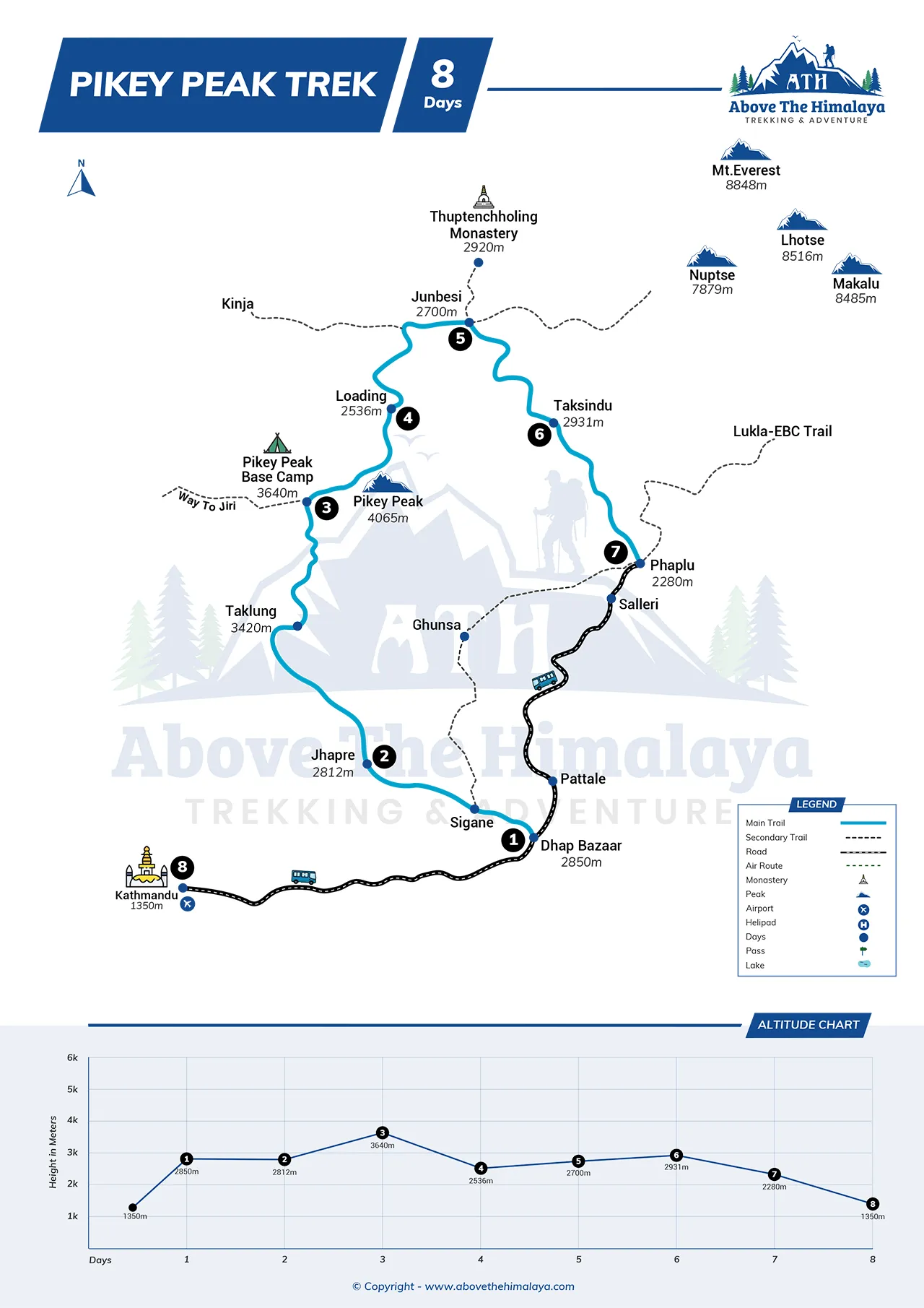
Pikey Peak Trek is a scenic trail that traverses the mountain villages, forested trails and high ridges to the Pikey Peak at 4,065 m. It starts with Kathmandu to Dhap drive and then to Jhapre, Pikey Base Camp, Loding and Junbesi and finally to Phaplu to head back.
The table below provides a quick overview of each day, including the route, overnight location and elevation, trekking distance, walking duration and included meals. It allows travelers to understand the overall pace and structure of the trek before reading the detailed day by day itinerary.
| Day | Route | Overnight Place & Elevation | Trek Distance | Duration | Included Meals |
| Day 1 | Kathmandu to Dhap by bus | Dhap, 2,920 m | 250 km | 9 to 10 hours | Breakfast, Lunch, Dinner |
| Day 2 | Dhap to Jhapre | Jhapre, 2830 m | 13 Km | 5 to 6 hours | Breakfast, Lunch, Dinner |
| Day 3 | Jhapre to Pikey Base Camp | Pikey Base Camp, 3,640 m | 15 km | 6 to 7 hours | Breakfast, Lunch, Dinner |
| Day 4 | Pikey Base Camp to Pikey Peak and Loding | Loding, 2,536 m | 14 km | 6 to 8 hours | Breakfast, Lunch, Dinner |
| Day 5 | Loding to Junbesi and Thupten Chholing | Junbesi, 2,675 m | 11 km | 4 to 5 hours | Breakfast, Lunch, Dinner |
| Day 6 | Junbesi to Taksindu | Taksindu, 3,071 m | 12 km | 5 to 6 hours | Breakfast, Lunch, Dinner |
| Day 7 | Taksindu to Phaplu via Chiwong Monastery | Phaplu, 2,475 m | 14 km | 5 to 6 hours | Breakfast, Lunch, Dinner |
| Day 8 | Phaplu to Kathmandu by bus | Kathmandu, 1,400 m | 265 km | 8 to 9 hours | Breakfast, Lunch |
Alternative Pikey Peak Routes
| Route | Suitable For |
| Dhap route | Standard shorter itinerary |
| Jiri/Shivalaya route | Trekkers interested in the traditional approach |
| Bhandar route | Longer itinerary |
| Phaplu start | Travellers wanting to reduce road travel |
Pikey Peak Trek Itinerary Options
| Trek Length | Suitable For | General Route |
| 5 to 6 Days | Travellers with limited time | Shorter Pikey Peak routes with fewer overnight stops |
| 7 Days | Travellers wanting a shorter itinerary | Dhap to Pikey Peak with a shorter return route |
| 8 Days | Travellers seeking a balanced itinerary | Dhap to Pikey Peak to Junbesi and Phaplu |
| 10+ Days | Travellers wanting a longer trek | Extended routes through Jiri or Bhandar |
Itinerary of Pikey Peak Trek – 8 Days
01
Day 01: Drive to Dhap Village (2920m) from Kathmandu, 9 hours
Our 8-day Pikey Peak trek begins with a scenic drive from Kathmandu to Dhap. A local bus will be ready to take us to the Dhap Village- a very beautiful location in the lower Solukhumbu region.
A tarmac road of the Araniko Highway will take us through the lovely small towns of Bhaktapur, Banepa, and Dhulikhel. Our driver will now switch onto the Okhaldhunga road on the Pushpalal (BP) Highway, leading us to the Sun Koshi River.
The rolling verdant hills and the rural atmosphere, the rafters on the waters of the Sun Koshi will be exciting to see. Eventually, we will be driving beside the amazing Tama Koshi and arrive at Ghurmi.
Now, the gorgeous setting of Okhaldhunga will welcome us, from where we will start to follow the Okhaldhunga-Solukhumbu highway that runs through the hills of rhododendrons and pines.
The dirt track will elevate for around three hours, finally leading us to Dhap. The Sherpa community, Kanchenjunga, Everest, and Mera will be ready to welcome us.
02
Day 02: Trek begins from Dhap to Jhapre Village (2830 m), 5 to 6 hours
The thrilling trekking segment of our Pikey Peak trek itinerary will commence from today. The trail follows gentle slopes and forest paths, with beautiful views along the way.
From Dhap, a soft sandy trail through the rhododendron thickets will lead us to Sigane Village. At a distance, we can look straight at Everest and Numbur Peaks.
The trail will now steadily elevate through the jungle of oaks, firs, and rhododendrons. En route, we will be able to cool our feet by several waterfalls as we make our way upward to Jhapre.
Along the trail, we will pass traditional chortens, white stupas, and mani walls before reaching a village with a small Buddhist monastery. After some rest and a meal, we can visit the monastery and explore the village.
03
Day 03: Trek from Jhapre to Pikey Base Camp (3,640 m), 6 to 7 hours
From Jhapre, our upstream trail will lead us along the slope of the Bhulbhule ridge. Here, we can sip a hot tea while capturing our senses with the phenomenal display of Everest.
A short while later, after Bhulbhule, we will come across the forked trail. Here, we will turn right and climb along the steeper forest track to reach Lhamuje.
As we gain altitude, the forests gradually give way to open alpine landscapes. We will meet two dandas (ridges) of Ramdin and Taklung en route.
After passing Bhulbhule, we continue through Lhamuje and the surrounding alpine pastures toward Pikey Base Camp. On clear days, the trail offers beautiful views of the surrounding hills and Himalayan peaks.
04
Day 04: Sunrise View from Pikey Peak (4065 m), then hike back down to Loding (2536 m), 6 to 8 hours
We start early in the morning and climb toward Pikey Peak using headlamps before sunrise. We aim to be the few fortunate spectators who can see the magical sunrise over the giant icy peaks.
From the base camp of the Pikey Summit, a steep, sometimes snowy, and rugged ridge slope will take us upward for around two hours. The thin mountain air can make the climb more demanding, so we will walk slowly and take regular breaks
Once at the summit, our worthy reward will be waiting for us. The 8167 m Dhaulagiri, the 8848 m Everest, the 8163 m Manaslu, and the 8586 m Kanchenjunga will slowly wake up before our eyes.
Along with them, the Numbur, Thamserku, Kangtega, Khatang, Gaurishankar, Dorje Lhakpa, and Langtang can also be seen shining under the orange light.
We will capture this mind-boggling moment for a while after which we will head towards the summit base camp for breakfast, then we will descend back down to Loding for our night.
05
Day 05: Trek down from Loding to Junbesi (2,675 m), 4 to 5 hours, and explore the Thupten Choling Gompa
From Loding, the dense forest path will again emerge which will take us down toward Taktor. Here, we can see the road coming down from Jiri, which was once marked by the footsteps of Tenzing Norgay and Edmund Hillary on the way to EBC and Everest.
The dusty trail from Taktor will now lead us downward toward Junbesi, where we will take shelter in one of its charming little lodges. A little while later, we will proceed to explore the Thupten Choling Gompa.
From the village, we will start to follow the calm currents of Junbesi Khola and walk past fascinating stone tombs. We will walk over a sturdy hanging bridge and reach the Gompa built around the 19th century by Kyabje Trulshik Rinpoche.
The elevation of the Gompa is 2920 m thus offering us the astounding spectacle of the Numbur Himal. Inside the Gompa, we can see numerous colorful thangkas, wall paintings, statues of Buddha, and many other architectural treasures.
Today, this Gompa is the home of around 900 nuns and monks, and the majority of them are the Tibetan Refugees. After our visit to the Gompa, we will return to our comfortable accommodation in Junbesi.
06
Day 06: Trek from Junbesi to Taksindu (3071 m), 5 to 6 hours
From Junbesi, our trail at first goes down steadily towards the Junbesi Khola. The small wooden bridge here will help us walk over the river. The track on the other side of the river rises gently through the forest towards the Salung Village.
If the weather is excellent, we will stop for a moment to admire the inexplicably beautiful profiles of Makalu (8485 m), Chamlang (7319 m), and Everest.
Get ready to meet yet another suspension bridge over the Dudhkunda Khola from where the trail again rises towards the apple village of Ringmo. Take a moment to taste the freshly made apricot, peach, and apple drinks and snacks.
After a short break and some refreshments, we continue uphill toward Taksindu La Pass (3,071 m). From the pass, we descend along the trail toward Taksindu Monastery (approximately 2,931 m), enjoying views of the surrounding hills and traditional Sherpa villages.
Taksindu Monastery is an important Buddhist religious site in the Solukhumbu region, known for its cultural and spiritual significance. After visiting the monastery, we continue to our local teahouse for an overnight stay.
07
Day 07: Trek from Taksindu to Phaplu (2475 m), and Visit Chiwong Monastery, 5 to 6 hours
From Taksindu, the forest trail will lead us down for a while. Along the way, we will pass by the Chiwong Gompa. This monastery is an important site where the Mani Rimdu festival is held every autumn, with the biggest celebration.
After visiting the monastery, we continue toward Phaplu, where we stay overnight in a local teahouse.
08
Day 08: Drive to Kathmandu from Phaplu, 8 to 9 hours
The moment has arrived to end our Pikey Peak trek journey. Once more, a local bus will be our friend to take us back to Kathmandu. You can also choose to travel via air through a short domestic flight or through a private jeep transfer as well at an added cost.
One more time, we will traverse the Okhaldhunga road from Solukhumbu and proceed beside the Sun Koshi River. The Pushpalal Highway will take us forward, guiding us toward the Araniko Highway.
Before reaching Kathmandu, one more time the lively towns of Dhulikhel, Banepa, and Bhaktapur will be passed. Once we are in our lodging in the capital, the evening will be full of celebration.
Phaplu to Kathmandu Flight Option
Travellers who want to reduce the long road journey can request a domestic flight from Phaplu to Kathmandu, subject to flight schedules and weather conditions. The flight option is available at an additional cost and should be confirmed at the time of booking.
Includes/Excludes
What's Included?
- A trekking guide certified and licensed by the government has training in high-altitude sickness and first aid.
- Local trekking porter, 1 Porter on 2 trekkers basis.
- Trekking staff, food, accommodation, salary, equipment, insurance, and clothing.
- Kathmandu to Dhap will be transported by local bus, and Phaplu to Kathmandu will be transported by local bus. A Private Land cruiser is available at an extra cost.
- Local Tea houses, also called guest houses/ lodges, twin sharing Room ( Bathroom is sharing) during your journey.
- Your daily meal (breakfast, lunch, and dinner). You can choose your meals from the menu, which includes different types of food.
- Trekking permit and fees, if applicable
- The guide will carry essential medical supplies and first aid kits.
- Above The Himalaya Trekking duffel bag. ( If you need to, please let us know before booking the trip and remind us before you arrive in Kathmandu so we can easily prepare.)
- All the trip information and details for the trek.
- Above the Himalayan Gifts and Trekking certificate after finishing your trek.
- Government taxes and service charges.
What's Excluded?
- Any services in Kathmandu
- Airfare to Nepal,
- Nepal entry visa fee, you can get on arrival here.
- Alcoholic, hot and cold drinks, tea & coffee, hot water, hot and cold showers.
- Kathmandu to Phaplu and Phaplu to Kathmandu air ticket if take flight instead of bus
- Personal expenses include laundry, Wifi, Telephone calls, sweets, snacks, beverages, Dessert, bar bills, and camera and Phone battery charging.
- Travel Insurance should include both rescue and medical assistance
- Personal trekking equipment you can buy and rent in Kathmandu trekking stores
- Tips for the guide, porter, and driver
- Other of your expenses that are not mentioned are costs included in the section.
Flexible Booking and Cancellation Policy
At Above the Himalaya Trekking, we understand that travel plans may change. Our booking policy provides clear terms and flexible options to help you plan your Himalayan adventure with confidence.
A 20% non-refundable deposit is required to confirm your booking, with the remaining balance payable upon arrival in Kathmandu/Pokhara before your trek begins. Departure dates can be changed free of charge at least 30 days in advance, subject to availability.
If you postpone your trip at least 30 days before departure, your deposit can be applied toward another trip within one year, subject to availability and any price differences. Date changes are not permitted within 30 days of departure, and no refunds are provided for early departures or unused services once the trip has started.
For complete details, please read our Booking and Cancellation Terms.
Route Map & Altitude Chart
Health, Safety & Emergency Support While on the Trek
Trekking at altitude involves consideration of health and safety. Drink plenty of water daily and eat healthy, balanced meals to stay energized. Take a rest if you are feeling dizzy or have a headache due to altitude. Our guides carry first aid supplies and help monitor trekkers for signs of altitude illness. Travellers considering altitude medication such as acetazolamide (Diamox) should consult a qualified healthcare professional before the trek.
In case of serious illness, guides have radios and can arrange helicopter evacuation if necessary. There are local health posts in larger villages such as Namkheli, but for emergencies, one may fly to Kathmandu. Cell phone coverage is limited; bringing a GPS tracker or satellite call device is a plus for safety.
It is a good idea to carry a small medical kit with essentials (pain killers, bandages, and any personal prescriptions). Stopping ascent if symptoms develop and arranging descent or medical support when necessary. In an emergency we will help you go get back to Kathmandu by drive or by helicopter evacuation.
Also, consider bringing along sunscreen and a hat for sun protection. Since signals are weak, inform your family of your itinerary and use GPS trackers if possible. With these precautions and attention to pacing, you can minimize risks and focus on having a good trek.
Alternative Pikey Peak Routes & Side Trips
There are a couple of ways to do the Pikey Peak trek. The normal route starts with driving to Dhap and then proceeding through Sherpa villages and Sherpa forests to the summit.
An alternate route follows the classic Hillary-Tenzing trail: it starts at Bhandar and goes via Namkheli (Stone Mountain Pass). This is a longer route that adds an extra day but traces the steps of the first climbers of Everest. For instance, an alternate itinerary of the Pikey Peak trek starts driving to Bhandar and follows up Namkheli, then joins the main trek trail at Golla.
Experienced trekkers will occasionally include a side excursion to Taksindu Hill (4,100 m) or viewpoints near the hill on the way back down for added adventure. You could also fly into Phaplu airport to reduce the driving time.
Side trips include a visit to the serene monastery at Namkheli, or walks along some of the local highland trails. These variations allow you to customize the trip: If you want a touch of history, you can follow Bhandar-Namkheli, or if you are looking for a shorter trek, you can start from Phaplu also.
Personal Expenses & Budget Considerations on the Trek
Our Pikey Peak Trek package includes accommodation, three meals daily during the trek, local transportation, a licensed trekking guide, porter service and applicable government taxes. Personal expenses such as tea, coffee, bottled water, hot showers, Wi-Fi, device charging and snacks are not included. We recommend allowing approximately USD 100 or more per person for additional expenses, depending on your spending habits. Tips for your trekking guide and porter are appreciated but not mandatory.
Language, Communication & Local Interaction
In the Pikey Peak trek route, you will find mostly Sherpa and Tamang communities. Nepali and local Sherpa dialects are spoken by villagers; English may be limited to guides and younger locals. Common greetings such as “Namaste” and “Dhanyabad” (thank you) are appreciated.
Simple phrases in Nepali go a long way with hosts. Interaction with locals is easy in teahouses and markets; local villagers are friendly and curious.
Asking permission to enter a home or temple is a sign of respect. Polite gestures such as folding hands or (Namaste), removing shoes before entering a monastery, are appreciated.
Schools are often willing to let visitors in, and children love to practice their English with trekkers. Avoid behavior that may upset, such as littering or loud noise. Overall, a smile and interest in their culture will make the hike more meaningful to everyone.
Mobile Network, Internet, and Charging Facilities on Pikey Peak Trek
Cell phone reception is limited on the Pikey Peak trek. Some mobile networks work in larger villages like Dhap, Namkheli, and Bhandar, but you can expect dead zones in the forests and high terrain frequently.
Teahouses may provide Wi-Fi for an evening fee, although the connection is slow and patchy. It is preferable to buy a local SIM card (NCell or Nepal Telecom) in Kathmandu; a basic data package ($5-$10) is enough for minimal browsing.
You should download offline maps and guides before leaving Kathmandu. Cell signals are slightly improved at Namkheli and near the top, but don’t count on it for your daily calls. Charging options in tea houses are available but may have a small charge associated with them ($2-$3).
Many teahouses are powered by either solar or generators; power can be spotty. Carry a portable power bank to keep devices running. On rainy days, keep electronics inside your daypack to keep them dry.
Photography Tips & Drones Regulations
The Pikey Peak trek is a photographer’s dream. Golden hour at dawn on the summit produces gorgeous shots of Everest and ridge lines. Pack a good camera or smartphone with extra batteries and memory cards to shoot the Himalayan panorama.
A wide-angle lens aids in capturing multiple peaks in a single frame. Be respectful when taking pictures of locals; always ask permission to photograph close portraits. Flying a drone requires a permit from the Civil Aviation Authority of Nepal.
Recreational flights are prohibited near airports (Kathmandu, Lukla, Phaplu) and over crowds. All photography is welcome in the natural world, but try not to disturb wildlife with flash or noise. Cloudy evenings provide an opportunity to photograph the starlit skies above the mountains. Overall, carry a tripod for stability and protect your gear in the rain or dust.
Festivals, Monasteries & Spiritual Life along the Pikey Peak Trail
The Pikey Peak trek route goes through deeply Buddhist Sherpa villages. You will see prayer flags, mani stones, and stupas (Chortens) in many stops. Namkheli Monastery, situated atop a ridge, is one of the highlights where daily rituals are performed by monks.
Local festivals such as Lhosar (Tibetan New Year, Feb) or Losar (Sherpa New Year) include masked dances, prayer dances, and colorful celebrations if your timing is right. There are also monks chanting mantras in the evenings, even on a regular day.
Villagers often gather in the evening at stupas to spin prayer-wheels for merit. Trekkers are welcome to quietly observe or participate in a puja (prayer ceremony) if invited. The rhythm of the trail is given by prayer bells and the smell of incense in the air. Overall, the spiritual atmosphere is peaceful: any village and every pass is filled with Buddhist devotions and Himalayan hospitality.
Trip extensions after Pikey Peak Trek
After completing the Pikey Peak trek, many travelers also combine it with other adventures in Nepal. One popular extension is to Everest Base Camp: from Lukla or Salleri, you can trek through Sagarmatha National Park to see Everest up close.
Trekkers with additional time can extend their journey through other villages in the lower Solukhumbu region or arrange a separate trekking itinerary in the Everest region.. Alternatively, you could drive back to Kathmandu via Salleri and reward yourself with Pokhara’s lakes or Chitwan’s Jungles after the hike.
Domestic flights from Phaplu or Lukla are also a quick way to get home with an aerial view of the Himalayas. These options make it possible to make Pikey Peak part of a longer Nepal travel plan. For instance, some trekkers combine it with a Chitwan jungle safari or a cultural tour of the Kathmandu Valley after the trek.
Others use it as a warm-up for more challenging treks such as Annapurna or Manaslu. Overall, Pikey Peak can be the beginning or midpoint of a magnificent Himalayan adventure.
Food & Drink on Pikey Peak Trek
Food on the Pikey Peak trek is basic, fresh and nutritional and is made to sustain long days of walking in moderate altitude. The food that is primarily served in the local teahouses consists of the traditional Nepali food like dal bhat (rice, lentils, vegetables), noodles, soups, fried rice, potatoes, eggs, and the vegetables of the season. Breakfasts will tend to consist of porridge, toast, pancakes or eggs.
Hot beverages such as ginger tea, lemon honey tea, black tea, and coffee are easily obtained and the trekkers take them very well. During the trek it is advisable to consume freshly cooked food and consume boiled or purified water. It is also convenient and responsible to the environment to carry a reusable bottle containing purification tablets or filter.
Altitude Sickness
Though Pikey Peak is regarded as a moderate altitude hike, there is the risk of having altitude sickness particularly around Pikey Base Camp and the summit. The most important changes to prevent symptoms include gradual ascent, regular pacing, and adequate hydration. The typical initial symptoms are headache, light-headedness, lack of appetite, and tiredness.
It is recommended that trekkers walk at a slow pace, have frequent breaks and not over strain themselves. Guides keep a close eye on the trekkers and are trained to provide action in case of when symptoms show up. Mild cases typically respond to rest and fluids, whereas severe ones may necessitate descent. Early communication and awareness will make your trekking experience safe.
Preparation and Fitness
Technical climbing skills are not necessary in the Pikey Peak trek, although basic physical training will significantly improve the comfort and fun. Before the trek, it is advised that one indulges in frequent walking, hiking or light cardio activities in order to develop stamina. Building leg strength and enhancing balance will assist when walking along forest trails and on gradual inclines.
Psychological training is also significant because the weather and trail days may change. Appropriate packing, such as layered clothes and worn-in hiking shoes, helps to make the experience go smoothly. The Pikey Peak trek is a manageable experience with reasonable fitness and the positive mind that beginners, families, and even senior trekkers can experience.
Trek Difficulty
The Pikey Peak trek is said to be a moderate grade of trekking experience, and it can be offered to both beginner and expert trekker. The trail has gradual ascents, forest paths, stone steps and some steeper sections around higher views but no technical skills in climbing are needed. The average time spent on walking in a day is four to seven hours, depending on the itinerary, the altitude gain and the walking pace.
This trek has the highest height that can be handled, so it is perfect to people who desire to see the Himalayas but without excessive physical effort. Frequent rest, slow going, and hydration assist in a comfortable experience of trekking. This hike equally fits trekkers who want a more peaceful and less populated but culturally enriched path.
Weather and Best Season
Spring and autumn are generally the best seasons for the Pikey Peak Trek, with pleasant daytime temperatures and good opportunities for clear mountain views. However, weather in the Himalayas can change quickly, and clouds, rain or snowfall are possible even during the main trekking seasons. The spring is particularly beautiful due to the blooming rhododendron forest as well as the fresh mountain air, whereas autumn is a good time due to the great visibility and sharp conditions.
Summer is warmer and greener and releases monsoon rain, hence such rain can make the trails muddy and sometimes travel could be delayed. The winter is colder, especially in the mornings and evenings when it is a clear day there are quiet trails and beautiful snow covered sceneries. The selection of season also contributes significantly to the safety and comfort, as well as to the overall enjoyment of the trekking.
Pikey Peak Trek Weather by Month
| Month | General Conditions | Trekking Suitability |
| January | Cold, possible snow | Possible with winter preparation |
| February | Cold, possible snow | Possible |
| March | Increasingly mild | Good |
| April | Mild and generally clear | Excellent |
| May | Mild and warmer | Good |
| June | Increasing rain | Less suitable |
| July | Monsoon conditions | Generally unsuitable |
| August | Monsoon conditions | Generally unsuitable |
| September | Rain gradually decreases | Good toward late month |
| October | Clear and stable | Excellent |
| November | Clear and cool | Excellent |
| December | Cold and shorter days | Possible with winter gear |
Pikey Peak Trek Permits
The permit regulations of Pikey Peak are based on the specific trekking route and the regulations that are currently in operation. Our team will make the necessary trekking documentation and permits of the advertised itinerary before the trek. During the trek, trekkers are supposed to carry a copy of their passport and the relevant permit documents, which can be inspected at the various points on the route.
All needed trekking permit for the Pikey peak is included in your trip cost. Above the Himalaya trekking handle the necessary Pikey peak trek permit.
Transportation
The Pikey Peak trek typically is transported to the trek starting point by means of overland travel to Kathmandu. The road goes across beautiful hill ranges, historic villages, terraced lands, and river valleys providing an ideal view of the Nepalese countryside. Transportation can be by private vehicle or shared jeep depending on the size of the group and conditions of the road.
All the transportation is done in advance so as to keep things safe, comfortable and on time. Upon completion of the trek, the transport back to Kathmandu is also arranged and the trekkers get time to rest and reflect on the trek. The success of the trek depends largely on reliable transportation.
| Transportation | Route | Status |
| Local Bus | Kathmandu to Dhap | Included |
| Local Bus | Phaplu to Kathmandu | Included |
| Private Jeep | Kathmandu to Dhap / Phaplu to Kathmandu | Optional |
| Domestic Flight | Phaplu to Kathmandu | Not included |
Travel Insurance
All the trekkers participating in Pikey Peak trek are highly advised to take travel insurance. The insurance cover must include trekking, medical treatment, trip interruption and helicopter evacuation in case of need. The trek is regarded to be moderate but the unpredictable nature of the terrain and weather conditions due to their remoteness may pose some unforeseen difficulties.
Being fully insured provides financial security and serenity in the journey. Trekkers must always carry a copy of their insurance documents and other emergency contact details. Travel insurance will provide a more secure, safe, and confident trekking experience in Nepal.
Tips for First-Time Nepal & First-Time Trekking Visitors
If this is your first trip to Nepal, or if this is your first trek, there are a few things you really should prepare for. Arrive in Kathmandu with a few days to spare to rest and adjust. Drink bottled water and eat lightly while in Kathmandu prior to trekking. Packing layers are key: Mountain weather can change fast (sunny days can get cold fast). Break in your hiking boots prior to the trip.
Learn a few Nepali phrases and customs – locals will appreciate any effort. Bring Sunscreen, sunglasses, and lip balm for sun and wind protection. A Fitbit or GPS is optional; focus on pacing yourself and enjoying the journey. Carry additional cash since there are no ATMs in remote areas.
Finally, always listen to the advice of your guide regarding altitude and weather. Traveling slow and steady with the right gear and respect for local rules will make your first trek in the Himalayas safe and memorable.
Porter & Guide System: Roles, Ethics & Weight Limits
Hiring a guide and porter is advised on the trek to Pikey Peak. A licensed guide knows the trail and culture and takes care of logistics for you. Guides are equipped with emergency gear and speak local languages as an added precaution and comprehension. Having a lighter daypack, porters will carry your luggage (up to 25 kg shared by two trekkers).
According to Nepali regulations, no porter should bring more than about 25 kg. Ethical companies ensure porters are well-fed and clothed and are paid fair wages. A porter may carry two duffels of 12.5 kg each.
At the end of the Pikey Peak trek, it’s conventional to give a tip to the guide and porter as a show of appreciation (around 10-15% of the cost of the trip split between them).
Guides and porters usually go ahead for booking teahouses, preparing the rooms, and carrying wood for cooking. In the teahouse, the porters and guides often stay free, while guests tend to cover their tips. Overall, they make your trek comfortable and leave you light on your feet.
Solo Trekking vs Guided Trek to Pikey Peak
While experienced hikers may trek on their own, first-timers are advised to consider a guide for Pikey Peak. Solo trekking may save money, but it requires full responsibility for navigation, permits, and safety.
Trails here are more easily navigated than in the high Himalaya, and villages are friendly, but it still helps to have local knowledge. A guide organizes the permits and teahouses, and makes certain you stay on route.
They know alternative routes in inclement weather and can communicate with local people in case of emergency. Some travellers want the freedom of going solo, but even if you only have a guide’s contact, it can be reassuring.
If trekking alone, stay on the well-worn trail and hike in daylight only. A self-reliant trekker will want good maps or GPS and will want to do all the logistics themselves. In general, solo trekking is possible here, but travelling in a group or with a guide adds safety and local insight.
Pikey Peak Trek vs Everest Base Camp Trek
Other trekking experiences in the Everest region are Pikey Peak and Everest Base Camp. Pikey Peak is a shorter and less high altitude and the Everest Base Camp route entails a longer trek and high elevations. The following comparison will aid you in selecting the trek that best fits in your available time, fitness and trekking objectives.
Comparison Table
| Feature | Pikey Peak Trek | Everest Base Camp Trek |
| Duration | 8 days | Usually 12 to 14 days |
| Highest Point | 4,065 m | 5,545 m at Kala Patthar |
| Difficulty | Easy to moderate | Moderate to challenging |
| Trek Duration | Shorter | Longer |
| Crowds | Generally quieter | Generally busier |
| Everest Views | Excellent mountain views | Close views of Everest and surrounding peaks |
| Lukla Access | Not required for the standard route | Commonly used on the classic route |
| Cost | Generally lower | Generally higher |
| Best For | Shorter Himalayan trekking | Travelers wanting the classic Everest experience |
The Pikey Peak Trek offers a shorter route to the Everest region to travelers with limited time, at a lower maximum elevation. The trail does not require the more distant path to Everest Base Camp. Everest Base Camp is recommended to travelers with more time and wish to explore more deeply into the Khumbu area and come to the base camp itself. This can be based on the number of days that you have available, the rate at which you want to trek at, your budget and desire to go on a long high altitude trek.
Wildlife, Plants & Natural Landscape of Pikey Peak Region
The Pikey Peak trek itinerary passes through different kinds of natural habitats. Lower elevations have forests of rhododendron, oak, and pine trees, which come into brilliant bloom in the spring.
You may see wild Himalayan birds such as eagles and vultures soaring above or colorful butterflies and the Himalayan Monal pheasant on the forest floor. At dawn and dusk, deer, wild boar, or Himalayan thar (mountain goats) can be observed near meadows.
Higher still, the forest gives way to alpine meadows lined with wildflowers such as primula and gentian, and pockets of juniper shrubs. Terraced fields and farmhouses make a patchwork below, and rocky ridges rise above.
The landscape changes all the time: dense forest, bamboo thickets, open pastures, and steep valley views. Wildlife sightings are unpredictable. Trekkers should keep a safe distance from wild animals and avoid disturbing their natural habitat.
Safety for Women Travelers on Pikey Peak Trek
Nepal is relatively safe for solo female trekkers, but basic precautions apply. During the Pikey Peak trek, you will be in remote places with mostly Sherpa communities.
Dressing modestly and respecting local culture helps evade unwanted attention. There are lodges and teahouses that have shared-bunk or private rooms with locks. Reputable travel companies have highly-rated female guides if that helps build confidence.
Traveling in a group or with a guide is a good idea for safety and companionship. Always inform your family or friends back home about your itinerary. Keep valuables out of sight and carry only what you need on a daily basis.
Women traveling alone often find Nepali people polite and nice. As with any trek, stay away from isolated trails at night. Overall, with common sense precautions and good company, female travelers say they feel quite safe and welcomed on this trail.
Common Mistakes to Avoid on Pikey Peak Trek
A few common mistakes can be easily avoided during this Pikey Peak trek itinerary. The altitude should not be underestimated, and you should take things slow and listen to your body in order to prevent sickness.
Eat and drink on schedule, do not skip meals or get dehydrated. Carry cash with you at all times because there are no ATMs or shops on the way. Pack layers and rain gear; the weather changes rapidly in the mountains.
Mobile signals can be unreliable along the trail, so download offline maps before leaving Kathmandu. Follow your guide’s instructions and allow enough time for rest, especially on the summit day.
Above the Himalaya, Trekking is also featured in Travel Daily News.
Frequently Asked Questions About the Pikey Peak Trek
We can see Mount Dhaulagiri in the west to Mt. Kanchenjunga in the east, including Everest from Pikey Peak. We can also enjoy the best panoramic views of the sunrise and sunset. We can see Everest and more of the Himalayas range with the deep green valleys. Now, it has easy access to local transport and simple accommodations.
The Pikey Peak trek Danda (a hill in Nepali) is most famous for its sunrise and sunset views. One can enjoy the sight of seven 8000-meter peaks. Mount. Kanchenjunga, Makalu, Everest, Lhotse, Manaslu, Annapurna. Also, It offers a view from Tibet, the side of Shishapangma and other mountains, Gauri Shanker, Lhotse Shar, Nuptse, AmaDablem, Mera, and Thamserku.
Being located in the popular Everest region, the Pikey Summit is overshadowed by the presence of other more known trekking peaks such as Lobuche, Mera, and Island. Plus, this is relatively a fresh trail that needs some exposure and interest from the government, trekking agencies, and trekkers.
Yes, definitely, you can see not only Everest but many more mountains in the Khumbu area.
Yes, according to your available time, budget, fitness, and preference, we can personalize the trek itinerary just for you.
No previous high-altitude trekking experience is required, but basic fitness and preparation are necessary to enjoy the trek safely.
Yes, reasonably fit beginners can complete the Pikey Peak Trek. However, the route includes steep climbs, uneven trails, and a summit reaching 4,065 m
Yes, insurance to trek up to 5,000m and a helicopter rescue are mandatory. It provides security to situations of emergencies or medical conditions.
Trekkers stay in simple teahouses with twin-sharing rooms. Teahouses offer basic beds, blankets, meals, and a cultural immersion.
Guided packages normally include breakfast, lunch, and dinner. Trail lunches can be included or purchased. Dal bhat and vegetable dishes are popularly available. Inform the teahouses in advance to arrange for vegan.
Spring (March – May) and autumn (September – November) have stable weather conditions and clear skies. These seasons are ideal for trekking and views.
Reviews on Pikey Peak Trek – 8 Days


Fran Hall
Barcelona, Spain.
Great Operator for Nepal Pikey Peak Trek
We’ve had a great trip in the Pikey Peak Trek area with our best guide and porters. They took excellent care of us. They always find the best hotel and food options.
The trek was a beautiful and less traveled area. There were only a few other trekkers, and still, it offered a spectacular view.
Fran Hall
UK

Kent Are
UK
Pikey Peak Trek - Best Trip Ever
We booked our Pikey Peak Trek with Above the Himalayan trekking online. We had a great time with them.
Our guide was the best, professional, friendly, and knowledgeable. He looked after us nicely throughout the trip.
We had a great time and a successful trek without problems. We will recommend you to our friends. Thank you, Above The Himalayas!
Kent Are
Norway

Rami Mandel
Tel, Aviv, Israel
Thank you Above The Himalaya for best Pikey peak Trek
The Nepal Pikey peak trek was a fantastic experience that will stay in my memory forever. The guide and porter we got from Above The Himalayan Trekking were great.
In particular, our guide, Basu, was always there if we needed anything. He is fascinated by chatting and local culture and has extensive mountain experience.
Our porter was very kind and always ahead of us. Everything for the trek was organized nicely and met our requirements.
We highly recommend the Pikey Peak trek with Above The Himalayas.
Rami Mandel.
Israel

Hannah Solan
Israel
Best trekking in less travel area Pikey Peak trek
We like the Pikey Peak trek. The trail is less crowded, and the tea house is nice enough. We were fortunate to arrange this trek with Above the Himalayas.
Puru gave us the best local guide from the same area. The price was reasonable, and the service we got was excellent. We are already planning our next trip with them again.
Hannah Solan.
Tel Aviv, Israel.

Derek Joseph
USA
Best short trek in Everest area
Pike Peak Trek, oh, it’s a Great Trek. It is the best-short trek to enjoy stunning views of the mountains, including Everest. The walk was easy but the first and last day’s drive was long.
This is also the best viewpoint of the Everest region. The guide and porter were terrific and did a great job. Above The Himalaya Trekking provided excellent service.
Derek Joseph,
UK

Elisabeth Harth
New York, USA
Wonderful lifetime Experience
I did 8 days Pikey Peak trekking In November. Our guide is Sitaram from Above The Himalayan Trekking. He was not only our guide but our best friend. He was someone to take care of us and give us valuable advice.
Without him, we couldn’t succeed on this trek. He was very polite and friendly.
The trip from our starting email to Puru, the company’s owner, to the end was better than we expected.
Elisabeth Harth

Simon Conner
Switzerland
Great Journey to Pikey Peak trek
We had a wonderful experience on our trip to Pikey peak trek. We were doing this trek with our guide Basu from Above The Himalayan Trekking, and it was our second trip with them.
Our Guide, Basu, was beneficial in every aspect. We modified the itinerary, and everything went well. We got exactly what we wanted.
Simon Conner.
Australia
Treking to Pikey peak
We had a fantastic Trekking Trip to the Pikey Peak trekking area With our Guide, Pasang.
The Trip was perfectly Organised By Above The Himalayan Trekking.
Thank you, Puru and team, for an unforgettable journey.
Nis Agmon
Hadera, Israel

Ricardo Salvador
Spain
Pikey Peak trek is best and less touristic area.
We did the hike to Pikey Peak trek with this company. Everything was perfect, and the company’s organization from arrival to departure was excellent. The hotel’s location and the rise’s schedule. Our guide, Suresh, was terrific, super responsible, and competent.
Thanks to Above the Himalaya Trekking, Mr. Puru, and his team for the great Pikey peak trek.
Ricardo Salvador
Spain.
Enjoy the best prices, flexible date changes, and instant booking confirmation.
Book This TripBook with Confidence
- Easy Booking: Secure your trip with just a 20% deposit.
- Flexible Date Changes: Free changes at least 30 days before departure.
- One-Year Deposit Credit: Use your deposit for an eligible postponed trip within one year.
- Private & Personalized: Flexible itineraries and group sizes.
- Experienced Local Guides: Professional guidance and support throughout your trek.
- Best Value: Competitive prices with clear package inclusions.
Your Trek Leader
Enjoy Himalayan scenery with the help of Nepal’s best guides with Government license holders and got training in first-aid, our Trip Leaders, know where you’ll find the best photos, most fascinating wildlife, and the best stream crossings.

Have Questions?Talk to Expert
Meet Mr. Purushotam Timalsena (Puru), Nepal's best trek and tour organizer, who has been working in the Himalayas for more than 24 years.
WhatsApp/Viber +977 98510 95 800