Customize Your Trip



Need Help? Let's Talk
+977 985-1095800Ama Dablam Base Camp Trek – 10 days


20% OFF
Trip Duration 10 days
Group Size 2-16
Maximum Altitude 4,600 m (Ama Dablam Base Camp)
Difficulty Grade Moderate to Difficult
Start & End Point Kathmandu/Kathmandu
Best Seasons Mar-May, Sep-Nov
Trip Highlights of Ama Dablam Base Camp Trek – 10 days
- Exciting Ama Dablam Base Camp trek to the base of Mt. Ama Dablam (6,812m)
- Sightseeing of Everest, Lhotse, Ama Dablam, as well as Makalu, in different locations on the trail.
- Scenic mountain flight to Lukla with adventurous crossings of high suspension bridges.
- Tengboche Monastery tour and Sherpa culture and spirituality.
- Trekking in Sagarmatha National Park (UNESCO World Heritage) – a variety of plants and animals, and beautiful scenery.
- Opportunity to see rare animals such as musk deer, Himalayan tahr, or colourful pheasants on the path.
Overview of Ama Dablam Base Camp Trek – 10 days
Ama Dablam Base Camp Trek is a wonderful experience in Nepal, the Everest region, where you can be close to the famous Ama Dablam peak. Ama Dablam stands 6,812 meters tall and is often called the Matterhorn of the Himalayas because of its sharp, beautiful shape that rises high into the sky. This is a trek that will result in a base camp of Ama Dablam at approximately 4,600 meters, and the beautiful scenery of the Ama Dablam and the other mountains nearby, such as Mount Everest, Lhotse, and Makalu.
As compared to the busier route to the Everest Base Camp, the Ama Dablam Base Camp trek is less crowded and offers a relatively quieter experience in the high Himalayas. The trek starts with an exciting flight out of Kathmandu to the mountain airstrip of Lukla, the entry point to the Khumbu region. From Lukla, the trail gently descends through green valleys along the Dudh Koshi River, crossing swinging suspension bridges decorated with prayer flags.
You will trek up mountain Sherpa villages like Phakding and busy Namche Bazaar, where the colorful markets and mountain views are seen at every turn. Namche is often called the Sherpa capital and is a natural acclimatization stop, where you can adjust to the thin air and immerse yourself in local culture. The trail continues through rhododendron forests, and you trek to Tengboche, where there is a famous monastery, with the view of Everest, Lhotse, and Ama Dablam.
This 10 day itinerary combines the Ama Dablam Base Camp trek with a crossing of Kongma La Pass at 5,535 m. After reaching Chhukung, you will cross the high pass and descend toward Lobuche before continuing to Pangboche. From Pangboche, you will make the trek to Ama Dablam Base Camp at approximately 4,600 m. The Kongma La section adds a higher and more demanding stage to the journey, so this itinerary is more challenging than a standard route to Ama Dablam Base Camp.
Once you have arrived at Ama Dablam Base Camp, just outside the beautiful village of Pangboche, you will feel overwhelmed by the mountain that has been described to be among the most beautiful in the world. The way back follows the same route through Pangboche and Namche, and finally makes a flight to Kathmandu in Lukla.
This 13-day journey to Ama Dablam Base Camp trek is a trip full of the scenic beauty of mountains, cultural experience in the Sherpa homeland, and the accomplishment that comes with the personal achievement of a remote base camp. It is a perfect option for adventurers who need a less popular, but equally satisfying alternative to the more popular walks in the Everest area.
Ama Dablam Base Camp Trek Route and Trail Conditions
The Ama Dablam Base Camp trek follows a varied trail through the Khumbu region, beginning with lower green valleys and gradually moving into a colder and more exposed mountain environment. The first part from Lukla to Namche passes through villages, forests, rivers and suspension bridges. After Namche, the trail becomes more mountainous as you continue toward Tengboche, Deboche, Pangboche and Dingboche.
From Pangboche, the trail to Ama Dablam Base Camp follows the Imja Khola area and climbs toward the base of the mountain. The base camp sits at approximately 4,600 m and provides close views of Ama Dablam and the surrounding peaks.
Trail conditions can change with weather, snowfall and seasonal maintenance. Your guide will check the conditions during the trek and adjust the pace or route when necessary.
Itinerary of Ama Dablam Base Camp Trek – 10 days
DAY
01
01
Day 01: Fly to Lukla (2,850m) and trek to Phakding (2,650m)
Your Ama dablam base camp trek journey begins with an early morning flight from Kathmandu to Lukla, an exciting 35-minute journey with panoramic Himalayan views.
After landing at the Tenzing-Hillary Airport in Lukla (2,850m), you will meet our team and start trekking. The trail descends gently through lush green hills and tiny hamlets like Chaurikharka.
Following the Dudh Koshi River, you will cross several suspension bridges draped with prayer flags.
After about three hours of easy trekking, you will arrive in Phakding (2,650m), a picturesque riverside village. Phakding is lower than Lukla, which helps you acclimatize gradually.
In the evening, you can explore the village, visit the local Rimishung Monastery, or relax by the river. Tonight, you will stay at a cozy tea house in Phakding.
Flight
35min
Accommodation
Teahouse
Meals
B L D
Trek Distance
8 km
Trek Duration
3-4 hrs
Altitude
2,850m
DAY
02
02
Day 02: Phakding to Namche Bazaar (3,440m)
After breakfast, Our Ama dablam base camp trek journey will follow the Dudh Koshi River, passing through a number of suspension bridges that are lined with prayer flags. The most famous is the Hillary Bridge, which stands high above the river.
You will go through Monjo, and your permits will be checked, and then you will enter the Sagarmatha National Park. Thence the path rises sharply up a gorged forest. On your way up, you can have the first view of Mount Everest between the mountains.
The steep climb to Namche Bazaar is tiresome yet worthwhile. In the afternoon, you will arrive at the bustling Sherpa town of Namche Bazaar, surrounded by terraced hills and stunning mountain scenery.
It is the primary trading centre of the Khumbu region, containing stores, cafes, and bakeries. After climbing, you will spend the night in a lodge and have a relaxing evening.
Accommodation
Lodge
Meals
B L D
Trek Distance
11-12 km
Trek Duration
6-7 hrs
Altitude
3,440m
DAY
03
03
Day 03: Acclimatization day in Namche Bazaar (3,440m)
You will have a rest today and will have time to get used to the altitude. You can have a small altitude hike to get more familiar with the height, and this can be hiking to the Everest View Hotel (3,880m), which has amazing views of Everest, Ama Dablam, and Lhotse.
Another place to see is the Sherpa Museum and Sagarmatha National Park Visitor Centre, where you can learn about the local culture and the history of mountaineering.
Alternatively, you should visit the local villages of Khumjung and Khunde, where there is a Hillary School and a monastery holding a supposed Yeti scalp.
The afternoon will be spent back in Namche to rest or go around shopping at local stores, or have coffee and apple pie at a bakery.
Staying a second night enables you to acclimatize to higher altitudes in a safe manner.
Accommodation
Lodge
Meals
B L D
Altitude
3,880m
DAY
04
04
Day 04: Namche Bazaar to Deboche (3,820m)
After breakfast, you will leave Namche and take a beautiful contour trail, where you can see Everest, Ama Dablam, and Thamserku.
The road turns down to Kyangjuma and Sanasa, where Himalayan pheasants or musk deer can be seen in the forest. Then the path takes us down to the Dudh Koshi River at Phunki Tenga (3,250m) where we will have lunch.
Thereafter, you will ascend uphill through pine and rhododendron forests to Tengboche with the famous Tengboche Monastery. This is where you can relax and have one of the finest mountain views in Nepal.
You will take a 20-minute stroll down to the small village of Deboche, a few minutes after you visit the monastery, which is another village located in the forest. You will stay in a warm teahouse.
Accommodation
Teahouse
Meals
B L D
Trek Distance
11-12 km
Trek Duration
5-6 hrs
Altitude
3,860m
DAY
05
05
Day 05: Deboche to Dingboche (4,410 m)
You will then take a walk through the rhododendron and juniper wood towards Pangboche after having breakfast. Its path takes the suspension bridge across the Imja Khola River, followed by an ascent to the Pangboche village, the highest permanent Sherpa settlement.
In this case, you will take close shots of Ama Dablam, and you will visit its traditional monastery in case it is open.
In the afternoon, after lunch at Shomare or Orsho, the path is more open and exposed, with few trees and expansive vistas of the mountains. You will ascend slowly over the valley to reach Dingboche, a pretty village of stone walls and small potato-patches.
The Lhotse, Island Peak, and Ama Dablam are beautiful. You will sit down at a teahouse, have a warm meal, and take your ease in the warm dining room, where you can enjoy the chill environment.
Accommodation
Teahouse
Meals
B L D
Trek Distance
11 km
Trek Duration
7-8 hrs
Altitude
4,410m
DAY
06
06
Day 06: Dingboche to Pangboche 3,985 meters (13,074 feet)
Trek from Lobuche to Pangboche (3,985 m), descending through the scenic Khumbu Valley. Enjoy views of Ama Dablam, Lhotse, and other Himalayan peaks as you pass traditional Sherpa villages and mountain trails.
In early-afternoon, you will arrive at Pangboche, where there are fields and stone houses. This village is particularly welcoming to the familiar sight of Ama Dablam looming above. You will stay over in a small teahouse.
Accommodation
Teahouse
Meals
B L D
Trek Distance
7 km
Trek Duration
3 hrs
Altitude
3,985 m
DAY
7
7
Day 7: Pangboche to Ama Dablam Base Camp (4,600 m) and back to Pangboche
In the morning, you will begin our special day in our Ama Dablam Base Camp Trek after breakfast. You will pass across the Imja Khola and go up steadily, on a small, winding highway. As you go higher, the nearer Ama Dablam seems, glowing over your head.
After 3-4 hours, you will arrive at the base camp (about 4,600), a large grassy field which is frequently used by climbers.
You feel inspired when you see the hanging glacier and steep ridges of the mountain soaring high above you. You will have lunch and take photos of this beautiful panorama before heading back down the same path.
The path to Pangboche is the less difficult one. In the evening you will rest in your logde, proud to have come to the base of one of the most beautiful mountains of the world.
Accommodation
Lodge
Meals
B L D
Trek Duration
6-7 hrs
Altitude
3,985
DAY
8
8
Day 8: Pangboche (3,985 m) to Namche Bazaar (3,440 m)
Today, your return journey will start at Pangboche as you walk down Deboche to the serene Tengboche Monastery.
You can have a brief pause or have tea and freshly baked pastry at the nearby bakery. It is there that you will begin to go down to Phunki Tenga, a suspension bridge to go across the river, and then slowly ascend to Kyangjuma. The trail has beautiful glimpses of Everest, Lhotse, and Ama Dablam.
Going down makes the air feel warmer, and it is easy to breathe. There will be a lot of greenery and jovial songs of birds along the way.
Towards afternoon, you will enter Namche Bazaar, which has bustling streets and small shops that seem alive after several days in the quiet of the mountains.
During the evening, you are able to have a sleep, take a hot shower, then have tea or coffee in a small cafe.
Accommodation
Teahouse
Meals
B L D
Trek Duration
5-6 hrs
Altitude
3,985m
DAY
9
9
Day 9: Namche Bazaar to Lukla (2,850m)
On your final Ama dablam base camp trek day, you will begin with a steep descent to get to the valley floor below Namche. This route runs through tiny settlements such as Jorsalle and Monjo, where you will exit the Sagarmatha National Park. You will proceed then to Phakding, with the green forest and the river.
Then, you will pass by a soft path with some slight ascents and arrive at Lukla after lunch. The walk down is a long and satisfying one with the mountain memories and smiles.
During the evening, you can celebrate your successful trek with your guide and porter, sharing jokes, local songs, and a pleasant meal. Overnight in Lukla.
Accommodation
Teahouse
Meals
B L D
Trek Distance
18-19 km
Trek Duration
6-7 hrs
Altitude
3,440m
DAY
10
10
Day 10: Fly back to Kathmandu (1,400m)
You will board an early morning flight in Lukla to Kathmandu, having one final view of the snowy Himalayan peaks through your window seat.
Upon landing, you will be left out of the hotel and the remaining part of the day will be left to rest, relaxing, or sightseeing through the colourful streets and markets of Thamel.
You can get some souvenirs, taste the Nepali cuisine, or just have a rest after your long adventure.
During the evening, you are welcome to attend a farewell dinner and reflect on your wonderful Ama Dablam Base Camp trek with gratitude and pleasant memories.
Flight
35 min
Accommodation
Hotel
Meals
Breakfast
Altitude
1,400m
Includes/Excludes
What's Included?
- Domestic flights between Kathmandu and Lukla are included, along with airport transfers to and from your hotel.
- You will stay in comfortable local tea houses during the trek, sharing twin rooms.
- All main meals are provided on the trek, offering a mix of Nepali and Western dishes.
- Safe drinking water and fresh seasonal fruits are available during the journey.
- A licensed, English-speaking trekking guide and porters (one porter for every two trekkers).
- Their salary, food, accommodation, insurance, and domestic flights are fully covered.
- All necessary permits and entry fees, including the Sagarmatha National Park permit and Khumbu Pasang Lhamu Rural Municipality fee.
- Your guide will carry a first aid kit and an oximeter to monitor your health.
- Emergency helicopter rescue arrangements are available if needed (your insurance must cover this).
- You’ll get a duffel bag for the trek and safe storage for your extra luggage in Kathmandu.
- A farewell dinner in Kathmandu at the end of your trek is also included.
What's Excluded?
- International flights to and from Nepal and the Nepal visa fee on arrival.
- Travel insurance, which must include high-altitude trekking and emergency rescue coverage.
- Accommodation and meals in Kathmandu before and after the trek (we can help arrange these if you like).
- Personal trekking gear like boots, jackets, or sleeping bags (available for rent or purchase in Kathmandu).
- Extra snacks, bottled drinks, soft drinks, or alcohol that you buy along the way.
- Hot showers, Wi-Fi, and battery charging at tea houses (small local fees apply).
- Tips for your guide and porter are not included, but are a kind way to show appreciation.
- Any extra costs caused by flight delays, bad weather, or other unexpected situations are not covered.
Flexible Booking and Cancellation Policy
At Above the Himalaya Trekking, we understand that travel plans may change. Our booking policy provides clear terms and flexible options to help you plan your Himalayan adventure with confidence.
A 20% non-refundable deposit is required to confirm your booking, with the remaining balance payable upon arrival in Kathmandu/Pokhara before your trek begins. Departure dates can be changed free of charge at least 30 days in advance, subject to availability.
If you postpone your trip at least 30 days before departure, your deposit can be applied toward another trip within one year, subject to availability and any price differences. Date changes are not permitted within 30 days of departure, and no refunds are provided for early departures or unused services once the trip has started.
For complete details, please read our Booking and Cancellation Terms.
Route Map & Altitude Chart
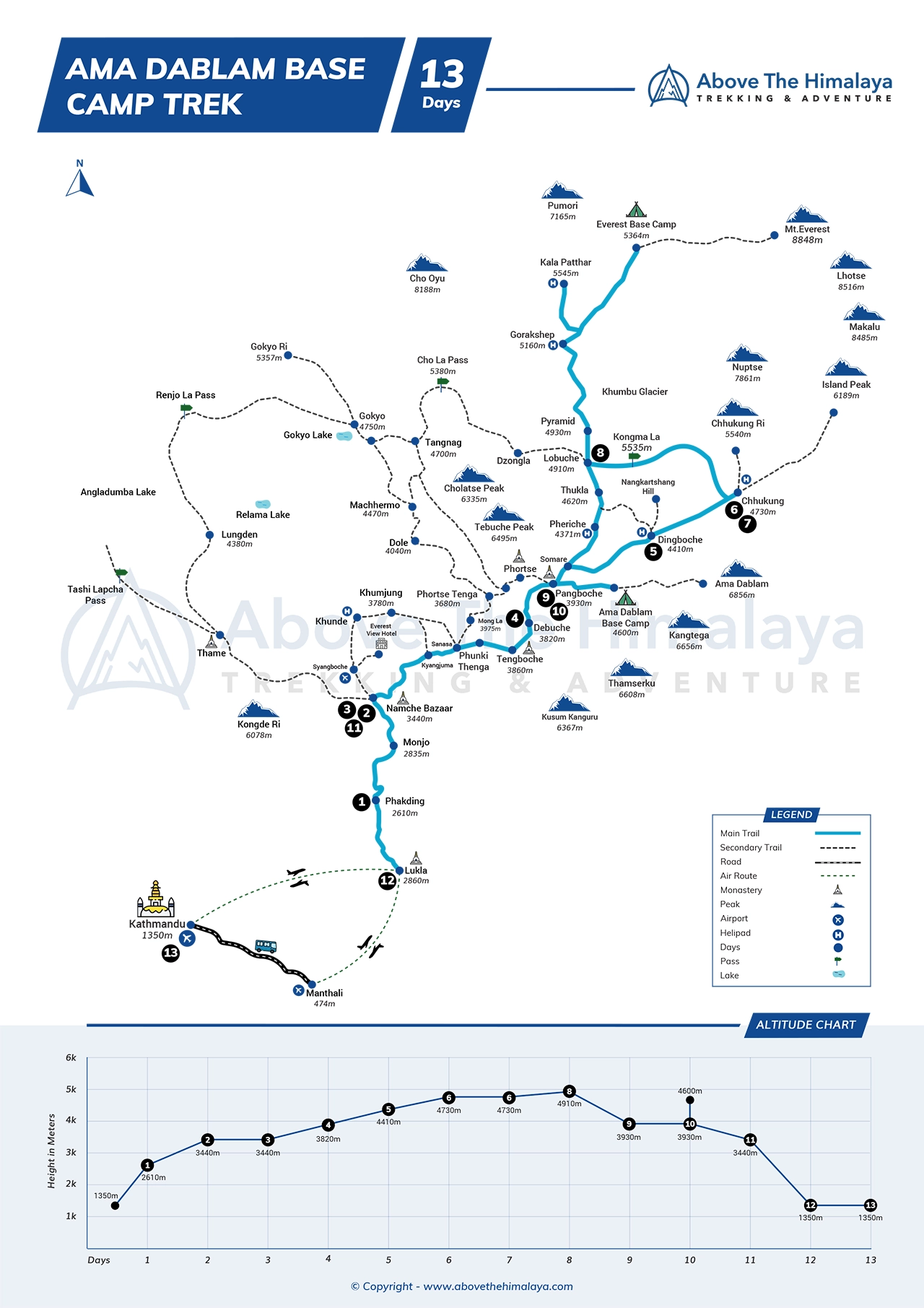
Ama Dablam Base Camp Trek Distance and Walking Hours
The daily walking distance varies considerably throughout the itinerary. Some days involve only a few hours of trekking, while the Kongma La crossing and the return to Lukla are longer days. The walking time also depends on weather, trail conditions, group pace and rest stops.
The table below gives a general picture of the trekking workload in your itinerary.
| Trek Section | Approx. Distance | Walking Time |
| Lukla to Phakding | 8 km | 3 to 4 hrs |
| Phakding to Namche | 11 to 12 km | 6 to 7 hrs |
| Namche to Deboche | 11 to 12 km | 5 to 6 hrs |
| Deboche to Dingboche | 11 km | 7 to 8 hrs |
| Dingboche to Chhukung | 5 km | 2 to 4 hrs |
| Chhukung Ri acclimatization hike | Approx. 5 km | 3 to 4 hrs |
| Chhukung to Lobuche via Kongma La | Approx. 10 to 11 km | 7 to 8 hrs |
| Lobuche to Pangboche | 16 km | 6 to 7 hrs |
| Pangboche to Ama Dablam Base Camp and return | Approx. 10 to 12 km | 6 to 7 hrs |
| Pangboche to Namche | Approx. 14 to 15 km | 5 to 6 hrs |
| Namche to Lukla | 18 to 19 km | 6 to 7 hrs |
The Kongma La crossing is the hardest walking section because of its high elevation and rugged terrain. The final approach to Ama Dablam Base Camp is also physically demanding because you reach approximately 4,600 m before returning to Pangboche.
Trek Difficulty
The Ama Dablam Base Camp trek is a moderate to challenging trek because this 13 day itinerary includes the crossing of Kongma La Pass at 5,535 m. Most days involve 5 to 8 hours of walking on uneven mountain trails, with several steep ascents and descents.
The trek to Ama Dablam Base Camp itself reaches approximately 4,600 m, but the Kongma La section takes you considerably higher. The pass crossing involves rugged terrain, loose rocks, steep sections, and thin air, so good physical fitness and stamina are important.
Previous high altitude trekking experience is helpful but not essential for fit trekkers who prepare properly. Following a gradual pace, taking the planned acclimatization days seriously, staying hydrated, and listening to your guide are important throughout the trek.
| Trek Factor | Details |
| Difficulty Grade | Moderate to Challenging |
| Highest Point | Kongma La Pass, 5,535 m |
| Ama Dablam Base Camp | Approximately 4,600 m |
| Typical Walking Time | 5 to 8 hours per day |
| Trail Conditions | Rocky, uneven, steep and rugged sections |
| Most Demanding Section | Chhukung to Lobuche via Kongma La |
| Trekking Experience | Previous high altitude experience is helpful |
| Fitness Required | Good physical fitness, endurance and stamina |
| Technical Climbing | No technical climbing required |
Weather and Best Season for Ama Dablam Base camp Trek
For a trek to Ama Dablam Base Camp, the best seasons are spring (March–May) and autumn (Sept–Nov). During these months, the weather tends to be stable, the skies are clear for stunning mountain views, and the daytime temperatures are moderate.
Spring offers blooming rhododendrons on the trail, while autumn provides crisp air and excellent visibility after the monsoon rains. The monsoon season (June–Aug) brings heavy rain, clouds, and a high risk of flight delays, so trekking during those months is not recommended. Trails become muddy and leech-infested, and views are often obscured by clouds.
Winter (Dec–Feb) is dry with crystal clear skies, but extremely cold at night – temperatures can drop well below freezing at base camp and the pass, and snowfall can occasionally block the Kongma La Pass. Winter trekking is possible for well-prepared trekkers (and the trails are very quiet), but you must be ready for harsh cold and some itinerary flexibility.
In summary, stick to spring or autumn for the most pleasant trekking conditions.
| Season | Months | Conditions | Suitability |
| Spring | March to May | Generally stable weather, clear mountain views and blooming rhododendrons | Excellent |
| Summer / Monsoon | June to August | Rain, clouds, muddy trails and possible flight delays | Less suitable |
| Autumn | September to November | Generally clear skies, stable weather and good visibility | Excellent |
| Winter | December to February | Very cold conditions and possible snowfall around Kongma La | Possible with proper preparation |
Food & Drink during the Ama dablam base camp trek
We provide three meals a day during the Ama Dablam Base Camp trek. Tea houses offer a mix of Nepali and Western dishes – dal bhat (rice with lentil soup and vegetable curry) is the staple that gives plenty of energy, along with soups, noodles, rice and potato dishes, and sometimes pasta or momos. There are plenty of vegetarian options (which we recommend at higher altitudes for better food hygiene). Meals are hearty and designed to keep you energized.
Drinking water will be safe. We include purification tablets or treated water, and you can also buy boiled water at the trek if you prefer. Avoid untreated water to stay healthy. Hot tea (ginger, lemon, milk tea) and coffee are available at every meal to keep you warm and hydrated. (Alcohol and extra beverages are not included – and we advise against drinking alcohol at high altitude as it can dehydrate you and affect acclimatization.)
Altitude Sickness
The trek extends to altitudes beyond 5,000m, and therefore, a risk is Acute Mountain Sickness (AMS). We also add acclimatization days so that you can get used to it slowly. The AMS symptoms are common; they are headache, dizziness, nausea, loss of appetite, and difficulty in sleep.
To reduce the risk, climb gradually, drink plenty of water, avoid drinking or smoking, and do not push yourself too hard. Our guides have been trained to identify AMS signs and will check your condition on a day-to-day basis.
In case you notice any symptoms, the initial procedure is to rest at the same level and allow your body to adapt. If symptoms worsen (e.g., severe headache, vomiting), we will descend to a lower altitude immediately – this is the most effective remedy. In rare severe cases, we will arrange emergency evacuation. By following the acclimatization plan and listening to your guide (and your own body), you can greatly reduce the chance of altitude sickness.
Ama Dablam Base Camp Trek Cost and What Affects the Price
The cost of the Ama Dablam Base Camp trek depends on several factors, including the number of people in the group, accommodation, domestic flights, meals, permits, guide and porter services, and the level of support provided during the trek. Your package includes the main trekking services, so travelers should also understand which personal expenses they need to budget for separately.
The Kongma La section can also affect the overall preparation and support required because this itinerary reaches 5,535 m. Travel insurance with high altitude trekking and helicopter evacuation coverage is particularly important for this route.
| Usually Included in the Package | Usually Paid Separately |
| Kathmandu to Lukla flights | International flights |
| Airport transfers | Nepal visa |
| Teahouse accommodation during trek | Travel insurance |
| Meals during trek | Personal trekking equipment |
| Trekking guide and porters | Snacks and extra drinks |
| Trekking permits | Hot showers and charging |
| Basic first aid support | Tips |
| Duffel bag and luggage storage | Personal expenses |
The final amount you spend can also vary depending on your choice of personal equipment, additional drinks, charging, WiFi, tips and unexpected expenses. Checking the inclusions and exclusions before booking will help you understand the actual cost of the trip.
Accommodation During the Ama Dablam Base Camp Trek
Accommodation during the trek is mainly provided in local teahouses and lodges. Rooms are generally simple and are commonly arranged on a twin sharing basis. Most teahouses have a shared dining area where trekkers eat their meals and spend time warming up after the day’s walk.
Facilities become more basic as you move toward higher elevations. Hot showers, WiFi and device charging are usually available for an additional fee where facilities exist. Availability can vary depending on the village, season and weather.
Your package includes teahouse accommodation during the trekking portion of the journey. The rooms are suitable for resting between trekking days, but travelers should not expect hotel style facilities in the remote mountain villages.
At higher elevations, keeping warm becomes more important than having extra facilities. A good sleeping bag and warm clothing will make the nights more comfortable. Your itinerary also includes overnight stays at Chhukung and Lobuche, where temperatures can be considerably colder than in Namche and the lower villages.
Ama Dablam Base Camp Trek vs Everest Base Camp Trek
Both treks take place in the Everest region and share several sections of the Khumbu trail, but their main destinations and experiences are different. The Ama Dablam Base Camp Trek focuses on reaching the base of Ama Dablam, while the Everest Base Camp Trek continues toward Everest Base Camp and usually includes Kala Patthar.
Your particular itinerary is also different from a standard Ama Dablam Base Camp route because it includes Kongma La Pass at 5,535 m. Therefore, it should not be described as automatically easier than the Everest Base Camp Trek.
| Feature | Ama Dablam Base Camp Trek | Everest Base Camp Trek |
| Main destination | Ama Dablam Base Camp | Everest Base Camp |
| Main mountain | Ama Dablam | Mount Everest |
| Base camp elevation | Approx. 4,600 m | Approx. 5,364 m |
| Highest point on your itinerary | Kongma La, 5,535 m | Depends on the route |
| High pass crossing | Kongma La included in this package | Not normally included |
| Main appeal | Ama Dablam and a high pass adventure | Everest Base Camp and Kala Patthar |
| Route character | Includes Chhukung, Kongma La and Lobuche | Focuses on the traditional Everest Base Camp route |
The better choice depends on what you want from your trek. If your main interest is seeing Ama Dablam up close and experiencing a high pass crossing, this itinerary is a good fit. If reaching Everest Base Camp and getting closer to Everest is your main goal, the Everest Base Camp route is more suitable.
Who Is the Ama Dablam Base Camp Trek Suitable For?
The Ama Dablam Base Camp trek is suitable for physically fit trekkers who are comfortable walking for several hours a day in mountainous terrain. Previous high altitude trekking experience is helpful, particularly because your itinerary includes Kongma La at 5,535 m, but it is not necessarily required for a well prepared and properly acclimatized trekker.
This particular 13 day itinerary is better suited to people who want more than a straightforward walk to Ama Dablam Base Camp. The route combines the mountain scenery of the Khumbu with Chhukung, the Kongma La crossing, Lobuche and the final visit to Ama Dablam Base Camp.
It may not be the right choice for someone looking for a short or easy Everest region trek. The high pass, long walking days and changing trail conditions require good endurance and the ability to handle steep and rocky sections.
Trekkers should be prepared to walk for up to 7 to 8 hours on the longer days and should be comfortable with sleeping at elevations above 4,000 m. Good preparation, sensible pacing and following the guide’s advice are important throughout the journey.
Preparation and Fitness for you Ama dablam base camp trek
The Ama Dablam Base Camp trek is much more pleasant in good fitness. We suggest you begin training a minimum of 8-12 weeks prior to your trip. Concentrate on endurance and leg power. Routine exercises such as jogging, cycling, swimming, or long treks (particularly uphill) will make you more stamina-wise to walk as many as 5-7 hours a day.
Attempt to add some training in carrying a daypack to practice trek conditions. Working on your legs (squats, lunges, and step-ups will work) and core will assist with steep ascending and descending.
Mentally, one should also be ready to go on the trek- the path can be demanding, and the weather can be volatile, and a positive attitude and resolve help a lot. Blisters can be prevented by making sure that your trekking boots are well broken in prior to the trek. Once you have the right training and the right mindset, you will be prepared to approach this adventure.
Visa and Permits
In the case of the Ama Dablam Base Camp trek, you will require a Nepal visa as well as trekking permits. Most nationalities can obtain Nepal visas on arrival at Tribhuvan International Airport in Kathmandu; a 15-day or 30-day tourist visa (paid in USD cash) will cover this trek.
As of now, a 30-day visa costs USD $50. It is simple: complete the form at the airport (or via the Internet before arrival), pay the money, and you will receive the visa stamp upon arrival.
There are two primary permits that are needed in the Everest region in terms of trek permits: the Sagarmatha National Park Entry Permit and the Khumbu Pasang Lhamu Rural Municipality entry fee. These permits are already included in the package cost, and we will obtain them on your behalf. The paperwork is all done by our team; you will only require a copy of your passport and some passport-sized photographs of you in Kathmandu.
The permit cards will be carried with you on the trek (they will be carried by your guide or reminded to you when you should present them at the checkpoints). In case you intend any side trips or extensions (such as climbing Island Peak), we would organize them accordingly (at an extra fee).
In short, we handle all the permits and permissions, which means you do not have to worry about the bureaucratic aspects.
Health & Safety during the Ama dablam base camp trek
We care about your safety during the Ama Dablam Base Camp trek. We have first aid-trained guides in the wilderness and a basic medical kit on the trek. The itinerary we have created is properly acclimatized to ensure that you are healthy at the altitude.
Please be obedient to your guide on the trail, particularly in awkward places or when yaks/porters are coming on narrow trails. Maintain good hygiene, and remember to sanitize your hands with hand sanitizer frequently; and only drink boiled or purified water (we will supply a way to do so).
We monitor weather conditions and trail conditions; in case something is unsafe (such as a landslide area or severe weather), then we will revise plans (postpone or divert) in order to evade dangers.
We have contingency plans in case of any serious health problem or injury. In case of the need for immediate descent or helicopter evacuation, our team can organize it (this is why the purchase of travel insurance is compulsory). Going with us implies you are in professional hands; we take care of the arrangements, and you can go trusting that the trek will be an enjoyable and safe adventure.
Transportation
We take care of all the necessary transportation. Your round-trip domestic flight between Kathmandu and Lukla is included (approx. 35 minutes each way). During peak season, flights may operate from Manthali (Ramechhap) instead of Kathmandu due to airport traffic – if that happens, we arrange comfortable road transport (about 5 hours drive, depending on traffic) to get you to Manthali in time for the flight.
We also handle all ground transfers in Kathmandu: our team will pick you up from your hotel and take you to the airport for your Lukla flight, and likewise, we’ll be there to meet you in Kathmandu when you fly back from Lukla.
Remember that the flights between Lukla have very strict weight restrictions (typically 10 kg of checked baggage and 5 kg of hand luggage per person). We will assist you in keeping any additional luggage in Kathmandu before the trek, and hence, you will only carry the required luggage.
In addition, Lukla flights are weather-related; the flights may be delayed due to unsafe conditions. We normally recommend one additional day in Kathmandu on completion of the Ama dablam base camp trek as a cushioning factor prior to your international flight. With our staff, you will not have to worry about the transportation logistics.
| Transportation | Details |
| Kathmandu to Lukla | Domestic flight, approximately 35 minutes |
| Lukla to Kathmandu | Domestic flight, approximately 35 minutes |
| Alternative Airport | Manthali Airport, Ramechhap during peak periods |
| Kathmandu to Manthali | Approximately 5 hours by road, depending on traffic |
| Kathmandu Airport Transfers | Included |
| Checked Baggage | Typically 10 kg per person |
| Hand Luggage | Typically 5 kg per person |
| Flight Delays | Possible due to weather and operating conditions |
Travel Insurance
Travel insurance is mandatory for anyone doing a Ama Dablam Base Camp trek with us. You must have a policy that covers high-altitude trekking – ideally up to 6,000 m – including emergency helicopter evacuation and medical treatment. We will ask for your insurance details before the trek (policy number and insurer emergency contact).
Double-check with your provider that trekking above 5,000 m in Nepal is included (some standard policies exclude very high altitude). Also, ensure the policy covers general travel risks (trip cancellations, lost baggage, etc., though the most crucial part is emergency evacuation and medical coverage.
In the unlikely event you need a helicopter rescue or hospitalization, having proper insurance will be a lifesaver (financially and logistically). We hope never to use it, but it’s essential to have. Make sure your insurance is valid for the entire trek duration. With that taken care of, you can do Ama dablam base camp trek with peace of mind knowing you’re protected.
Alternative Routes
If you want to modify your journey, there are a few options. The Everest Base Camp trek (about 12 days) is a classic route that overlaps with this trek until Pangboche, then goes to Everest Base Camp (5,364m) and Kala Patthar (5,545m). It’s busier but takes you to the foot of Everest itself.
If you prefer a shorter and easier trek, an Everest Panorama Trek up to Tengboche (or even just Namche) offers great views without the high altitude pass or base camp – it’s ideal if you have limited time or don’t want to go above 3,800m.
We can also customize this Ama Dablam Base Camp trek itinerary – for example, skipping Kongma La Pass to make it less strenuous (instead of the pass, you’d go a lower route via Tengboche to Dingboche/Lobuche), or adding on a visit to Gokyo Lakes and even crossing Cho La Pass if you have extra days and want to be part of the Everest Three Passes trek route.
Let us know your interests and timeframe – we’re happy to suggest the best route or adjustments to create your ideal Himalayan trek.
Your Extra Expenses
The additional costs incurred in the Ama dablam base camp trek consist of a couple of personal expenses that are not included in the package. You will have to spend on your Nepal visa (approximately USD 50 for a 30-day visa on arrival) and travel insurance. Hotels and meals in Kathmandu before and after the trek are not included, and therefore, budget on where you stay and where you eat.
You also have to carry your own or hire your own trekking equipment, including boots, a jacket, and a sleeping bag, but we will give you a duffel bag to carry your stuff. All additional food, bottled water, soft drinks, coffee, or alcohol is at your own cost.
The tea houses can impose a little charge for using hot showers, Wi-Fi, or charging your phone, and you will pay them directly. Tipping is customary in Nepal. Many trekkers budget around USD 80–150 per person for the whole trek, shared between the guide and porters.
Other personal expenses, such as souvenirs, additional tours, or unforeseen expenses caused due to flight delays are not included as well. These costs are better to keep in Nepali Rupees in small notes, as there are no ATMs except in Kathmandu, and even in Namche Bazaar, they are not always available.
Language & Communication
English is the common language on the Ama dablalm base camp trek trails. Our guides are fluent in English (as well as Nepali and the Sherpa language) and will help you communicate with locals. Most tea house owners and staff along the route speak basic English, so you can order meals and have simple conversations without issue.
You will hear the greeting “Namaste” everywhere – it means “hello”. Feel free to use it kindly. Learning a few Nepali phrases (like “dhanyabad” for thank you) or Sherpa greetings is not required, but locals appreciate the effort. Overall, language will not be a barrier during the trek, and whenever you need help or translation, your guide will assist.
Mobile Network, Internet & Charging Facilities
The Ama Dablam Base Camp trek has poor mobile and internet connections, particularly in the higher places. Network connectivity is possible in Lukla, Phakding, and Namche Bazaar with Ncell or NTC SIM cards, but the signal is poorer or disconnects further up the mountain. There are a few teahouses that offer internet via prepaid Wi-Fi cards like the Everest Link, but this may be slow or go out of service during poor weather conditions.
Connection to Namche Bazaar is the best, but past Pangboche is extremely limited. It would be better to inform your family that you may be away for most of the trek.
Phones and cameras can also be charged in the tea houses at a low cost of NPR 200-500 per charge using solar or generator energy. In lower villages, the prices are low, and in remote villages, high. Always bring a good power bank and spare batteries, and always make sure to charge your devices to full capacity.
Leaving your phone in airplane mode and switching it off at night would save your battery. You will be able to have enough power to take photos and make essential use in the company of a relaxing break to the digital world with a bit of planning.
Don’ts on this trip
During the Ama Dablam Base Camp trek, it is important to follow some basic guidelines to stay safe and respectful. Any symptoms of altitude sickness, including nausea, dizziness, or headache, should not be overlooked. Always inform your guide in case you feel unwell and take a rest or a descent where necessary.
Move gradually and consistently, allowing your body time to acclimate to the elevation. Do not litter the path and bring your trash till you can find a suitable bin.
You can always bring your trash home and then leave it in the right bin. Show respect to locals and culture by asking permission to take photographs, taking off your shoes and hats in monasteries, and dressing sensitively.
You should never walk alone, particularly at night, and always remain with your group. Do not take too much alcohol or smoke too much because they may complicate the adaptation to the altitude. These few tips will enable you to have a safe, comfortable, and respectful trip in the Himalayas.
Trip Extension
If you have additional days in Nepal after your Ama Dablam Base Camp trek, we can help you plan some great trip extensions. Many trekkers choose to unwind after their trek with a wildlife safari in Chitwan National Park (home to rhinos, elephants, crocodiles, and maybe tigers) or a visit to the beautiful lake city of Pokhara for some relaxation by the lake and views of the Annapurnas.
Cultural tours around the Kathmandu Valley are also popular – you can explore UNESCO World Heritage Sites like Patan Durbar Square, Bhaktapur, Boudhanath Stupa, and Pashupatinath Temple to get a deeper insight into Nepal’s history and spirituality.
If you’re up for another trek, we can arrange shorter treks, such as a 3-day Poon Hill trek in the Annapurna region (famous for its sunrise view) or even a multi-day tour to Tibet or Bhutan for a completely different Himalayan culture experience. Simply let us know what interests you and how much time you have; we can customize and arrange a memorable extension trip to complement your trek.
Photography & Drone Rules
Himalayas are beautiful to take photos in because of the spectacular mountain views and local culture. Taking any pictures in the Ama dablam base camp trek is fine as long as you are respectful.
Do not take close-up shots of individuals, particularly the monks or elders; always seek permission before taking close shots of religious events or interiors of monasteries. When it is the right time, your guide will tell you. The majority of Sherpa are friendly and accustomed to trekkers taking photos, but a smile and an invitation are worth a lot.
The use of drones on the Everest is highly limited. Operating flying drones within the Sagarmatha National Park without the official consent of the Civil Aviation Authority of Nepal and the park office is prohibited.
These permits are extremely hard to get, and flying without one may lead to fines or seizure. Drones can also disrupt the animals and tranquil mountain life. We should forget about drones and find a way to capture our moments with a simple camera.
Cultural Festivals on the Trail
The Khumbu land is the land of Sherpa culture and traditions, and various colorful festivals are celebrated throughout the year. The best-known is the Mani Rimdu Festival, in October or November of the year, which is held at Tengboche Monastery. The monks dance sacred mask dances and pray for three days, and thousands of Sherpa families attend to participate.
Provided that your trek is as long as this one is, you will have a chance to enjoy this great event accompanied by music, dance, and happiness. In May or June, another festival is known as Dumji and takes place in villages such as Namche and Khumjung. It pays homage to Guru Rinpoche, who introduced Buddhism to the Himalayas.
Losar, the Tibetan New Year, is an occasion that is celebrated in February; it is normally a family affair. We can assist in arranging a visit to a festival, should you desire. Although you are not on a trek during one, you will still feel the Sherpa culture, their generosity, and spiritual life during your Ama dablam base camp trek.
Tips for First-Time Nepal Visitors
To get a visa on arrival at Kathmandu airport, you need to carry a passport photo and visa fee in USD; hence, you can get a visa in Nepal on your first visit. Nepali people are friendly and polite, and therefore greet them with Namaste and respect them by taking off their shoes before they enter temples or their homes. Wear simple clothes and never take photos of the locals without their consent.
Stay healthy by taking only bottled or purified water and consuming freshly cooked food. Eat the local food, but prefer packed and hygienic food stalls. Everything in Nepal tends to be done in a slow manner, and therefore, you should be open-minded and have fun. The individuals are friendly and accommodating, and a smile or a simple dhanyabad (thank you) will never go wrong.
Ama Dablam Base Camp Trek Packing List
Packing properly is important for the Ama Dablam Base Camp trek, especially because your itinerary includes the Kongma La Pass at 5,535 m. Conditions change as you move from the lower valleys to the higher parts of the Khumbu, so you need clothing that can be layered rather than relying on one heavy jacket. Your main trekking bag should contain the items you need during the day, while the duffel bag carried by the porter can hold heavier equipment and extra clothing.
Good trekking boots with ankle support are important for the rocky and uneven sections. Warm layers, gloves, a hat, sunglasses, sunscreen, and a sleeping bag are also useful at higher elevations. Bring a reusable water bottle or hydration system, personal medicines, basic toiletries, and a headlamp. Since charging can be limited in the higher villages, a power bank and spare batteries are useful.
| Category | Recommended Items |
| Clothing | Base layers, fleece, down jacket, waterproof jacket and trekking trousers |
| Footwear | Broken in trekking boots, warm socks and lightweight camp shoes |
| Warm gear | Gloves, warm hat, neck warmer and thermal layers |
| Trekking gear | Daypack, sleeping bag, trekking poles, headlamp and water bottle |
| Sun protection | Sunglasses, sunscreen, lip balm and sun hat |
| Personal items | Toiletries, quick drying towel and personal medicines |
| Documents | Passport, insurance details and some Nepalese cash |
| Electronics | Phone, camera, power bank and spare batteries |
Avoid carrying too much because you will be walking for several hours on most trekking days. A comfortable daypack with only the essentials will make the longer sections, particularly the Kongma La crossing, easier to manage.
Most Asked Questions by Travellers
No technical climbing experience is required, though, as this is a high pass trek (Kongma La 5,535 m), we highly recommend some prior multi-day trekking or standard trekking experience. Preparation and good fitness are essential to make days of 6-8 hours of walking comfortable.
Yes, we recommend having a licensed trekking guide and a local porter for safety and logistical support in the high-altitude Everest region. Our package includes an experienced trekking guide and one porter for every two trekkers at no additional cost.
Yes, vegetarian food is very common and frequently most appropriate at the higher altitudes. Common dishes include dal bhat, noodles, soups, and vegetable curries. Dietary accommodations, like vegan or gluten-free, can also be accommodated by request.
Lukla flights may be delayed or canceled due to unfavorable weather conditions. If this happens, our team will assist with rebooking the next available flight or arranging alternative transportation when possible.
We recommend keeping at least one extra buffer day in Kathmandu after the trek in case Lukla flights are delayed.
There’s no strict age limit. This route has been completed by trekkers aged 12 to 70 years. You can do it as long as you are healthy and relatively fit. Children below 18 are required to walk around with a guardian.
No, this walk only reaches the Ama Dablam Base Camp of approximately 4,600 m. You will get to see the mountain top without any technical climbing. It is an enjoyable and scenic trek and not a climb.
Reviews on Ama Dablam Base Camp Trek – 10 days
Be first to post a review in this trip.
Posted on Tripadvisor 

H H
9 December 2025
 Verified
Thank you for the best tour we have ever had!
I planned to stay at the Everest View Hotel this time and travel there because I wanted to see Everest, the highest mountain in the world, slowly, but despite the short schedule due to my children's school, all I got was a response that it was difficult to contact several tour companies. The Himaraya Trekking, Above, has worked out a smooth and safe schedule and had the best experience for me and my family. I will never forget the view of Mount Everest. Thank you very much.
Posted on Tripadvisor

Mike F
26 November 2025
VerifiedAnother Amazing Trip with Above the Himalaya
This is my 3rd trip with Above the Himalaya and Puru. Each trip with Puru has exceeded expectation with the quality of the guides, porters and attention to detail. We were a team of 5 trekker and our ages were all above 67 years of age with the oldest being 73. We are all experienced hikers and trekker and our plan was to trek up the Khumbu Valley to the Cho La pass to Gokyo to the Renjo La pass to return to Lukla. However, the weather altered our plans as Cyclone Montha blanketed the country in rain at lower elevations and significant snowfall at the upper elevations. Due to the weather, no one was trekking and everyone was staying put in their current location during the storm. All the passes were closed due to the deep snow. We were in Namche when the storm was blanketing the country.This is where Above the Himalaya really shines is in the ability to adapt to the changing conditions and our safety. In conversation with our lead guide, we decided to alter our route to trek through the Gokyo valley to reach Gokyo and then do the Renjo La pass. Sitaram our lead guide and Dhurba our assistant guide was both attentive to the changing conditions and always kept a keen eye for how we were doing and feeling on the trek. The pacing was excellent as none of us had any hint of altitude sickness as we reached a maximum elevation of 5,365m.Having trekked and hiked all over the world with different tour companies, Puru’s company is simply the best. The communications, focus on safety, the guides and staff, the accommodations, and the food are all amazing. All you have to do is focus on the beauty of the mountains, enjoy the joyfulness of the Nepali people and have fun exploring the trails. I am planning my next trip with Puru for 2027 as there is no other trekking company to match Puru’s level of service.
Posted on Tripadvisor

Mie K. A.
25 November 2025
VerifiedTake a small step into the Himalayas
I went with Above The Himalaya Trekking’s Everest View Hike in November 2025 and can only recommend with my whole heart!I had never visited Nepal or the Himalayas before and had a life long dream of seeing Mt Everest. I had though, hiked a lot in various parts of the world, but never above 2000 m, so I went with the five day Everest View Trek to take a small step and see how I would handle the altitude. From first enquiry about dates and various questions, to my arrival back from the trip, Puru has been an invaluable help, always standby on mail and WhatsApp, pulling strings and making things happen.Also big shout out to the amazing guide I was teamed with, Kamal, who did everything he could to answer all my curious questions about vegetation, animal life, Nepalese culture and everything in-between :) Kamal was the perfect gentleman, offering little treats and reminding me to take breaks, and all in all I felt very safe and in good hands all the time. He also had good banter and jokes, which lifted the spirit of even the hardest climb.It was cold most nights and mornings and even though the tea houses provided heavy blankets (and I could borrow extra) I was glad I had the sleeping bag with me, which I rented through Puru. But I could definitely have survived without and saved the space in my pack.In total, I’m very pleased I’ve got to experience this lovely country with Above the Himalaya Trekking and if I ever come back for the big leap into the mountains, I’ll chose Kamal and Puru all over again :)
Posted on Tripadvisor

nameless
25 November 2025
VerifiedNepal trek-Gokyo
Second trek with Above the Himalaya, this time to Gokyo and over Renjo La. Our lead and assistant guides (Sitaram and Dhurba) were excellent. Due to several days of rain at lower elevations and snow higher we needed to change our plans while in the midst of our trek. Above the Himalaya accomplished this smoothly and flawlessly, which ultimately resulted in a better experience. We’ll be back!
Posted on Tripadvisor

Yu S
22 November 2025
VerifiedGreat Experience and Friendly people.
We had a great time with Above the Himalayas tour company in Oct. Ajay, the tour guide in Kathmandu is very friendly and knowledgeable. He took us to a lot of places that we can experience local authentic daily life. Puru, the owner, arranged and organized our trip in such way that we really feel comfortable and enjoyable. We are specially impressed by his quick action and management skills. Our flight to Pokhara got cancelled due to bed weather. Within minutes, Puru was able to arrange a car and a driver to drive us to Pokhara! It saved out trip.
Posted on Tripadvisor

Sally M
14 November 2025
VerifiedGlorious trekking experience - ABC
We had the most wonderful experience doing the Annapurna Base Camp trek with our fabulous guide, Tanka, and porter, Ravi. The trek was glorious, despite some rainy days, and although we weren't sure we would get to see the peaks at ABC, the weather cleared just in time and we had an amazing sunrise there. What made the whole trip so special, though, were Tanka and Ravi, who remained cheerful at all times and went out of their way to make everything as good as it could be. This included setting a pace with regular breaks which made the walking completely manageable, modifying the itinerary so we could visit additional villages, getting up in the middle of the night to see if the sky would be clear for sunrise, and bringing a sense of ease and humour to all our interactions. We just loved the whole thing and are keen to return to Nepal for another trek. It was magical!
Posted on Tripadvisor

Peter E
27 October 2025
VerifiedAbove the Himalayas goes above and beyond expectations!
From start to finish everything was perfect! Puru, the managing director, was always quick with his responses to my questions when I first contacted him about planning our trek, and he continued to check to see that everything was going well throughout.Our guide Tanka and porter Ravi were fantastic! Their friendly demeanor kept our experience lively and interesting the entire time and made sure that we were well taken care of. Even small details like Ravi coming in and double checking our rooms to see that we had left nothing behind before leaving each morning, and seeing that meals were prepared the way we liked them weren't overlooked. Tanka was also quite knowledgeable about the mountains, the people, and just about everything "Nepal". He enthusiastically shared stories about his family and Nepalese life in a general way.Although there was a clear itinerary each day, and for the whole trek, Tanka allowed for flexibility in terms of time and where to stay. He was even willing and able to make changes to same-day accommodation based on how far we anticipated hiking that morning. I can't say enough about how much we enjoyed our hike and I would definitely recommend Above the Himalayas for anyone considering a trek.
Posted on Tripadvisor

Akane U
25 October 2025
VerifiedAmazing tour
For me and my son, Pru thought of a four-day trekking tour.His interaction was very smooth.On the first day, I went with my son to Gandrouk, and on the second day, he went to a higher place (mulde view point, Poon hill) with his guide Ashok. Ashok was very kind and took me to various local places. The food was also very good.My guide, Tangka, was very kind and helped me a lot.I recommend this travel agency because it's great.
Posted on Tripadvisor

Daniel F
24 October 2025
VerifiedEverest Base Camp Trek
My friends and I just completed the EBC trek. From the time I met Puru at the Canada Place trade show in Vancouver BC, Canada I felt comfortable going to Nepal. His communications via WhatsApp were seamless answering all our questions. Everything went exactly according to plan. Our guide Suresh was amazing. He took very good care of us the whole time. From guiding us to making sure we had everything we needed to be happy. The food the whole way up and back was amazing! 5 ⭐️. Our 2 porters were great as well. I have a whole new respect and appreciation for what they do. They are the true hero’s to what we can do as a team. We chose the basic trek the lodging was to be expected. If I was to do again I would choose the luxury trek. The hotels in Kathmandu at the Hotel Aloft and the Hotel Lo Mustang were top notch as well as the buffets. Highly recommend this local company!
Posted on Tripadvisor

adrienne h
24 October 2025
VerifiedGreat tour, would recommend!
My friend and I completed the 10 day Annapurna circuit with Above Trekking Himalaya. Buddha our porter was a little mountain goat, pocket rocket. When I got altitude sickness he carried my bag, as well as mine and my friend’s big pack. He was friendly and loved to played cards with us, always with a cheeky smile on his face. Sitaram our guide was very knowledgeable of the area and quite serious. He was always available if we had any questions and went above and beyond to try get us the best/quietest rooms in the tea houses. Puru was fabulous working behind the scenes to ensure our trip was as smooth as possible. He was very quick to respond to any messages. It was a great experience to see Nepal with some locals and I certainly appreciated their support when I succumbed to altitude sickness. They stayed close to us the whole time and checked in frequently making us feeling safe and supported the entire time.
Verified by Trustindex
Trustindex verified that these reviews were published on Above the Himalaya Trekking - Private Day Tours's Tripadvisor profile. Learn more
20% OFF
Enjoy the best prices, flexible date changes, and instant booking confirmation.
Book This TripBook with Confidence
- Easy Booking: Secure your trip with just a 20% deposit.
- Flexible Date Changes: Free changes at least 30 days before departure.
- One-Year Deposit Credit: Use your deposit for an eligible postponed trip within one year.
- Private & Personalized: Flexible itineraries and group sizes.
- Experienced Local Guides: Professional guidance and support throughout your trek.
- Best Value: Competitive prices with clear package inclusions.
Your Trek Leader
 Enjoy Himalayan scenery with the help of Nepal’s best guides with Government license holders and got training in first-aid, our Trip Leaders, know where you’ll find the best photos, most fascinating wildlife, and the best stream crossings.
Have Questions?Talk to Expert
Meet Mr. Purushotam Timalsena (Puru), Nepal's best trek and tour organizer, who has been working in the Himalayas for more than 24 years.
WhatsApp/Viber +977 98510 95 800



Trips for All

Private Trip
Peaceful tour with your travel buddy and guide
Small Group Travel
Travel with people having similar adventure dreams
Trips for Kids
Calling all young adventurers - join us for a journey of a lifetime!
Trips for Adventurers
Climbing & mountaineering adventures for thrill-seekers