Customize Your Trip




Need Help? Let's Talk
+977 985-1095800


10% OFF
Trip Duration 17 Days
Group Size 2-10 people
Maximum Altitude Makalu Base Camp (4,870m)
Difficulty Grade Difficult
Start & End Point Kathmandu/Kathmandu
Best Seasons Mar-May, Sept-Nov
Makalu Base camp Trek Highlights
- Scenic flight from Kathmandu to Tumlingtar
- Drive through Khandbari and Chichila to the trekking trail.
- Trek through Num, Seduwa and Tashigaon.
- Acclimatization at Khongma Danda
- Cross the high passes between Khongma Danda and Dobate
- Trek through Yangri Kharka and Langmale Kharka to Makalu Base Camp
- Reach Makalu Base Camp and return through the Barun Valley.
Overview of Makalu Base Camp Trek
The Makalu Base Camp Trek takes you deep into the eastern Himalayas of Nepal, where the trail passes through quiet mountain villages, forests, high passes, alpine valleys and glacial landscapes. The trip starts with a Kathmandu to Tumlingtar flight and then a road trip to Khandbari. It then extends to Chichila, Num, Seduwa and Tashigaon to Khongma Danda.
The following Makalu Base Camp Trek 17 Days itinerary will have an acclimatization day at Khongma Danda and then the trail will proceed to reach high passes. The path between Khongma Danda and Dobate is a more challenging section of the journey and there are a number of mountain trail ascents and descents. The terrain is slowly altered after Dobate, in heading to Yangri Kharka and Langmale Kharka.
The path continues onward up into the Barun Valley and the mountains get closer to you as you head toward Makalu Base Camp. You arrive at Makalu Base Camp on Day 10 at approximately 4,870 meters where you can relax and enjoy the views of the various surrounding peaks and the high mountain landscape. The following day involves sightseeing around the base camp and then starting the journey back to Yangri Kharka.
This Makalu Base Camp Trekking route follows the same trail back through Dobate, Khongma Danda, Seduwa and Num. On the last trekking day you leave Num to Chichila and then drive to Tumlingtar. On Day 17, the trip is completed by a flight back to Kathmandu. The Makalu Base Camp Trek itinerary is designed for experienced trekkers who are comfortable with long walking days, steep ascents and descents, and remote mountain conditions.
The route passes through villages where Rai and Sherpa communities maintain their local traditions and ways of life. In the lower parts, there are forests but as you ascend to the upper valley, you see the alpine landscape and Makalu at one point, the trek provides you with a progressive shift in the landscape as you proceed deeper into the region.
Makalu Base Camp Trek Route Overview
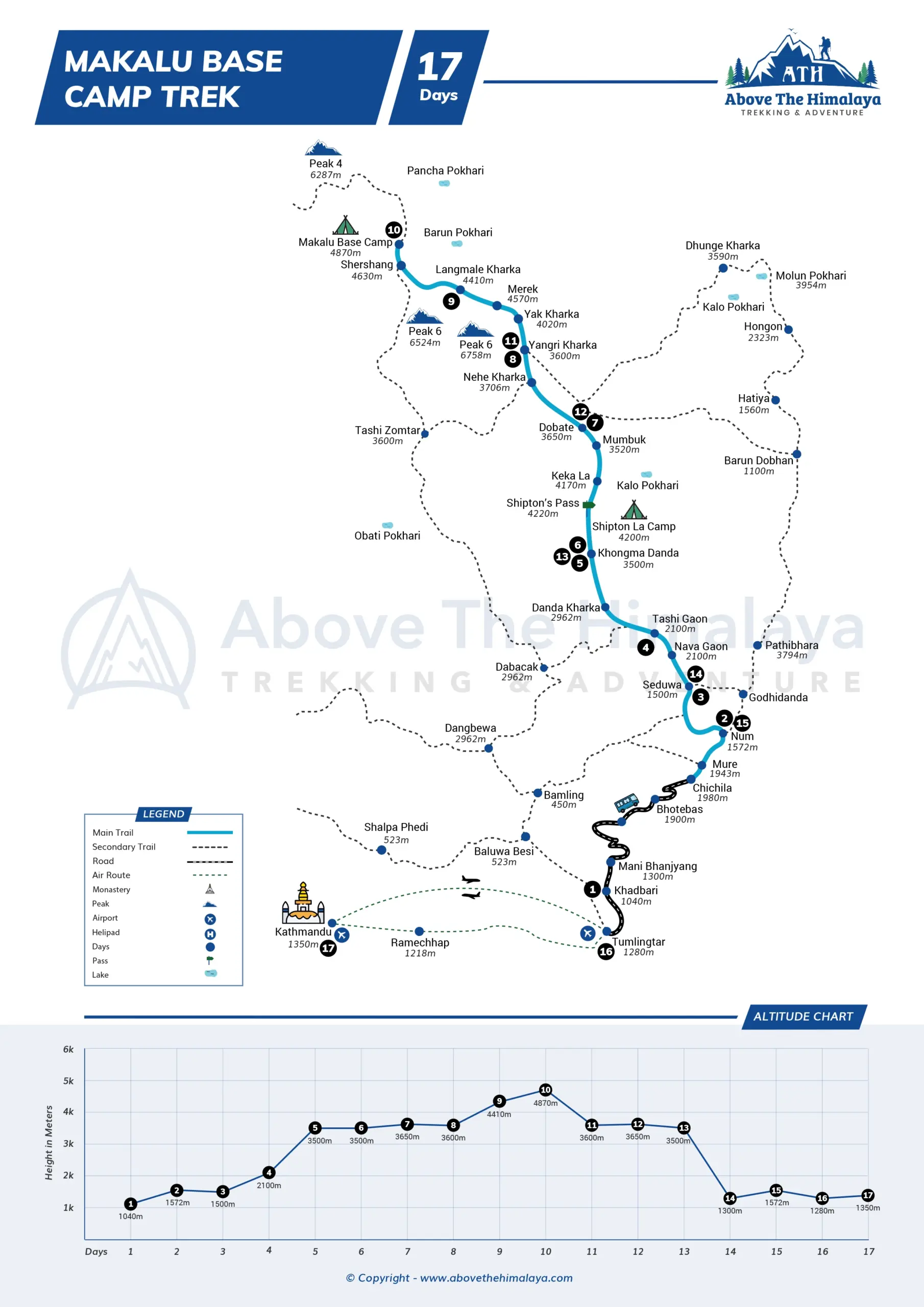
The Makalu Base Camp Trek will start with a flight at Kathmandu to Tumlingtar and then a drive to Khandbari. The trekking portion begins at the lower hills and slowly passes through Chichila, Num, Seduwa and Tashigaon to Khongma Danda. We spend one day acclimatising at Khongma Danda before crossing the high passes toward Dobate. The trail leads to Makalu Base Camp with a stop at Dobate, Barun Valley, Yangri Kharka and Langmale Kharka.
After exploring Makalu Base Camp, we retrace our route through Yangri Kharka, Dobate, Khongma Danda, Seduwa and Num before returning to Tumlingtar. The last part links Num to Chichila and Tumlingtar where you fly back to Kathmandu.
Makalu Base Camp Trek Route at a Glance
| Route Section | Main Stops | What to Expect |
| Approach | Kathmandu → Tumlingtar → Khandbari | Flight and road journey into the Makalu region |
| Lower Trail | Khandbari → Chichila → Num | Hillside villages, forests and rural landscapes |
| Village Section | Num → Seduwa → Tashigaon | Gradual ascent through mountain settlements |
| Acclimatization | Tashigaon → Khongma Danda | Trek to Khongma Danda followed by an acclimatization day |
| High Pass Section | Khongma Danda → Dobate | Steeper terrain and several high passes |
| Barun Valley | Dobate → Yangri Kharka → Langmale Kharka | Alpine surroundings and changing mountain landscapes |
| Base Camp Section | Langmale Kharka → Makalu Base Camp | High altitude terrain and views of Makalu |
| Return Trail | Makalu Base Camp → Yangri Kharka → Dobate | Descend through the Barun Valley |
| Lower Return | Dobate → Khongma Danda → Seduwa → Num | Retrace the trail toward the lower valleys |
| Final Journey | Num → Chichila → Tumlingtar → Kathmandu | Road journey followed by the flight to Kathmandu |
This Makalu Base Camp Trek itinerary follows a gradual progression from the lower hills into higher alpine terrain. The trail encompasses one acclimatization day preceding the high pass segment and enables the trekkers to take time around Makalu Base Camp and then back using the same path. One of the main aspects of the journey is the transformation of the landscape, the forested hills and villages, into the upper Barun Valley.
Itinerary of Makalu Base Camp Trek
DAY
01
01
Day 01: Fly from Kathmandu to Tumlingtar and Drive to Khandbari
We will take an early flight from Kathmandu to Tumlingtar, the main gateway for the Makalu region. We also see the hills and mountains on the flight as we head out of Kathmandu Valley. Once we arrive at Tumlingtar, we will meet our driver and continue by road toward Khandbari.
The highway ascends the hills and crosses rural communities on its way.
Khandbari is the district headquarters of Sankhuwasabha and an important town for travellers heading toward the Makalu region. We will spend the night here and make final preparations for the walking days ahead.
Bus
Accommodation
Teahouse
Meals
Breakfast, Lunch, Dinner
Altitude
Khandbari (approximately 1,020 m / 3,346 ft)
DAY
02
02
Day 02: Drive from Khandbari to Chichila and Trek to Num
After breakfast, we will leave Khandbari by road and drive toward Chichila. The road reaches higher grounds by taking a journey through hilly side settlements and forested places.
The Makalu Base Camp Trekking starts at Chichila. We will follow the trail toward Num through forests and rural landscapes, with several ups and downs along the way. Num is a small village located above the valley of the Arun River and forms a key location on the route to Makalu Base Camp.
We will spend the night at Num and prepare for the first longer trekking day ahead.
Walking Day
Approximately 5 to 6 hours
Accommodation
Teahouse
Meals
Breakfast, Lunch, Dinner
Altitude
Num (1,560 m / 5,118 ft)
DAY
03
03
Day 03: Trek from Num to Seduwa
Today we will leave Num and descend toward the Arun River before climbing again toward Seduwa. It is a steep trail, with some steps made of stone and some parts of wood, and a slow and even walk will be beneficial.
The landscapes shift as we move on, with the environment in the lower hills giving way to the more mountainous landscape. Seduwa is a small village that is surrounded by cultivated hillsides and forests. We will have time to rest after reaching the village and prepare for the gradual increase in altitude during the following days.
Walking Day
Approximately 5 to 6 hours
Accommodation
Teahouse
Meals
Breakfast, Lunch, Dinner
Altitude
Seduwa (approximately 1,500 m / 4,921 ft)
DAY
04
04
Day 04: Trek from Seduwa to Tashigaon
The path between Seduwa and Tashigaon goes on through the Makalu hills. The walk will take us through terraced fields, forest areas and small villages as we slowly rise in altitude.
The trail contains a few ascents and descents, but the speed will be moderate enough to save strength to cover the more challenging parts of the hike. Tashigaon is one of the main villages along the route. Beyond the village, the trail becomes steeper and more remote. After reaching Tashigaon, we will settle in and rest for the night.
Walking Day
Approximately 5 to 6 hours
Accommodation
Teahouse
Meals
Breakfast, Lunch, Dinner
Altitude
Tashigaon (approximately 2,100 m / 6,890 ft)
DAY
05
05
Day 05: Trek from Tashigaon to Khongma Danda
Today the trail becomes steeper as we leave Tashigaon and climb toward Khongma Danda. We will walk through forested terrain with a series of ascents that require a steady pace.
Khongma Danda is an important overnight stop before we cross the high passes toward Dobate. The settlement is a distinct transition between the forested terrain below and the alpine terrain that lies ahead.
We will have a good rest at Khongma Danda and prepare for the acclimatization day.
Walking Day
Approximately 5 to 6 hours
Accommodation
Teahouse
Meals
Breakfast, Lunch, Dinner
Altitude
Khongma Danda (approximately 3,500 m / 11,483 ft)
DAY
06
06
Day 06: Acclimatization Day at Khongma Danda
Today is dedicated to acclimatization at Khongma Danda. Instead of going on upwards, we will rest the day so that our bodies can have time to adapt to the rising altitude.
We may take a short walk around Khongma Danda, depending on the weather and how everyone is feeling. The day also comes in handy to test equipment and get enough rest and hydrate before the high pass section.
Our guide will monitor everyone’s condition and check for symptoms of altitude sickness before we continue toward Dobate the following morning.
Walking Day
approximately 1–3 hours
Accommodation
Teahouse
Meals
Breakfast, Lunch, Dinner
Altitude
Khongma Danda (approximately 3,500 m / 11,483 ft)
DAY
07
07
Day 07: Trek from Khongma Danda to Dobate via the High Passes
Today is one of the more challenging days of the Makalu Base Camp Trek. From Khongma Danda, we cross several high passes, including the Shipton La and Keke La sections, before reaching Dobate. The route involves steep climbs, rocky trails and exposed mountain terrain. Snow or ice may make the crossing more difficult.
The trail entails climbing up and down mountainous rugged terrain. The weather may vary rapidly in this region, and we will maintain a moderate speed and adhere to the orders of our trekking group. The scenery around us grows more alpine as we get farther away towards the lower settlements.
After crossing the high passes, we will descend toward Dobate, where we will spend the night.
Walking Day
6 hrs
Accommodation
Teahouse
Meals
Breakfast, Lunch, Dinner
Altitude
Dobate (approximately 3,650 m / 11,975 ft)
DAY
08
08
Day 08: Trek from Dobate to Yangri Kharka
The trekking trail from Dobate descends through forested terrain toward the Barun Valley before continuing to Yangri Kharka. We will slowly go down through wooded areas until we get to the more open areas at Yangri Kharka.
As the trail enters more into the Makalu Barun region, the surroundings start to change. Part of the route is accompanied by the sound of the Barun River, which is slowly replaced by the valley opening up to give us access to higher mountain terrain.
Yangri Kharka can be used as an overnight camp before the path passes on to Langmale Kharka and the higher Barun Valley.
Walking Day
Approximately 5 to 6 hours
Accommodation
Camp
Meals
Breakfast, Lunch, Dinner
Altitude
Yangri Kharka (approximately 3,557 m / 11,670 ft)
DAY
09
09
Day 09: Trek from Yangri Kharka to Langmale Kharka
Today we will continue farther into the upper Barun Valley. The trail gradually climbs through the upper Barun Valley, where forests give way to more open alpine terrain.
We will traverse the alpine terrain where we will have the view of the surrounding mountains and mountain valleys. As we ascend, the air will become less dense, and we will keep our pace steady, with stops when necessary.
Another notable stop on the way to Makalu Base Camp is Langmale Kharka, an essential staging ground before the final ascent. We will rest here and prepare for tomorrow’s trek to base camp.
Walking Day
6-7 hrs
Accommodation
Camp
Meals
Breakfast, Lunch, Dinner
Altitude
Langmale Kharka (approximately 4,410 m / 14,468 ft)
DAY
10
10
Day 10: Trek from Langmale Kharka to Makalu Base Camp
Today we reach Makalu Base Camp, the main destination of our 17 day trek. We leave Langmale Kharka and proceed through the high alpine scenery to Makalu Base Camp. The trail takes us through more and more rocky and glacial scenery as we head towards the base camp region. Mount Makalu and the other mountains around it become more noticeable as we climb further in the valley.
In a few hours we will arrive at Makalu Base Camp, which is at approximately 4,870 meters. Time at the base camp will depend on weather and group conditions. After reaching Makalu Base Camp, we will have time to enjoy the surrounding mountain scenery and rest at our overnight camp.
Walking Day
Approximately 6 to 7 hours
Accommodation
Camp
Meals
Breakfast, Lunch, Dinner
Altitude
Makalu Base Camp (approximately 4,870 m / 15,978 ft)
DAY
11
11
Day 11: Explore Makalu Base Camp and Trek Back to Yangri Kharka
We will spend the morning exploring around Makalu Base Camp and taking in the surrounding high mountain landscape. In case of favourable weather and group situation, our group may include a brief exploration walk around the base camp area.
The Barun Glacier and surrounding mountain terrain provide the main features of today’s walk.
We will start back to Yangri Kharka after spending some time in the area. As we descend toward Yangri Kharka, we gradually return to lower elevations.
Walking Day
6-7 hrs
Accommodation
Camp
Meals
Breakfast, Lunch, Dinner
Altitude
Yangri Kharka (approximately 3,557 m / 11,670 ft)
DAY
12
12
Day 12: Trek from Yangri Kharka to Dobate
We will continue the return journey from Yangri Kharka toward Dobate. We retrace our route from Yangri Kharka toward Dobate, passing through the Barun Valley and forested sections. The trail includes both uphill and downhill sections before we reach Dobate.
Today’s walk is familiar in parts because we are following the same trail used during the approach. The change in direction provides different views of the valley and surrounding hills. On arriving at Dobate, we will have some time to take a break and get ready to go on to the next section towards Khongma Danda.
Walking Day
Approximately 5 to 6 hours
Accommodation
Teahouse
Meals
Breakfast, Lunch, Dinner
Altitude
Dobate (approximately 3,650 m / 11,975 ft)
DAY
13
13
Day 13: Trek from Dobate to Khongma Danda
The trail climbs from Dobate back toward Khongma Danda. We will retrace the high pass section, this time completing the major climbs in the opposite direction.
The landscape may be challenging especially on the steeper parts hence we will have a slow pace. Once we reach Khongma Danda, the hardest high altitude part of the route will be behind us.
We will spend the night at Khongma Danda and rest before continuing toward Seduwa.
Walking Day
6-7 hrs
Accommodation
Teahouse
Meals
Breakfast, Lunch, Dinner
Altitude
Khongma Danda (approximately 3,500 m / 11,483 ft)
DAY
14
14
Day 14: Trek from Khongma Danda to Seduwa
Today we will leave the higher mountain terrain and descend toward Seduwa. The trail passes through forests and lower hillside areas as the altitude gradually decreases.
Although we are descending, the uneven trail and long downhill sections can still be tiring. We will have frequent pauses and maintain a comfortable pace.
We continue descending toward Seduwa, where we will spend the night. Once in the village, we will be able to rest and have a more tranquil evening.
Walking Day
Approximately 6 to 7 hours
Accommodation
Teahouse
Meals
Breakfast, Lunch, Dinner
Altitude
Seduwa (approximately 1,500 m / 4,921 ft)
DAY
15
15
Day 15: Trek from Seduwa to Num
We will continue from Seduwa toward Num, following the familiar trail through the hills. The route includes both uphill and downhill sections, so we will take our time and enjoy the changing scenery.
As we move lower, the landscape becomes grener and warmer. The villages and cultivated hillsides provide a clear contrast to the high alpine terrain we experienced near Makalu Base Camp.
After reaching Num, we will rest for the evening and prepare for the final road journey toward Tumlingtar.
Walking Day
Approximately 5 to 6 hours
Accommodation
Teahouse
Meals
Breakfast, Lunch, Dinner
Altitude
Num (approximately 1,560 m / 5,118 ft)
DAY
16
16
Day 16: Trek from Num to Chichila and Drive to Tumlingtar
Our final trekking section takes us from Num toward Chichila. We will walk through the lower hills and forested surroundings before reaching Chichila.
From Chichila, we will meet our vehicle and drive toward Tumlingtar. The road journey provides a change from the walking days and takes us back toward the airport area.
Once we reach Tumlingtar, we will check into our accommodation and prepare for the flight to Kathmandu the following day.
Walking Day
Approximately 4 to 5 hours
Accommodation
Hotel
Meals
Breakfast, Lunch, Dinner
Altitude
Tumlingtar (approximately 500 m / 1,640 ft)
DAY
17
17
Day 17: Fly from Tumlingtar to Kathmandu
After breakfast, we will transfer to Tumlingtar Airport for our scheduled flight back to Kathmandu, subject to weather and airline operations. The flight brings the Makalu Base Camp Trekking journey to an end.
After landing in Kathmandu, you can continue with your onward travel plans or stay in the city for additional time. Our team will assist with the necessary airport arrangements before the trip concludes.
Flight
30 min
Meals
Breakfast
Altitude
Kathmandu (approximately 1,400 m / 4,593 ft)
Includes/Excludes
What's Included?
- Kathmandu to Tumlingtar and return flights
- Transportation mentioned in the itinerary
- Accommodation during the trek
- Meals as specified in the package
- Experienced trekking guide and support staff
- Required trekking permits
- TIMS card
- Necessary trekking and camping equipment
- Guide and support staff meals and accommodation
- Government taxes and service charges
What's Excluded?
- International flights
- Nepal entry visa
- Travel insurance
- Personal expenses
- Personal trekking equipment
- Extra accommodation or meals outside the itinerary
- Drinks and bottled water
- Tips for guides and support staff
- Emergency evacuation and medical expenses
- Services not specifically mentioned under inclusions
Flexible Booking and Cancellation Policy
At Above the Himalaya Trekking, we understand that travel plans may change. Our booking policy provides clear terms and flexible options to help you plan your Himalayan adventure with confidence.
A 20% non-refundable deposit is required to confirm your booking, with the remaining balance payable upon arrival in Kathmandu/Pokhara before your trek begins. Departure dates can be changed free of charge at least 30 days in advance, subject to availability.
If you postpone your trip at least 30 days before departure, your deposit can be applied toward another trip within one year, subject to availability and any price differences. Date changes are not permitted within 30 days of departure, and no refunds are provided for early departures or unused services once the trip has started.
For complete details, please read our Booking and Cancellation Terms.
Route Map & Altitude Chart
Who Can Do the Makalu Base Camp Trek?
The Makalu Base Camp Trek is suitable for trekkers who are comfortable with long days of walking on uneven mountain trails. The 17 day route includes several uphill and downhill sections, high altitude terrain and a demanding pass crossing between Khongma Danda and Dobate.
Previous high altitude trekking experience is strongly recommended because this route involves long walking days, steep climbs and remote mountain terrain. Good physical preparation and the ability to walk for several hours on consecutive days are important. Our schedule allows us an acclimatization day at Khongma Danda before we proceed to the elevated areas of the trail.
The Makalu Base Camp Trekking route reaches around 4,870 meters at Makalu Base Camp. Due to the altitude, trekkers must be ready to face lower temperatures, thinner air and varying weather patterns. We will move at a constant speed and have frequent rests in the ascending passages.
People with limited trekking experience should prepare through regular walking, hiking or other endurance activities before the trip. Before joining, anyone with a medical condition that might influence high altitude travel should discuss the trek with a qualified medical professional.
Our itinerary includes an acclimatisation day at Khongma Danda. However, altitude sickness remains a risk, particularly during the ascent toward Langmale Kharka and Makalu Base Camp. Additional acclimatisation time or itinerary changes may be necessary depending on individual conditions.
Best Time for Makalu Base Camp Trek
The best time for the Makalu Base Camp Trek is generally spring and autumn. Better trekking conditions, clearer mountain views, and manageable weather are generally enjoyed in March to May and September to November.
Higher areas such as Khongma Danda, Langmale Kharka and Makalu Base Camp can be very cold, even during spring and autumn. Warm clothing and suitable trekking equipment are essential.
Makalu Base Camp Trek Season Guide
| Season | Months | General Conditions |
| Spring | March to May | Mild lower temperatures and generally good trekking conditions |
| Summer and Monsoon | June to August | Rain, cloud, muddy trails and possible landslides |
| Autumn | September to November | Generally clear skies and suitable trekking conditions |
| Winter | December to February | Cold temperatures and possible snow at higher elevations |
The spring is warmer with vibrant vegetation in the lower areas of the trail. Clearer conditions generally follow the monsoon in autumn, but at elevated altitudes, the temperatures are lower.
It may be more challenging in winter due to cold and snow as it can make the high pass and upper area of the Barun Valley a little harder. The trails and road sections around Tumlingtar and Chichila may be impacted by rain during the monsoon.
Permits Required for Makalu Base Camp Trek
The Makalu Base Camp Trek has several permits. These are Makalu Barun National Park entry permit, the relevant local permit and a TIMS card. TIMS card is distributed by a registered trekking agency and trekkers in general trekking regions are required to get TIMS card by Nepal Tourism Board before they start their trek.
| Permit | Requirement |
| Makalu Barun National Park Permit | Required |
| Makalu Rural Municipality Permit | Required where applicable |
| TIMS Card | Required |
Before the trek, our team will take care of the necessary permits and TIMS card. These are documents that Trekkers should bring along the trip since they can be inspected at various points along the road.
Trek Difficulty
Makalu Base Camp Trek is a high altitude challenging trek. The trail involves some steep climbs, rough trails, long walking days and a few sections at higher altitudes. The route is also through the remote regions where there is a scarcity of facilities.
It is good to be physically prepared. Previous high altitude trekking experience is strongly recommended for the Makalu Base Camp Trek. The route includes steep ascents, long walking days and remote mountain trails. Good physical fitness is essential, but it does not prevent altitude sickness. Trekkers without previous high altitude experience should discuss their preparation with our team before booking.
This plan will involve an acclimatization day at Khongma Danda before the trail reaches the elevated parts. Hiking and stair climbing or running or cycling in the months prior to the trek can be used to develop the stamina and strength required throughout the trek.
Altitude Sickness and Acclimatization
The altitude becomes a significant aspect of Makalu Base Camp Trekking because the path ascends to Makalu Base Camp at an approximate of 4,870m. Anyone may experience altitude sickness, no matter how old or fit you are, so you need to climb slowly and watch your health.
The itinerary includes an acclimatization day at Khongma Danda. The typical symptoms of altitude sickness are headache, nausea, dizziness, fatigue and insomnia. Inform your guide if you experience these symptoms. If you experience symptoms of altitude sickness, inform your guide immediately and do not continue ascending until the symptoms have resolved. If symptoms worsen, descend to a lower altitude. Serious symptoms, such as confusion, difficulty walking or breathlessness at rest, require urgent descent and medical assistance.
Food and Accommodation
Meals during the trek are generally simple and prepared using locally available ingredients. Among these are dal bhat, rice, noodles, pasta, potatoes, soup, vegetables, eggs and bread that are common along the route. On longer walking days, it can also be helpful to carry a couple of personal snacks like energy bars, nuts, or dried fruit.
Accommodation and other facilities become more limited as we travel deeper into the Makalu region.Depending on the section of the route, you may stay in simple lodges or tented camps. In the more remote and higher regions the facilities are often limited and trekkers must be ready to deal with limited facilities.
Packing and Preparation
The Makalu Base Camp Trek itinerary is simpler to control with proper preparation. Pack warm layers, a waterproof jacket, comfortable trekking boots, a suitable sleeping bag, gloves, a warm hat, sunglasses and sunscreen.
A headlamp, trekking poles, water bottles, personal medicines and a basic first aid kit are also handy. Carrying water purification tablets or an appropriate filter is important since bottled water is not always available.
Pack according to the season and avoid carrying unnecessary items. Your trekking agency can also advise you about equipment that can be rented or provided for the trip.
Culture and Local Communities
Several local communities reside in the Makalu area, such as Rai and Sherpa. The upper and the lower villages possess their traditions, languages and lifestyles.
Trekkers must adhere to local traditions in the process. Ask permission before photographing others, obey local regulations in monasteries and sacred places and never interfere with prayer flags, chortens or other cultural objects.
The journey also provides opportunities to interact with local people and learn more about life in the remote mountain communities.
Travel Insurance
We strongly recommend comprehensive travel insurance for the Makalu Base Camp Trek because the route passes through remote mountain areas with limited access to medical facilities. In your policy, trekking to the highest altitude of the trip and emergency medical care should be covered.
Ensure the policy also covers emergency evacuation such as helicopter evacuation where necessary. It should also cover trip cancellation or interruption where applicable.
Carry your insurance details and emergency contacts at all times on the trek. Read the policy and ensure the activities and altitude of your trek is covered before travelling.
Makalu Base Camp Trek Cost for 2027
Our 17 day Makalu Base Camp Trek will cost you depending on the number of travellers, accommodation facilities and services that are part of the package. We also plan individual trips and have the flexibility of departure dates so that you can move at a pace that best fits you with the assistance of an expert local guide.
Our trekking package includes the services mentioned in the trip inclusions, such as domestic flights between Kathmandu and Tumlingtar, road transportation, trekking accommodation, meals, required permits and guide services. We will also expound on the camping and porter support that will be in your quotation.
The Makalu region is more remote than many popular trekking areas in Nepal, so transportation, accommodation and logistical arrangements require careful planning. The overall price can change according to your group size and any extra services you can request.
Get in touch with our team and know the most up to date Makalu Base Camp Trek price in 2027. We will provide a detailed quotation explaining what is included, what is excluded and any personal expenses you should budget for before confirming your booking.
High Passes on the Makalu Base Camp Trek
Khongma Danda to Dobate is one of the hardest sections of Makalu Base Camp Trek. Trekkers cross several high passes, including Shipton La and Keke La, while walking through steep mountain terrain with rocky paths and exposed sections.
The trail involves repeated climbs and descents, which can be tiring even for experienced trekkers. Snow and ice can settle on sections of the route particularly during colder months or immediately after a snowfall. The changes in weather at these altitudes can occur very rapidly, and it is necessary to use appropriate clothes and trekking gear.
We spend an acclimatisation day at Khongma Danda before attempting the crossing. Our guide will evaluate the weather, trail and health of the trekkers then proceed to Dobate. In the event of inappropriate conditions, we might have to change the walking schedule or the itinerary.
Its descent is also along the same stretch of high pass that is Dobate to Khongma Danda. The 17 day itinerary should thus be ready with two stressful days crossing trekkers. Previous mountain trekking experience and good physical fitness are strongly recommended.
Booking and Cancellation Policy
We understand that travel plans can change, especially when preparing for a remote trek such as Makalu Base Camp. At Above the Himalaya Trekking, we have flexible booking services to ensure that you make plans to go on a journey with confidence.
You can verify your private Makalu Base Camp Trek by making a 20% non-refundable deposit. The rest can be paid when one arrives in Kathmandu, before the trek. After we get your deposit, our team will assist in booking the trekking services required and information regarding your itinerary and preparation.
If you need to change your travel dates, we offer free date changes when requested at least 30 days before departure. When you defer your trip, your deposit could be applied to a future trip within a year, under our booking policy and expenses incurred on supplies.
The itinerary can be sometimes influenced by domestic flights, mountain weather and road conditions. In case of delays or any other unforeseen situations, which might necessitate some changes, then our team will explain to you the options available. There may also be additional accommodation costs, transportation or other costs.
Once the trek has started, unused services are non-refundable. We suggest the buying of a complete travel insurance which includes high altitude trekking, interruption and emergency evacuation of the trip. Please review our full booking terms and conditions before confirming your reservation.
Frequently Asked Questions About the Makalu Base Camp Trek
Trekking to Makalu Base Camp demands high physical fitness and trekking experience because of its demanding trail with steep slopes and bumpy pathways and elevated elevation.
The Makalu Base Camp Trek requires a Makalu Barun National Park entry permit and a TIMS card under the Nepal Tourism Board’s published requirements. Additional permits or local fees may apply depending on the exact route. Our team will confirm and arrange the necessary documents before departure.
While most of the trek passes through lodges and teahouses, there are some sections where camping becomes necessary because of minimal facilities.
A licensed trekking guide accompanies you throughout the Makalu Base Camp Trek, helping with navigation, daily arrangements and safety decisions. Porter support depends on your confirmed package. We will explain the number of porters and the baggage allowance before booking.
Yes. We strongly recommend travel insurance covering trekking to at least the maximum altitude of your itinerary, emergency medical treatment and helicopter evacuation where available. Check your policy carefully before travelling, as some insurance plans exclude high altitude trekking.
Previous trekking experience is helpful because the route includes long walking days, steep sections and high altitude terrain. We do not recommend the Makalu Base Camp Trek as a first trek for most beginners. Previous experience with multi day mountain trekking, preferably at high altitude, is strongly recommended.
Yes, solo travellers can book a private Makalu Base Camp Trek with Above the Himalaya Trekking. We arrange a licensed guide and the necessary support staff for your trip. The price depends on the number of travellers and the services included.
Mobile coverage can vary considerably along the route. Signal is more available around some lower settlements, while coverage can be limited or unavailable in remote and higher sections.
Yes. Mountain weather can affect flights, road travel and trekking conditions. If changes are necessary, our guide and team will make arrangements based on the situation and available options.
The section between Khongma Danda and Dobate includes several ascents and descents over rugged mountain terrain. We will take the section at a steady pace and allow enough time for rest along the way.
The itinerary does not include a separate rest day at base camp. Day 11 includes time to explore around Makalu Base Camp before we begin the return trek toward Yangri Kharka.
If a trekker becomes unable to continue because of illness, injury or another serious problem, our guide will assess the situation and coordinate the appropriate arrangements. Depending on the circumstances, this may involve descending to a lower elevation or arranging transportation and medical assistance.
Reviews on Makalu Base Camp Trek
Posted on Tripadvisor 

H H
9 December 2025
 Verified
Thank you for the best tour we have ever had!
I planned to stay at the Everest View Hotel this time and travel there because I wanted to see Everest, the highest mountain in the world, slowly, but despite the short schedule due to my children's school, all I got was a response that it was difficult to contact several tour companies. The Himaraya Trekking, Above, has worked out a smooth and safe schedule and had the best experience for me and my family. I will never forget the view of Mount Everest. Thank you very much.
Posted on Tripadvisor

Mike F
26 November 2025
VerifiedAnother Amazing Trip with Above the Himalaya
This is my 3rd trip with Above the Himalaya and Puru. Each trip with Puru has exceeded expectation with the quality of the guides, porters and attention to detail. We were a team of 5 trekker and our ages were all above 67 years of age with the oldest being 73. We are all experienced hikers and trekker and our plan was to trek up the Khumbu Valley to the Cho La pass to Gokyo to the Renjo La pass to return to Lukla. However, the weather altered our plans as Cyclone Montha blanketed the country in rain at lower elevations and significant snowfall at the upper elevations. Due to the weather, no one was trekking and everyone was staying put in their current location during the storm. All the passes were closed due to the deep snow. We were in Namche when the storm was blanketing the country.This is where Above the Himalaya really shines is in the ability to adapt to the changing conditions and our safety. In conversation with our lead guide, we decided to alter our route to trek through the Gokyo valley to reach Gokyo and then do the Renjo La pass. Sitaram our lead guide and Dhurba our assistant guide was both attentive to the changing conditions and always kept a keen eye for how we were doing and feeling on the trek. The pacing was excellent as none of us had any hint of altitude sickness as we reached a maximum elevation of 5,365m.Having trekked and hiked all over the world with different tour companies, Puru’s company is simply the best. The communications, focus on safety, the guides and staff, the accommodations, and the food are all amazing. All you have to do is focus on the beauty of the mountains, enjoy the joyfulness of the Nepali people and have fun exploring the trails. I am planning my next trip with Puru for 2027 as there is no other trekking company to match Puru’s level of service.
Posted on Tripadvisor

Mie K. A.
25 November 2025
VerifiedTake a small step into the Himalayas
I went with Above The Himalaya Trekking’s Everest View Hike in November 2025 and can only recommend with my whole heart!I had never visited Nepal or the Himalayas before and had a life long dream of seeing Mt Everest. I had though, hiked a lot in various parts of the world, but never above 2000 m, so I went with the five day Everest View Trek to take a small step and see how I would handle the altitude. From first enquiry about dates and various questions, to my arrival back from the trip, Puru has been an invaluable help, always standby on mail and WhatsApp, pulling strings and making things happen.Also big shout out to the amazing guide I was teamed with, Kamal, who did everything he could to answer all my curious questions about vegetation, animal life, Nepalese culture and everything in-between :) Kamal was the perfect gentleman, offering little treats and reminding me to take breaks, and all in all I felt very safe and in good hands all the time. He also had good banter and jokes, which lifted the spirit of even the hardest climb.It was cold most nights and mornings and even though the tea houses provided heavy blankets (and I could borrow extra) I was glad I had the sleeping bag with me, which I rented through Puru. But I could definitely have survived without and saved the space in my pack.In total, I’m very pleased I’ve got to experience this lovely country with Above the Himalaya Trekking and if I ever come back for the big leap into the mountains, I’ll chose Kamal and Puru all over again :)
Posted on Tripadvisor

nameless
25 November 2025
VerifiedNepal trek-Gokyo
Second trek with Above the Himalaya, this time to Gokyo and over Renjo La. Our lead and assistant guides (Sitaram and Dhurba) were excellent. Due to several days of rain at lower elevations and snow higher we needed to change our plans while in the midst of our trek. Above the Himalaya accomplished this smoothly and flawlessly, which ultimately resulted in a better experience. We’ll be back!
Posted on Tripadvisor

Yu S
22 November 2025
VerifiedGreat Experience and Friendly people.
We had a great time with Above the Himalayas tour company in Oct. Ajay, the tour guide in Kathmandu is very friendly and knowledgeable. He took us to a lot of places that we can experience local authentic daily life. Puru, the owner, arranged and organized our trip in such way that we really feel comfortable and enjoyable. We are specially impressed by his quick action and management skills. Our flight to Pokhara got cancelled due to bed weather. Within minutes, Puru was able to arrange a car and a driver to drive us to Pokhara! It saved out trip.
Posted on Tripadvisor

Sally M
14 November 2025
VerifiedGlorious trekking experience - ABC
We had the most wonderful experience doing the Annapurna Base Camp trek with our fabulous guide, Tanka, and porter, Ravi. The trek was glorious, despite some rainy days, and although we weren't sure we would get to see the peaks at ABC, the weather cleared just in time and we had an amazing sunrise there. What made the whole trip so special, though, were Tanka and Ravi, who remained cheerful at all times and went out of their way to make everything as good as it could be. This included setting a pace with regular breaks which made the walking completely manageable, modifying the itinerary so we could visit additional villages, getting up in the middle of the night to see if the sky would be clear for sunrise, and bringing a sense of ease and humour to all our interactions. We just loved the whole thing and are keen to return to Nepal for another trek. It was magical!
Posted on Tripadvisor

Peter E
27 October 2025
VerifiedAbove the Himalayas goes above and beyond expectations!
From start to finish everything was perfect! Puru, the managing director, was always quick with his responses to my questions when I first contacted him about planning our trek, and he continued to check to see that everything was going well throughout.Our guide Tanka and porter Ravi were fantastic! Their friendly demeanor kept our experience lively and interesting the entire time and made sure that we were well taken care of. Even small details like Ravi coming in and double checking our rooms to see that we had left nothing behind before leaving each morning, and seeing that meals were prepared the way we liked them weren't overlooked. Tanka was also quite knowledgeable about the mountains, the people, and just about everything "Nepal". He enthusiastically shared stories about his family and Nepalese life in a general way.Although there was a clear itinerary each day, and for the whole trek, Tanka allowed for flexibility in terms of time and where to stay. He was even willing and able to make changes to same-day accommodation based on how far we anticipated hiking that morning. I can't say enough about how much we enjoyed our hike and I would definitely recommend Above the Himalayas for anyone considering a trek.
Posted on Tripadvisor

Akane U
25 October 2025
VerifiedAmazing tour
For me and my son, Pru thought of a four-day trekking tour.His interaction was very smooth.On the first day, I went with my son to Gandrouk, and on the second day, he went to a higher place (mulde view point, Poon hill) with his guide Ashok. Ashok was very kind and took me to various local places. The food was also very good.My guide, Tangka, was very kind and helped me a lot.I recommend this travel agency because it's great.
Posted on Tripadvisor

Daniel F
24 October 2025
VerifiedEverest Base Camp Trek
My friends and I just completed the EBC trek. From the time I met Puru at the Canada Place trade show in Vancouver BC, Canada I felt comfortable going to Nepal. His communications via WhatsApp were seamless answering all our questions. Everything went exactly according to plan. Our guide Suresh was amazing. He took very good care of us the whole time. From guiding us to making sure we had everything we needed to be happy. The food the whole way up and back was amazing! 5 ⭐️. Our 2 porters were great as well. I have a whole new respect and appreciation for what they do. They are the true hero’s to what we can do as a team. We chose the basic trek the lodging was to be expected. If I was to do again I would choose the luxury trek. The hotels in Kathmandu at the Hotel Aloft and the Hotel Lo Mustang were top notch as well as the buffets. Highly recommend this local company!
Posted on Tripadvisor

adrienne h
24 October 2025
VerifiedGreat tour, would recommend!
My friend and I completed the 10 day Annapurna circuit with Above Trekking Himalaya. Buddha our porter was a little mountain goat, pocket rocket. When I got altitude sickness he carried my bag, as well as mine and my friend’s big pack. He was friendly and loved to played cards with us, always with a cheeky smile on his face. Sitaram our guide was very knowledgeable of the area and quite serious. He was always available if we had any questions and went above and beyond to try get us the best/quietest rooms in the tea houses. Puru was fabulous working behind the scenes to ensure our trip was as smooth as possible. He was very quick to respond to any messages. It was a great experience to see Nepal with some locals and I certainly appreciated their support when I succumbed to altitude sickness. They stayed close to us the whole time and checked in frequently making us feeling safe and supported the entire time.
Verified by Trustindex
Trustindex verified that these reviews were published on Above the Himalaya Trekking - Private Day Tours's Tripadvisor profile. Learn more

Ali Hall
UK
Makalu Base Camp a less travel area

We wanted to trek in a less traveled area of Nepal and still wanted to do the house trek. Above the Himalayan trekking suggested Makalu base camp trek.
We had a fantastic time in this less traveled and beautiful region. We highly recommend this trek for trekkers looking for new and less traveled areas in Nepal. You can do a basic homestay and tea house trek.
Ali Hall
10% OFF
Enjoy the best prices, flexible date changes, and instant booking confirmation.
Book This TripBook with Confidence
- Easy Booking: Secure your trip with just a 20% deposit.
- Flexible Date Changes: Free changes at least 30 days before departure.
- One-Year Deposit Credit: Use your deposit for an eligible postponed trip within one year.
- Private & Personalized: Flexible itineraries and group sizes.
- Experienced Local Guides: Professional guidance and support throughout your trek.
- Best Value: Competitive prices with clear package inclusions.
Your Trek Leader
 Enjoy Himalayan scenery with the help of Nepal’s best guides with Government license holders and got training in first-aid, our Trip Leaders, know where you’ll find the best photos, most fascinating wildlife, and the best stream crossings.
Have Questions?Talk to Expert
Meet Mr. Purushotam Timalsena (Puru), Nepal's best trek and tour organizer, who has been working in the Himalayas for more than 24 years.
WhatsApp/Viber +977 98510 95 800



You May Like




Trips for All
Private Trip
Peaceful tour with your travel buddy and guide
Small Group Travel
Travel with people having similar adventure dreams
Trips for Kids
Calling all young adventurers - join us for a journey of a lifetime!
Trips for Adventurers
Climbing & mountaineering adventures for thrill-seekers