Customize Your Trip

Need Help? Let's Talk
+977 985-1095800


10% OFF
Highlights of Mardi Himal Trek
- Mardi Himal Trek is Easily Accessible and Affordable Trekking Trail
- Great countryside hills, terrace farming, and mountain landscapes.
- Passing through beautiful Rhododendron forests blooming in many different colors.
- Most beautiful hiking trail
- Dynamic landscapes and the serene forest are the best parts of this trek
- Along with trekking, you can do yoga in a pristine environment
- This trek is the perfect destination for the nature lover
- Getting the opportunity to explore the unique culture and tradition of Nepal
- Watching the magnificent view of the giant Himalayas — Machhapuchhre, Annapurna South, Hiunchuli, and Dhaulagiri.
- Getting insights into the Gurung community and culture
- Traveling through narrow twisting paths, rhododendron forests, high valleys, and rocky Himalayan terrain will be an adventure.
- Adventure lovers would adopt this venture with great pleasure
- Sparkling sunrise and sunset views are worth watching
Trip Extension
Suppose you have more time in Nepal after this trip. In that case, we can help you to extend your trip by running different treks in Nepal, tours in Bhutan and Tibet, Jungle safari tours at Chitwan, Bardia, and other National parks, Nepal luxury hotel booking, Rafting, Ultra-light flights, or any other travel-related services. You can get more information here.
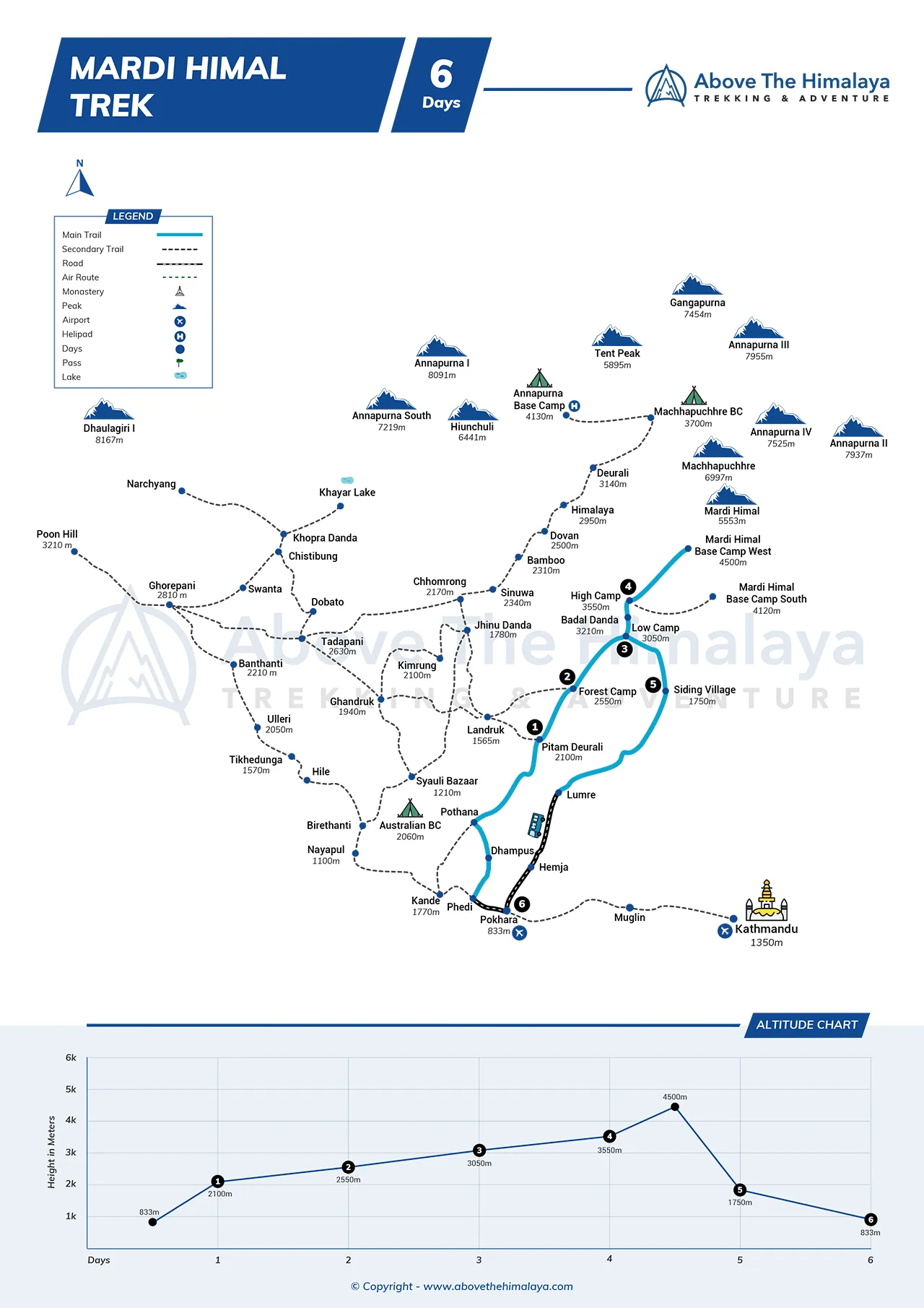
Route Map & Altitude Chart
Most Asked Questions by Travellers
 General
The Mardi Himal Trek is located in the Annapurna region of Nepal, just east of the popular Annapurna Base Camp trail. It begins near Pokhara and climbs up a beautiful ridge to the base camp of Mardi Himal.
The standard Mardi Himal Trek usually takes 5 to 7 days depending on the chosen itinerary and pace. The Short Mardi Himal trek can be completed comfortably in 6 days starting and ending in Pokhara.
Yes, the Mardi Himal Trek is suitable for beginners who have a basic level of fitness and enjoy walking. It does not expect any previous high-altitude trekking or technical climbing experience.
It is not as crowded as the Annapurna Base Camp or the Everest Base Camp and particularly during off-peak months. But in spring and fall, there are other people on trek along the ridge sections.
The ascent provides scenic shots of Machhapuchhre and Annapurna south via a scenic ridgeline. It is unusual in its quiet access roads and spectacular sunrise scenery over the tree lines.
Yes, children and older trekkers with good health can complete the Mardi Himal Trek at a steady pace. The appropriate amount of rest days and the comfortable walking pace make it easy to most age groups.
The past trekking experience is not compulsory and useful in this path. Nature is generally favorable and the necessary stamina is reasonable enough to successfully complete the trek.
It will be thick rhododendron forests, narrow ridges, alpine meadows and mountain views. The changing terrain keeps the Mardi Himal Trek visually interesting throughout the journey.
 Preparation & Fitness
You have to be able to comfortably walk a number of hours daily on hills and downhill paths. Pre-trek cardio training will also help in enhancing stamina and respiration.
Stamina can be enhanced by light hiking, jogging, cycling, or climbing a few steps a few weeks prior to the trip. Building the strength of legs and increasing the balance will make the trail more comfortable.
Yes, strengthening exercises of legs and core strength in the gym can help to be more stable in irregular trails. Strong training with light cardio provides balanced training.
Specific altitude training is not necessary for the Mardi Himal Trek. Slow ascending and gradual steps in the trail are normally enough to get used to.
The answer is yes, first-time trekkers would be able to complete the trek with good preparation and instructions. An itinerary is chosen to avoid any unnecessary fatigue.
The state of mind is equally the most significant as the physical condition since the weather and the condition of the trail may vary in the mountains. Being adaptable and tolerant is a way of enjoying the experience.
Training with a light pack to get used to carrying personal items can be done by lifting items as high as you can. The posture and shoulders are also ready to walk over many days.
A slow and steady pace is recommended throughout the Mardi Himal Trek. Strolling at a relaxed pace and not in a hurry will help to save energy and have better experience on the whole.
 Permits
No, the Annapurna Conservation Area Permit (ACAP) is a compulsory document that all trekkers would need to visit the Mardi Himal. At the trail there will be designated checkpoints where your permit will be checked.
The permits may be issued at Kathmandu or Pokhara at either the tourism office or registered trekking agency. In a lot of cases, trekkers would find it convenient to get them organized by their trekking company.
The duration of your trekking itinerary in the Annapurna Conservation Area normally determines the duration of the permits. They should also be carried along until you leave the area.
Yes, the permit fees vary with nationality. The citizens of SAARC tend to pay less fee than other international travelers.
No, you must obtain the necessary permits and enter into the conservation area. In the checkpoints, the authorities are able to deny entry without a valid document.
Yep, the children do tend to require permission in case they are hiking around the Annapurna region. However, there may be specific legislations that may vary based on age and nationality.
TIMS requirements can be varied with the existing government regulations. TIMS is unnecessary in most instances when you are trekking along with a registered guide though again checking the latest regulations with an authorized trekking agency prior to trekking will be prudent.
You will normally have to carry a copy of passport and passport sized photographs. The paperwork can be assisted in an efficient manner through the help of a registered agency.
 Insurance and Visa
Mountain trekking in Nepal requires the use of travel insurance which is very vital. It gives the monetary cover against unplanned medical cases or emergency cases.
High altitude trekking activities should be covered in your insurance policy. It must also contain emergency evacuation services.
Traveling to Nepal it is preferable to book travel insurance in advance. Numerous international policies might not permit coverage initiated once the trip has been undertaken.
Yes, a Nepal tourist visa is necessary to the country by the majority of foreigners. Upon arrival at the airport, the visa is normally issued.
Depending on the application, tourist visas are usually issued in 15, 30 or 90 days. You are free to select the period that is in line with your traveling schedule.
Yes, they can get extensions of tourist visa in the immigration office in Kathmandu or Pokhara. Expansion will involve additional fees and authentic travelling documents.
Even for shorter routes like the Mardi Himal Trek, insurance coverage is strongly advisable. The conditions in mountains are unpredictable with moderate challenges.
Medical and rescue costs will also be self funded without the insurance. Without a cover, emergency services in the mountain areas may be extremely expensive.
 Guides & Support Staff
The Mardi Himal Trek is located in the Annapurna region of Nepal, just east of the popular Annapurna Base Camp trail. It starts around Pokhara and ascends on a beautiful ridge to the base camp of Mardi Himal.
The standard Mardi Himal Trek usually takes 5 to 7 days depending on the chosen itinerary and pace. The Short Mardi Himal trek can be completed comfortably in 6 days starting and ending in Pokhara.
There is normally a sharing of one porter between two trekkers to ferry more luggage. It enables you to carry a light daypack without any problem.
Yes trekking guides will be trained in first aid and elementary high altitude response. Their experience assists in handling minor problems before they escalate.
Most licensed guides in the Mardi Himal Trek speak functional to good English. The communication is generally cheap and easy to the international trekkers.
Tipping is a popular activity in Nepal and is thought to be a sign of respect. Although not obligatory, it is a decent gesture of acknowledging their effort and encouragement.
Yes, it is possible to have a private guide, whether they are individuals, couples, or families. This gives it some flexibility in pace and schedule whilst on the trek.
Yes, there are female trekking guides on request, which are registered by agencies. Most of the trekkers are glad to see that there is a choice according to comfort and preference.
 Accommodation and Facilities
The Mardi Himal Trek is based on tea house accommodation along the route. Lodges are plain but friendly with basic rooms and common facilities.
Depending on the time of the year and availability, private rooms might be possible in the lower parts. Shared rooms are more widespread at higher camps because there is not as much room.
There are tea houses that provide hot showers at a fee. Availability can run down in the direction of higher altitudes.
The majority of lodges have either electricity or solar lighting. It is a minor additional expense to charge electronic devices.
Attached bathrooms are uncommon in higher sections of the Mardi Himal Trek. Trekkers share most of the facilities.
Lodges will be occupied very fast during peak seasons, particularly around High Camp. Early booking will ensure one gets a better room and is not inconvenienced.
Yes, tea houses tend to have a blanket in every room. Nevertheless, it is advisable to bring a sleeping bag to add more warmth and cleanliness.
There is a lack of heating in the rooms, particularly in the higher elevations. A central heater can be installed in the dining area in colder seasons.
 Food and Drinks
Nepali, Indian and plain western dishes are served as a combination in tea houses. The menu is simpler as you ascend to higher heights.
Yes, vegetarian is quite common everywhere on the road in all tea houses. The reason is that many trekkers take vegetarian foods because they are easy to digest at high altitudes.
Sometimes fresh fruits can be found in the lower villages, but are scarce in higher camps. Availability is subject to season and transport of supply.
The consumption of water is available at tea houses along the way. A large number of trekkers use water purifying tablets or filters to protect the environment.
Most lodges have basic snacks such as biscuits, chocolate bars and instant noodles. Transportation costs make prices higher as you go up.
Yes, it is better to bring personal energy bars or dry snacks in Pokhara. It also offers additional convenience and costs less on altitudes.
In most of the tea houses, alcoholic beverages are sold. Nonetheless, alcohol intake is usually discouraged at higher elevations.
Certain tea houses are also able to modify meals to simple diets when given prior notice. It is also beneficial to discuss special needs with your guide prior to the trip.
 Weather & Seasons
The most popular seasons include spring and autumn: the weather is stable and the mountains can be clearly seen. These months are also even comfortable to walk around.
During the winter nights at the higher altitudes, the temperatures may fall below freezing. Its layering is critical in order to be comfortable and warm.
The path may be of moderate traffic in the spring and autumn. It is however, not usually crowded as compared to other Annapurna routes.
Yes trekking can also be done in monsoon but there might be restricted mountain views due to rain and cloudy sky. Forest areas may also turn slippery.
The snowfall is typical of winter and sometimes in early spring. Snow has the potential of making ridges parts more picturesque yet a touch harder.
They are usually visible in autumn when the sky has cleared after a monsoon. During winter, there are also mountainous views, in a clear day.
Wind speeds may increase in the vicinity of the High Camp and Base Camp. Early mornings are usually calmer and provide more stable walking conditions.
Yes, there might be unexpected weather, and it might be necessary to make minor changes to walking plans. Attitude flexibility will also make the experience safe and enjoyable.
 Health & Safety
Yes, the trail is said to be safe with fair preparation and reasonable fitness. An additional safety measure will be selecting a trusted guide or trekking agency.
No advanced medical centers are found along the higher parts of the trek. The guides and some lodges provide the basic first aid support.
You must notify your guide as soon as you experience any discomfort or unusual symptoms. Minor issues can be avoided and sometimes they are prevented by early attention and rest.
Landslides are not very common but they may happen in case of heavy rains in the monsoon season. When trekking in stable seasons, such risks are minimized.
Consumption of untreated water due to natural sources is not advisable. Better health protection is guaranteed by utilizing purification techniques.
Sightseeing of wildlife is infrequent and not very dangerous. The majority of animals do not get in the way of humans and are not dangerous.
Proper shoes and a consistent walking rate help avoid falls and injuries to muscles. Fatigue is also minimized by regular stretching and hydration.
Yes, there are emergency rescue services when there is a serious situation. Effective travel insurance can be used to control the costs.
 Packing & Gear
When you have a porter, you should keep your daypack very light and just have to carry what you really need. Managing weight is better on uphill climbs.
Even though tea houses offer blankets, a sleeping bag offers additional warmth and cleanliness. It is particularly handy during colder times.
Heavy and comfortable trekking shoes with good grip is highly suggested. Well-broken in footwear can avoid blisters.
The trekking poles are useful in maintaining balance during steep uphill and downhill climbing. They also alleviate the pressure on the knees when going downhill.
Yes, at more elevated camps the temperature may fall way down. It is necessary to have a warm insulated jacket during mornings and evenings.
It is recommended that they wear a lightweight waterproof jacket and a backpack cover. The weather in the mountains is changeable.
Sunscreen, lip balm, sunglasses, and a reusable water bottle are some of the items that may be overlooked. These are minor simple things that enhance comfort in the trek.
Yes, there are numerous stores in Pokhara where rental equipment can be found at reasonable prices. An alternative to carrying along heavy equipment is renting.
 Booking & Payment
During peak seasons, it is always best to book at least a few weeks before. It assists in making early reservations to have a place and a guide.
A deposit is normally necessary in most trekking companies in order to confirm your booking. The remaining portion is normally paid prior to the trek.
Yes, you can do last-minute bookings, particularly during the off-season. But it might not be that available in the high season.
The rates of group bookings are usually better since the cost like guide services and transportation is shared. Bigger groups can have more relaxed prices.
The payment at most of the agencies is in major currencies and bank transfers occasionally. Card payments can be offered but can add service fees.
The policies of cancellation differ depending on the company and the season. Using the terms of the refund, it is necessary to revise them before finalizing your booking.
Yes, there are lots of companies which provide flexible itineraries to suit your schedule and preferences. The customization can have an impact on the total cost based on the requested services.
You need to know well what is covered and what is not in your package. Personal expenses and optional services are normally paid separately.
 Transportation & Flight
Pokhara is accessible by having a tourist bus, private vehicle, or a domestic flight between Kathmandu and Pokhara. Its trip is picturesque, with hills and rivers on the path.
Airport transfers can be done at request through many of the trekking companies. The best thing to ensure this service is confirmed at booking.
The Pokhara to Phedi or trailhead distance is not very long. This makes the Mardi Himal Trek one of the most accessible treks in Nepal.
In dry seasons, the condition of the roads is mostly stable. Monsoon rain can sometimes be a problem on the rural roads.
There is no need to do any domestic flights as the trek starts off near Pokhara. This makes logistics easy as opposed to distanced Himalayan paths.
Yep, it is possible to arrange personal cars to be even more comfortable and flexible. This is the best choice when there are a few people or families.
There might be occasional delays because of traffic and weather conditions. The trekking companies tend to help change plans when they are required.
A lot of packages entail transportation between Pokhara and the trailhead. Always it is better to verify the specifics.
Reviews on Mardi Himal Trek





Donna Kirkpatrick & David Ridley
Edmonton, Canada
Mardi Himal Trek and Chitwan Jungle Safari Tour

Nothing was ever too much to ask for. When we needed one, our driver became like a friend for two weeks—a friendly face in a sea of humanity. Our Mardi Himal trek was incredible due to Phurba’s efforts.
He looked after us like family, and we never had to worry about anything. His choice of teahouses for us was exceptional upon completing our adventure to Nepal.
I can find nothing that I would have changed in my choices offered by Puru. A three-night stay in Chitwan National Park was relaxing. It was the finale of our lifetime trip—hats off to Puru and his team.
Donna Kirkpatrick & David Ridley
one quantum leap
California, USA
Professional & Affordable Trekking”
What we enjoyed about working with Puru was his excellent Mardi Himal Trek. The timely responses to our questions and the ease in booking our trip. When we arrived, all the necessary details from beginning to end.
Our guide, Basu, was always concerned about our happiness. He is always worried about our safety. Our porter, Murari, worked to get our belongings from one teahouse to the next. Both guys always smiled and ensured the Mardi Himal trek went off without a hitch.
They will pick us up from the Airport and take us to our hotel. They handle all our permits. Our guide took care of food, lodging, and transportation. All we had to do was enjoy our trek, the wonderful people of Nepal, and the sights to discover.
Please do not hesitate to contact Puru to establish a program that works for you. He guided us on the best trek and made the necessary recommendations based on our wishes. We went there to celebrate my 60th birthday and the goal of trekking the Himalayas.
We would encourage you to spend your dollars with the company. They are appreciative of your business. We felt so good knowing that our dollars were going into our things. For all those we came in contact with and not for unnecessary expenses.
I’m happy to answer any other questions and hope this review is helpful.
Nepal is a beautiful country
Trekking is a unique experience
The Nepalese are warm and welcoming
Puru and his team make it all so easy
Just go for it!!!
One quantum leap
Peter
USA
Best Mardi Himal Trek
Our family enjoyed the Mardi Himal trek. We had the best mountain views during the tour. We received great hospitality, amiable guides, and porters. The organization was the best. I highly recommend this trek.
Peter
USA
Above the Himalaya and the people behind it
The only way to experience and enjoy the beautiful country of Nepal is with Puru. The service, the kindness, and the most professional crew make the trip the best. They will guarantee you the experience of a lifetime on your Mardi Himal trek!
Dandan
Kfar Saba, Israel
Piotr Jedrzejczak, Dobroslawa Wcislo, Daniel Wcislo, Jerzy Baehr, Jan Make-Maczynski, Slawomir Melle
Warsaw, Poland
Mardi Himal Trek in March.
We are a group of eight friends traveling together for five years. We trekked in the Alps, Carpathians, Pamirs, and Caucasus mountains.
This Mardi Himal trek was among the best of our tour of the organization, with amiable staff and good food.
We recommend Puru and his agency to travelers visiting the Nepali Himalayas.
Piotr Jedrzejczak, Dobroslawa Wcislo, Daniel Wcislo, Jerzy Baehr, Jan Make-Maczynski, Slawomir Melle.
Poland
10% OFF
Book with Confidence
- Flexible bookings and easy trip date changes
- Personalized service and customized group sizes
- Safe travels with owner-operated services and highly experienced guides
- Best price guarantee for the most value for your money
- Secure & easy online booking
Your Trek Leader
 Enjoy Himalayan scenery with the help of Nepal’s best guides with Government license holders and got training in first-aid, our Trip Leaders, know where you’ll find the best photos, most fascinating wildlife, and the best stream crossings.
US$ 760 Per Person
Have Questions?Talk to Expert
Meet Mr. Purushotam Timalsena (Puru), Nepal's best trek and tour organizer, who has been working in the Himalayas for more than 24 years.
WhatsApp/Viber +977 98510 95 800



You May Like


Trips for All
Private Trip
Peaceful tour with your travel buddy and guide
Small Group Travel
Travel with people having similar adventure dreams
Trips for Kids
Calling all young adventurers - join us for a journey of a lifetime!
Trips for Adventurers
Climbing & mountaineering adventures for thrill-seekers