Customize Your Trip

Need Help? Let's Talk
+977 985-1095800


15% OFF
Highlights of Honey Hunting in Nepal tour
- Enjoy the scenic drive to Khudi via the countryside road.
- Nepal is rich in honeybee diversity: there are five types of bee species in Nepal
- Enjoy the homestay experience with the local Gurung community.
- Capture the best picture in your camera collecting honey from Himalayan cliffs.
- Honey hunting in Nepal is an age-old tradition following till now.
- Red honey is also known as “mad honey” because it contains a toxin called grayanotoxin.
Testimonials - Guests Sharing Their Incredible Experiences
Trip Extension
Suppose you have more time in Nepal after this trip. In that case, we can help you to extend your trip by running different treks in Nepal, tours in Bhutan and Tibet, Jungle safari tours at Chitwan, Bardia, and other National parks, Nepal luxury hotel booking, Rafting, Ultra-light flights, or any other travel-related services. You can get more information here.
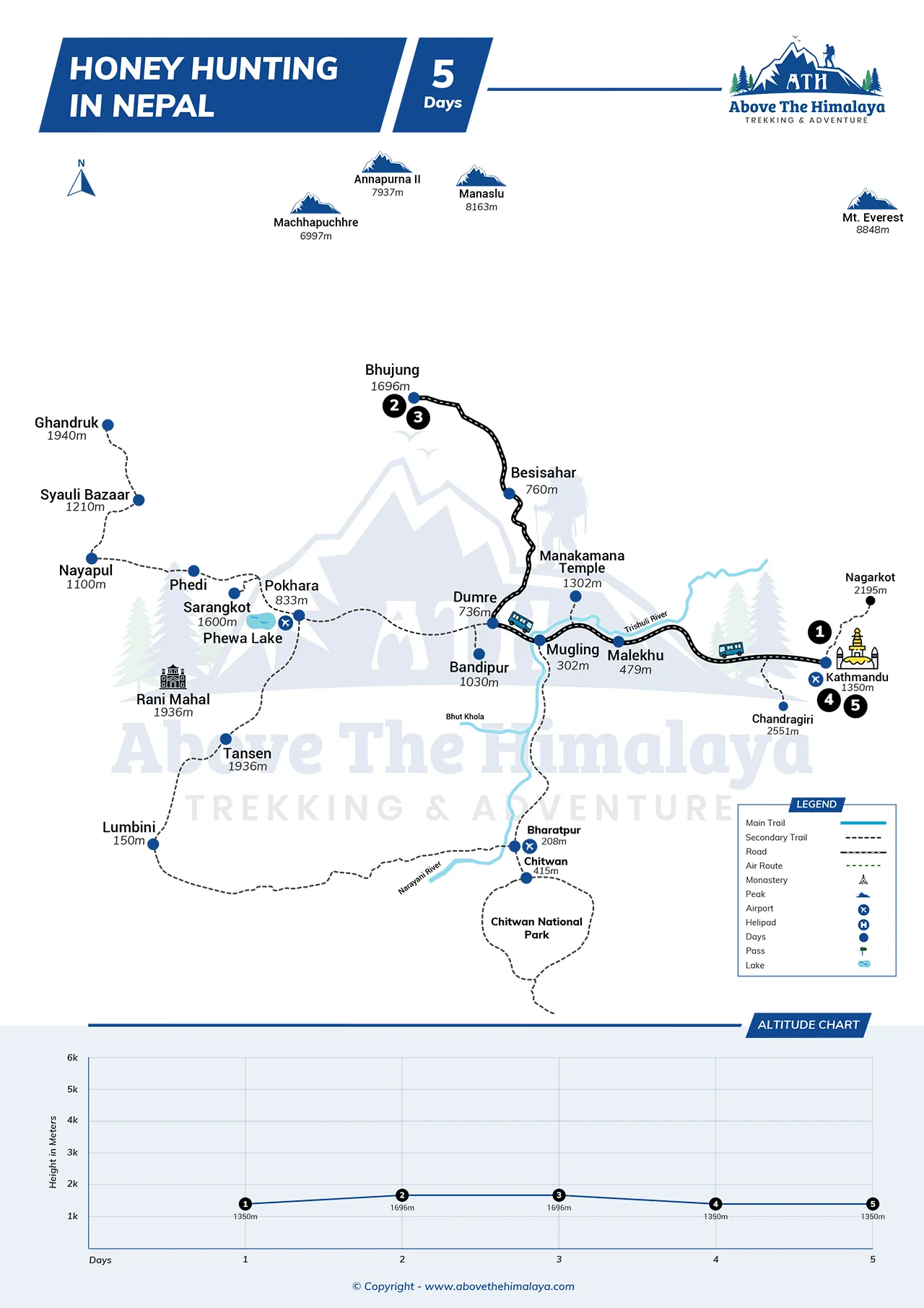
Route Map & Altitude Chart
Most Asked Questions by Travellers
 General
This is an experience where the living cultural tradition is observed instead of getting to a mountain destination. The Nepal honey hunting tour blends village life, seasonal ritual, and nature into one meaningful journey.
Yes, it is open to families when children feel comfortable in rural environments and can follow safety guidelines. It is rather an observational, learning program, rather than a physical adventure program.
The cultural contact mostly occurs at the overnight stay in the village of Bhujung. This provides sufficient time to learn about the local life outside of the harvesting event.
Yes, many tourists are also using it together with either trekking in the Annapurna area or cultural sightseeing in Kathmandu. The schedule can be modified depending on the days that are available.
No, Honey Hunting in Nepal operates only during specific seasonal harvest periods. The dates are restricted and according to the natural cycle of honey collection.
Yes, it is possible to meet Gurung families in the village which gives an opportunity to communicate in a friendly manner. Your guide will be able to assist in language translation and cultural practices explanation.
The group size is also limited in order to ensure comfort and respect towards the village environment. Smaller groups also mean that there are more space to see during the harvesting event.
A portion of the harvested honey is sold locally and some could also be sold in small portions. The harvesting is not done on commercial large scale production but on a community basis.
 Preparation & Fitness
No prior trekking experience is required for this Nepal honey hunting tour. The minimum of mobility and ability to walk short distances.
The walking is reduced to several hours in the village walks and in the neighborhood. It is slow and can accommodate the majority of travelers.
Tourists do not need to hike up steep landscapes and cliffs. It is all the local honey hunters who do all the technical harvesting work.
It is beneficial to engage in light exercise in the form of walking or climbing the stairs a few weeks before traveling. This will make you feel relaxed when walking in the countryside or when spending hours on the road.
The elevation is not high and does not need any special acclimatization. Majority of travellers adopt changes with ease.
Yes, the general healthy travelers in old age can comfortably join in. The program gives a walking pace flexibility.
Individuals are also accommodated and tend to experience small group departures. It is easy to find contact with other people in the community environment.
You are free to take your own time and have breaks when required. The program is flexible and not pressurizing.
 Permits
Yes, some local authorizations are necessary in order to organize the observation of the harvesting as legal. These permits are usually arranged in advance as part of the Nepal honey hunting tour package.
Yes, the local village committee and honey hunters are subsidized out of part of the permit cost. This will keep the tradition alive and it is directly helpful to the community.
No, you do not have to go and get permit procedures yourself. The tour operator will handle all the necessary paperwork before your arrival in the village.
Regional conservation fees can be used depending on the particular area. These are usually added to the total package price.
Local governments or village committees can confirm permits prior to the event of harvesting. A formalities is managed effortlessly on your behalf by your guide.
Individual photography does not necessarily need a special license. Commercial shooting will however require the permission of the local authorities.
Harvesting is seasonal and natural and permits are needed to access the event. The last time always depends on the decision of honey hunters.
In case of unfavorable weather conditions, then the community can change the schedule. When it becomes necessary, the alternative arrangements will be coordinated by your guide.
 Insurance and Visa
The travel insurance is not compulsory but highly encouraged. It offers coverage of sudden health or travel complications.
Insurance that includes medical costs, trip delays, and emergency transportation is recommended. Rural travel activities coverage is another peace of mind.
There is also no need of high-altitude coverage since the tour will be moderate in terms of elevation. Universal travel insurance is mostly adequate.
Yes, majority of the travelers will be able to get tourist visa when they arrive at Tribhuvan International Airport. Ensure that your passport is valid at least six months.
Make sure your visa duration covers your full stay in Nepal. In case you want to stay longer, have a longer visa period.
Always keep a copy of your passport, visa and insurance with you. It is also useful to keep digital copies that are secure.
This is not obligatory but is recommended because of the rural surrounding. It might take transport time to access immediate medical facilities in the city.
Yes, every traveler even children must be covered. This will guarantee adequate backup in the event of any contingency.
 Guides & Support Staff
It is accompanied by a reputable local guide who has knowledge of the Annapurna area and culture in the village. Gurung honey hunters handle the technical work during the time of the harvesting event.
Yes, the primary tour guide speaks English to help foreign tourists. They get to assist in translating talks with local villagers as well.
Honey hunters are experienced members of society and have been doing it over generations. Their experience is gained through years of experience, as opposed to being a result of commercial climbing training.
Yes, the harvesting team collaborates with strict roles and coordination. Your guide is with the group to explain and help.
Yes, any questions are welcome at the right time. Your guide will tell you the tricks and the cultural significance without annoying the working team.
Yes, female travelers regularly join the Nepal honey hunting tour. The village atmosphere is friendly and courteous.
The homestay is also owned by a local family that warmly receives guests. They facilitate in making your stay to be comfortable and also culturally enriching.
Yes, the guides assist in working with the Gurung community in a respectful way. They make the communication process to be cultural and smooth.
 Accommodation and Facilities
Simple and comfortable rooms are available, normally in a twin sharing arrangement. It is more about cleanliness and local hospitality as opposed to luxury.
Depending on availability, there might be the possibility of having private rooms. This should be requested when making a reservation.
There can be some houses with western toilets and other ones with traditional ones. Your guide will be able to give you information on the particular setup ahead of time.
The village usually has electricity although at some point there is a limitation in supply. It is also always a good idea to bring a power bank.
Yes, it is normally possible to charge in the homestay. The availability can be reduced based on the conditions in local power supply.
There could be slow speed or lack of Wi-Fi access because of rural connections. This period is often spent by many travelers disconnecting and relaxing in the environment.
Yes, simple bedding and blankets are offered so you could be comfortable. In colder seasons, it is convenient to come with an additional layer.
Yes, Gurung communities are known for their warm hospitality toward visitors. The surrounding is friendly and conducive to a leisurely stay.
 Food and Drinks
Food is guided by classic Nepali home-style cooking methods done by the host family. The menu is normally determined by what is in season in the village.
Yes, the preferences in the dietary can be easily controlled beforehand. Give notice to the team to avoid late arrangements.
There are small local stores that can sell bottled water in small amounts. The use of a purification option and reusable bottle is suggested.
Yes, you can be offered such traditional drinks cooked by the host family. In case you do not want to consume some drinks, you can say no.
Yes, tea is usually taken in the morning and evening. Coffee can be also served based on the home stock.
Simple snacks can be sold in local convenience stores. It is a good idea to bring few personal snacks which are available in Kathmandu.
The meals are prepared in home kitchens and are made using the local ingredients. In case of a sensitive stomach, it is better to eat simple cooked food.
Availability is dependent on the season and regulation in the community. It should be done with due respect and in small quantities.
 Weather & Seasons
Both spring and fall harvesting seasons are usually mild in terms of weather. Days are pleasant, whereas mornings and evenings may be colder.
The main harvesting windows have fewer rainfalls though it might still occur now and then. Light rain protection should be carried.
Yes, the weather conditions do determine the time when the harvest takes place. Adjustments may be short in case of strong wind or heavy rain.
During the day, the weather is normally favorable to outdoor activities. Climate is favourable to easy walking and watching.
Evenings may be cool, in the out of the core of summer. The warm layers are useful in the evening after the sunset.
In spring and autumn, there is usually good visibility of the hills around. The mountain scenery relies on the weather in the area.
In hilly areas morning mist is possible. It tends to clear up as the day goes by.
Both spring and autumn are favourable since they coincide with the natural harvesting seasons. It is available by the schedule of the local community.
 Health & Safety
There are basic health posts in accessible proximity of the village. To get a high-quality medical treatment, one might have to transfer to a bigger city.
Contact your guide and ask him to assist as soon as possible. Early communication will avoid the development of minor problems into serious problems.
Before travelling people with known allergies need to visit a doctor. It is highly recommended to carry personal medication including antihistamines or prescribed emergency treatment.
Since the tour will be conducted in a rural and forested area, small insects are natural. Long sleeves when outdoor can be used to limit exposure.
To avoid stomach discomfort, untreated water must be avoided. The water should always be boiled or purified.
Yes, children are able to see when under strict supervision by adults. They have to be calm and listen to whatever the guide tells them.
The local community is friendly and accustomed to visitors during the harvest season. Simple personal awareness will always be advisable when going anywhere.
General check-up is useful in case of underlying medical conditions. Carrying normal medications is a guarantee of comfort during the journey.
 Packing & Gear
Well gripped comfortable walking shoes are best suited in village paths. There is no need of heavy mountaineering boots.
Yes, it is essential to wear layers because mornings and evenings may be cool. Typically a light jacket or fleece is enough.
The sleeping bag is not a necessity, though it may be a bonus in colder seasons to provide more comfort. Basic bedding is usually offered at homestays.
Sleeves and trousers are long and prevent contact with insects. Do not use bright colors that the bees will be attracted to.
Trekking poles are optional and handy in the event you need additional balance in rough trails. Most travelers do not need them.
Yes, you can wear a hat, sunscreen and sunglasses when you are outdoors. Strong sunlight can be experienced in the hill regions even during the cooler weather.
An average sized backpack that is waterproof is appropriate. Carry the pack easily when walking in the village.
Yes, it is possible to carry small amounts of local currency. ATM may be unavailable in the countryside.
 Booking & Payment
It is advisable to make a reservation at least a couple of months ahead since harvesting periods are short. Early reservations can assist you in getting your desired date of departure.
Yes, a deposit is normally required to reserve your seat on the Nepal honey hunting tour. The balance that remains is normally paid out early or on arrival.
The majority of operators accept major online payment systems and bank transfer. In Kathmandu, cash payment can also be done on an agreement basis.
The departure is based on minimum group size and seasonal harvesting confirmation. The operator will make you aware in advance in case of an adjustment.
It might be possible to reschedule according to the availability within the harvest window. Communication of changes should be done in as little time as possible.
The cancellation policies are subject to various terms of booking. One should always revisit the terms and conditions before confirming the reservation.
Yes, greater numbers can get special price agreements. The price per individual can decrease with the increase in the number of people in the group.
Yes, it can be customized according to time and logistics. More sightseeing or hiking days may be usually added.
 Transportation & Flight
This experience does not need any domestic flight. The village area is accessed by road through Kathmandu.
The drive will require a few hours depending on the traffic and road conditions. The trip is made pleasant with scenic countryside views.
The tour package normally includes airport pick-up and drop-off. On arrival, you will be received by your guide or representative.
Comfort and convenience are usually carried out by using private cars. In some parts, the road conditions might be rough and a jeep can be applied.
Yes, you can book your own transportation. The timing is made smoother though by coordinated group transport.
The path is along the well-travelled highways and country roads. Experienced drivers in hill traveling are cautious of the ride.
No, there will be regular meal, refreshment and short-break stops. This facilitates the long travel hours.
The program typically ends with an airport transfer after breakfast according to your flight schedule. When you extend your stay, timing is manageable.
Reviews on Honey Hunting in Nepal





Kiara Clarkson
USA
Mad Honey

Mad honey is a particular version of honey. Bees extract it from the rhododendron flower. Rhododendron flower has Grayanotoxin. So, mad honey has hallucinogenic properties. You can get Himalayan Red Honey or Mad Honey in the Himalayan Region of Nepal.
You can find Himalayan Red Honey in the Besisahar in the Lamjung District of Nepal. There, you can get Mad Honey in its purest and raw form. However, you can find processed and packed versions of the same honey in various shops in Kathmandu and Pokhara.
Amanda
USA
Thank you for the great tour and tasty Mad honey
I did the honey hunting tour in May and had a chance to get back to my home. This mad honey taste is excellent. Every day, I eat 1 to 2 spoons, and it gives me great energy and makes me active. Thank you for the great tour and lovely Raw honey. I highly recommend it.
Amanda
henry
USA
Honey hunting is a fascinating experience to behold. The marvel of nature at its best.
klrachel
Kuala Lumpur, Malaysia
Honey Hunting Trip
It was an incredible experience; we wanted to see the honey hunters for a long and find a dream that came true. We made this trip with great help from the Above the Himalaya trekking team. Mr. Puru is so prompt in giving small details.
The local guide, Khem, was so helpful and took care of every small thing for us and gifted us wild be honey. We had the best new experience in life.
Thank you for organizing such a great trip.
klrachel
Nellie F
USA
Amazing Tour Of Nepal
I was traveling with two friends. We did a honey-hunting tour in Nepal (Bhugung Taku bhir Lamjung). It was a wonderful experience, especially with the help of our guide and porters. The trail was quite slippery. Puru, the Owner, provided us with the best guides and porters. They were familiar with us and cared for every small thing.
We have traveled by jeep between Lamjung Khudi. The Above the Himalaya team had our best interests in mind during the entire trek and tour. They kept us informed of every detail. They were flexible to our requests. They ensured that all guest houses took care of us.
They taught us about Nepali culture and language. Consider booking with Above the Himalayas!
Thank you, Above the Himalaya and team, for making our trip memorable.
Nellie F
15% OFF
Book with Confidence
- Flexible bookings and easy trip date changes
- Personalized service and customized group sizes
- Safe travels with owner-operated services and highly experienced guides
- Best price guarantee for the most value for your money
- Secure & easy online booking
Your Trek Leader
 Enjoy Himalayan scenery with the help of Nepal’s best guides with Government license holders and got training in first-aid, our Trip Leaders, know where you’ll find the best photos, most fascinating wildlife, and the best stream crossings.
US$ 1550 Per Person
Have Questions?Talk to Expert
Meet Mr. Purushotam Timalsena (Puru), Nepal's best trek and tour organizer, who has been working in the Himalayas for more than 24 years.
WhatsApp/Viber +977 98510 95 800



You May Like


Trips for All
Private Trip
Peaceful tour with your travel buddy and guide
Small Group Travel
Travel with people having similar adventure dreams
Trips for Kids
Calling all young adventurers - join us for a journey of a lifetime!
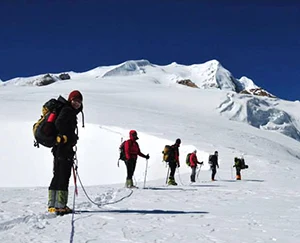
Trips for Adventurers
Climbing & mountaineering adventures for thrill-seekers