Customize Your Trip

Need Help? Let's Talk
+977 985-1095800


10% OFF
Highlights of Pikey Peak Trek
- Spectacular sunrise and panoramic Himalayan views from the summit of Pikey Peak
- Gentle 8-day trek suitable for beginners, families, and seniors
- Genuine Sherpa villages and old Buddhist monasteries along the way
- Escape the crowds on the Pikey Peak trek route; an off-the-beaten-path alternative to Everest Base Camp
- Scenic road journey through rolling hills to the trek start (Dhap)
- Lush rhododendron forests and varied mountain landscapes
- Cultural immersion with friendly Himalayan locals & cozy teahouses
Trip Extension
Suppose you have more time in Nepal after this trip. In that case, we can help you to extend your trip by running different treks in Nepal, tours in Bhutan and Tibet, Jungle safari tours at Chitwan, Bardia, and other National parks, Nepal luxury hotel booking, Rafting, Ultra-light flights, or any other travel-related services. You can get more information here.
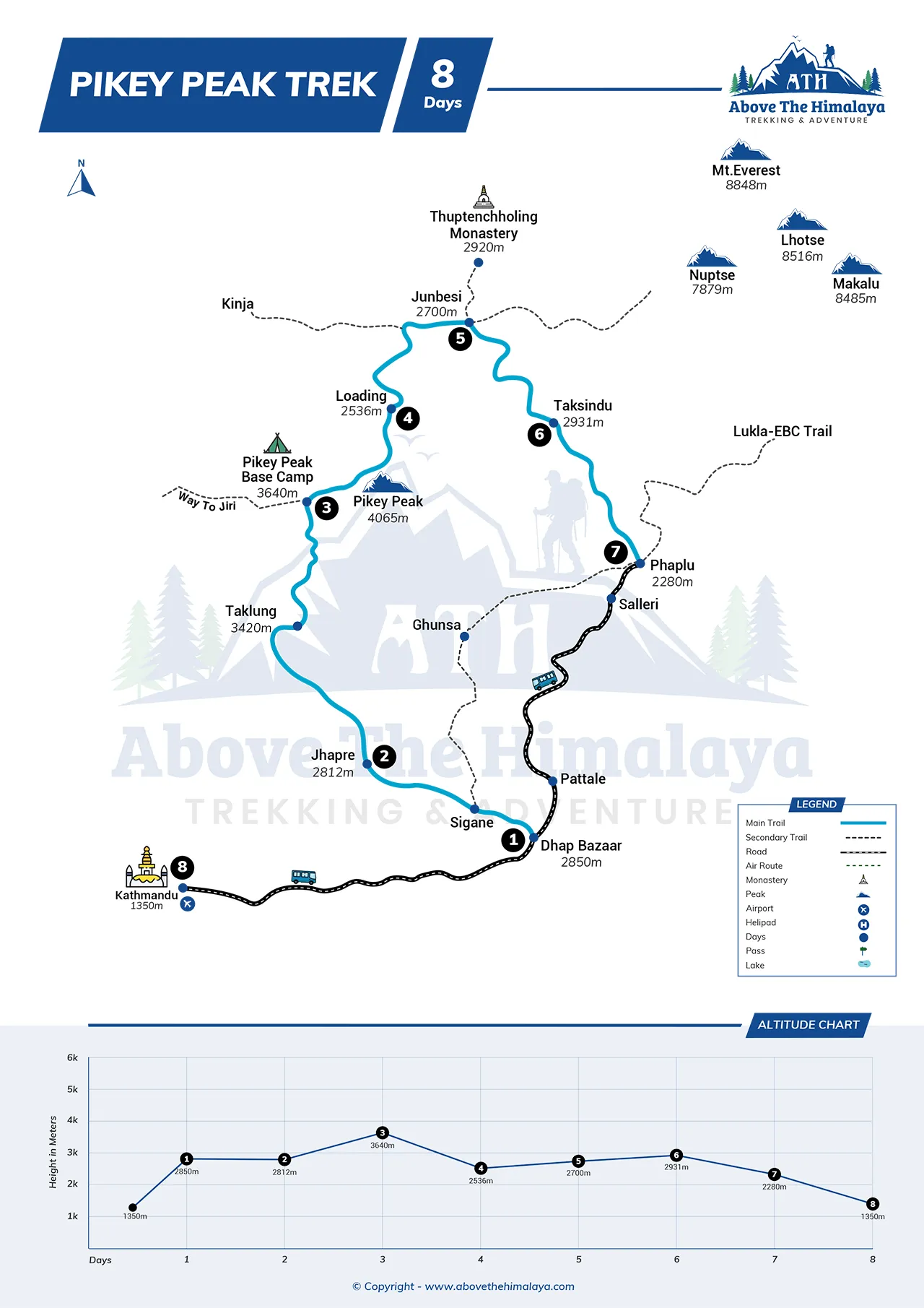
Route Map & Altitude Chart
Most Asked Questions by Travellers
 General
Pikey Peak trek is an 8 day trek in Solu-Khumbu region with the view of Everest and Sherpa culture. It is suitable for moderate level hiker and gives a memorable Himalayan experience.
It lies in the eastern region of Nepal (lower Solu-Khumbu region) west of the Everest Base Camp area. The trek goes through beautiful villages and scenic trails en route.
The Pikey Peak trek itinerary starts at Dhap and ascends through Namkheli to the summit of Pikey Peak and down through Golla and Bhandar to Kathmandu. The days involve moderate walking with cultural and scenic highlights.
The route would be from Dhap to the top and down through Golla to Bhandar. Trekkers enjoy a mixture of forests, traditional villages, and mountain views.
The summit of the Pikey Peak is about 4,065 meters (13,342 feet). Proper acclimatization on the trail helps to avoid altitude-related discomfort.
The total distance of Pikey peak trek is about 94 km (58 miles) in 8 days. The walking hours are manageable for beginners that are moderately fit.
You can take panoramic views of Everest, Kanchenjunga, Lhotse, Makalu and other Himalayan peaks. Sunrise and clear days are some of the breathtaking scenery.
No previous high-altitude trekking experience is required, but basic fitness and preparation are necessary to enjoy the trek safely.
Guides are optional, but they might help with permits, navigation and local expertise. The presence of a guide will help to make the experience smoother and safer.
The trail generally begins from Dhap which is covered by jeep or bus from Kathmandu. This is a convenient starting point for the trek.
The trail is much less crowded than the route to the Everest Base Camp. Trekkers always appreciate quiet stretches along the way.
Spring (March – May) and Autumn (September – November) are suitable for stable weather and clear skies. These are the periods with the best views and trekking conditions.
Nepalese Rupees (NPR) are used for payments on the way of the trek. ATMs can be used in Kathmandu and a few towns, but cash is recommended for remote areas.
Yes, flying to Phaplu can save time when traveling on the road. This option makes the trek more convenient for those who only have limited time.
Healthy children at age 10 and older can join. The moderate pace and shorter days of walking make it appropriate for families.
 Preparation & Fitness
This trek needs moderate fitness, consisting of 4-6 hours per day of walking. Cardio exercises such as cardio training, hiking, and walking before the hike will be beneficial in preparing your body.
Yes, it helps to practice hiking on the hills and doing cardio, such as running or cycling. Strength training to legs and core is also recommended for uphill and downhill walks.
Yes, with a constant pace and breaks, seniors and children can get by quite comfortably. The longest day is on hiking and is around 6 hours.
Daily walking is typically 4 – 6 hours with rest and tea breaks. Some days might be shortened during acclimatization periods.
No complicated climbing gear is required. Good hiking boots, multiple layers, a warm jacket, rain gear, sun protection, and a daypack are adequate.
The nights are also chilly, approximately 0 °C in summer. Carry warm clothes and a sleeping bag liner.
Kathmandu is low altitude (around 1,350m), so no acclimatisation is required in the city. Proper acclimatization occurs gradually on the trek.
The ascent is gradual, gaining about 300-500 meters per day. The trek is manageable and not technically difficult, though occasional uphill sections exist.
Move slowly, drink plenty of fluids, eat well, and contemplate medication if necessary. Always tell your guide if you are not feeling well.
Yes, it is easy for beginners with well-maintained trails and convenient teahouses. The trek is a safe introduction to Himalayan trekking.
Bring layered clothing, a rain jacket, hiking boots, a hat, gloves, sunblock, a water bottle, a flashlight, and personal medications. These items are for safety and comfort along the trail.
Poles are helpful on uneven or slippery sections, but are not mandatory. They can make walking easier and relieve stress on the knees.
You need only to carry a daypack of about 5-8 kg. Main luggage can be carried by a porter, normally up to 25 kg per person.
 Permits
A Sagarmatha National Park permit and Khumbu Rural Municipality permit are needed. Each trekker must have his or her own permit for entry to the area.
The park permit is around NPR 3000 and the rural municipality permit is around NPR 2000 per person. These can usually be arranged by trekking agencies prior to departure.
Permits can be obtained in Kathmandu from your trekking agency or from the government offices. It is advised to make the arrangements before the trek begins.
No, the old TIMS card is no longer required. The park and local permits are adequate for trekking.
Most guided tours will have the permit fees in their packages. Independent trekkers are advised to budget for them separately.
Yes, each trekker including children needs a personal permit. This assists in removing risk and access to the trail in accordance with the law.
 Insurance and Visa
Yes, insurance to trek up to 5,000m and a helicopter rescue are mandatory. It provides security to situations of emergencies or medical conditions.
Insurance should cover emergency rescue, medical evacuation, and treatment for any altitude sickness. It gives a peace of mind during the trek.
Most nationalities receive a tourist visa at the airport of Kathmandu or at the land border. The fee stands for about USD 30 for 30 days.
Current rules differ, so check before traveling. Some requirements may include vaccination proof or a negative test.
Routine vaccines such as tetanus, hepatitis A, and typhoid are recommended. Visit a travel clinic for the most up-to-date recommendations.
Drones need a permit from the Civil Aviation Authority of Nepal. Still photography does not require a special permit, although avoid the airports and crowded areas.
 Guides & Support Staff
A guide is not required but they add to the safety, they handle permits, and they provide insights into the local area. They make the trek more comfortable and enjoyable.
Guides manage the group, deal with the logistics, book the teahouses, translate, and manage emergencies. They make sure that trekkers have a good and safe trip.
Porters carry heavy baggage, so trekkers can walk in a comfortable manner. They usually carry up to 25kg and follow the group along the trail.
Customary tips are US$10-15 per day for guides and US$5-8 for porters. Tips can be shared if travelling in a group.
Generally, one guide heads up to six trekkers, and one porter carries luggage for two. This allows for proper support and safety.
Yes, certified female guides are available on request. Tell your trekking operator in advance if preferred.
 Accommodation and Facilities
Trekkers stay in simple teahouses with twin-sharing rooms. Teahouses offer basic beds, blankets, meals, and a cultural immersion.
Most teahouses have their own attached bathrooms, but some of the smaller teahouses may share facilities. Basic amenities are available en route throughout the trek.
Many teahouses have solar or gas-heated showers for a small fee. Water may be at a premium, so showers are usually short.
Some teahouses have Wi-Fi access, but it is slow and only available at night. Trekkers should not use the internet for regular use.
Yes, most teahouses will charge you to charge your things, for a nominal fee. It is also advised to carry around a power bank.
 Food and Drinks
Guided packages normally include breakfast, lunch, and dinner. Trail lunches can be included or purchased.
Yes, dal bhat and vegetable dishes are popularly available. Inform the teahouses in advance to arrange for vegan.
Boiled or treated water should be used. Carry a refillable bottle and purifier for the sake of convenience.
Yes, take along additional snacks such as energy bars, nuts for long trekking days. Local shops may sell some, but favorites are recommended.
Tea, coffee, hot chocolate, and soft drinks are generally available. There could also be a restriction and higher pricing of alcohol in the upper villages.
Yes, bottled water can be found in teahouses and can be expensive. To fill a purifier bottle is cheaper and less risky.
 Weather & Seasons
Spring (March – May) and autumn (September – November) have stable weather conditions and clear skies. These seasons are ideal for trekking and views.
June – August is the season of heavy rains and muddy trails. Mountain views are often obstructed, so it is not recommended to go trekking.
Summit mornings may drop below 0°C, with daytime temperatures around 10–15°C. Warm layers, jackets, and a sleeping bag liner are recommended for comfort.
Snow is possible in early springs or late autumn. Trekking boots and light crampons are useful in icy conditions.
High elevation exposure to UV rays is high. Sunscreen, sunglasses, and sun are highly recommended.
Avoid monsoon months (June – August) because of the rains and slippery paths. Deep winter (December – February) is very cold with little daylight.
 Health & Safety
Mild symptoms such as headache and nausea can be experienced above 4,000m. Gradual elevation and hydration assist most trekkers to properly acclimatize.
Inform your guide instantly and rest. Hydrate, eat lightly, and descend if symptoms worsen.
Basic health posts are found in larger villages. Serious conditions may warrant evacuation by helicopter to Kathmandu.
No malaria is not a danger above 2,000m. Medication for malaria is not required for this trek.
Regular vaccines like tetanus, typhoid, and hepatitis should be taken. Visit a travel clinic to obtain the most current suggestions.
No, always drink boiled, bottled, or treated water. This is to keep from getting sick to the stomach during the trek.
Nepal is a relatively safe country to travel to. Petty theft is possible in cities, but trails and villages are generally secure.
Carry enough medication along with extras in case of delay. Tell your guide of any allergies or health issues.
Reviews on Pikey Peak Trek – 8 days





Fran Hall
Barcelona, Spain.
Great Operator for Nepal Pikey Peak Trek

We’ve had a great trip in the Pikey Peak Trek area with our best guide and porters. They took excellent care of us. They always find the best hotel and food options.
The trek was a beautiful and less traveled area. There were only a few other trekkers, and still, it offered a spectacular view.
Fran Hall
UK
Kent Are
UK
Pikey Peak Trek - Best Trip Ever
We booked our Pikey Peak Trek with Above the Himalayan trekking online. We had a great time with them.
Our guide was the best, professional, friendly, and knowledgeable. He looked after us nicely throughout the trip.
We had a great time and a successful trek without problems. We will recommend you to our friends. Thank you, Above The Himalayas!
Kent Are
Norway
Rami Mandel
Tel, Aviv, Israel
Thank you Above The Himalaya for best Pikey peak Trek
The Nepal pikey peak trek was a fantastic experience that will stay in my memory forever. The guide and porter we got from Above The Himalayan Trekking were great.
In particular, our guide, Basu, was always there if we needed anything. He is fascinated by chatting and local culture and has extensive mountain experience.
Our porter was very kind and always ahead of us. Everything for the trek was organized nicely and met our requirements.
We highly recommend the Pikey Peak trek with Above The Himalayas.
Rami Mandel.
Israel
Hannah Solan
Israel
Best trekking in less travel area Pikey Peak trek
We like the Pikey Peak trek. The trail is less crowded, and the tea house is nice enough. We were fortunate to arrange this trek with Above the Himalayas.
Puru gave us the best local guide from the same area. The price was reasonable, and the service we got was excellent. We are already planning our next trip with them again.
Hannah Solan.
Tel Aviv, Israel.
Derek Joseph
USA
Best short trek in Everest area
Pike Peak Trek, oh, it’s a Great Trek. It is the best-short trek to enjoy stunning views of the mountains, including Everest. The walk was easy but the first and last day’s drive was long.
This is also the best viewpoint of the Everest region. The guide and porter were terrific and did a great job. Above The Himalaya Trekking provided excellent service.
Derek Joseph,
UK
Elisabeth Harth
New York, USA
Wonderful lifetime Experience
I did 8 days Pikey Peak trekking In November. Our guide is Sitaram from Above The Himalayan Trekking. He was not only our guide but our best friend. He was someone to take care of us and give us valuable advice.
Without him, we couldn’t succeed on this trek. He was very polite and friendly.
The trip from our starting email to Puru, the company’s owner, to the end was better than we expected.
Elisabeth Harth
Simon Conner
Switzerland
Great Journey to Pikey Peak trek
We had a wonderful experience on our trip to Pikey peak trek. We were doing this trek with our guide Basu from Above The Himalayan Trekking, and it was our second trip with them.
Our Guide, Basu, was beneficial in every aspect. We modified the itinerary, and everything went well. We got exactly what we wanted.
Simon Conner.
Australia
Treking to Pikey peak
We had a fantastic Trekking Trip to the Pikey Peak trekking area With our Guide, Pasang.
Once-in-a-lifetime experience.
The Trip was perfectly Organised By Above The Himalayan Trekking.
Thank you, Puru and team, for an unforgettable journey.
Nis Agmon
Hadera, Israel
Ricardo Salvador
Spain
Pikey Peak trek is best and less touristic area.
We did the hike to Pikey Peak trek with this company. Everything was perfect, and the company’s organization from arrival to departure was excellent. The hotel’s location and the rise’s schedule. Our guide, Suresh, was terrific, super responsible, and competent.
Thanks to Above the Himalaya Trekking, Mr. Puru, and his team for the great trip.
Ricardo Salvador
Spain.
10% OFF
Book with Confidence
- Flexible bookings and easy trip date changes
- Personalized service and customized group sizes
- Safe travels with owner-operated services and highly experienced guides
- Best price guarantee for the most value for your money
- Secure & easy online booking
Your Trek Leader
 Enjoy Himalayan scenery with the help of Nepal’s best guides with Government license holders and got training in first-aid, our Trip Leaders, know where you’ll find the best photos, most fascinating wildlife, and the best stream crossings.
US$ 850 Per Person
Have Questions?Talk to Expert
Meet Mr. Purushotam Timalsena (Puru), Nepal's best trek and tour organizer, who has been working in the Himalayas for more than 24 years.
WhatsApp/Viber +977 98510 95 800



You May Like





Trips for All
Private Trip
Peaceful tour with your travel buddy and guide
Small Group Travel
Travel with people having similar adventure dreams
Trips for Kids
Calling all young adventurers - join us for a journey of a lifetime!
Trips for Adventurers
Climbing & mountaineering adventures for thrill-seekers