Customize Your Trip

Need Help? Let's Talk
+977 985-1095800


20% OFF
Highlights of Poon Hill short Trek
- Excellent view of Dhaulagiri, Nilgiri, Annapurna South, and Mahhapurche (Fishtail)
- Sunrise and best sunset view at Poon Hill
- Explore the local Gurung culture in Ghandruk village on our 4 days Poon Hill trek
- Gazing through the spectacular snow-capped mountains such as Dhaulagiri (8167M), Manaslu (8163 M,) and Annapurna I (8091m), and the other Himalayas is peace to the heart.
- Explore tiny villages and well-arranged settlements: Birethati, Hile, Tikhedhunga, Ghorepani, and Tadapani.
- Walking along the lush forest and viewing different creatures is beautiful and enjoyable.
- Waterfall and rice terrace are worth watching on the Poon Hill short trek
- The locals will offer you an excellent hospitality environment and serene surroundings
- Exploring different creatures along the way and culturally rich ethnic villages is fantastic
Itinerary of Poon Hill Trek – 4 Days
DAY
01
01
Day 01: Pokhara Trek to Tikhedhunga
You will have breakfast at your hotel in Pokhara before you start your Poon hill trek. After that, your trekking guides will meet you and brief you about your 3 days or 4 days Poon hill trek journey.
We will start our journey with a car drive for about one and a half hours, which takes us to Nayapul. We will have a short walk from here and reach Birethanti (1000 m).
We will check the Acap permit and start our actual Poon Hill trek journey, as the first part is climbing stairs. We will have lunch in the small village of Sudame. We will continue our short trek to Hile, with Tikhedunga being a 10-15 minute hike away. We will spend the first night of our Poon Hill trekking at a local guesthouse in Tikhedunga.
Walking Day
4 hrs
Accommodation
Guest House
Meals
Lunch, Dinner
Altitude
Tikhedhunga (1,540m)
DAY
02
02
Day 02: Tikhedhunga trek to Ghorepani
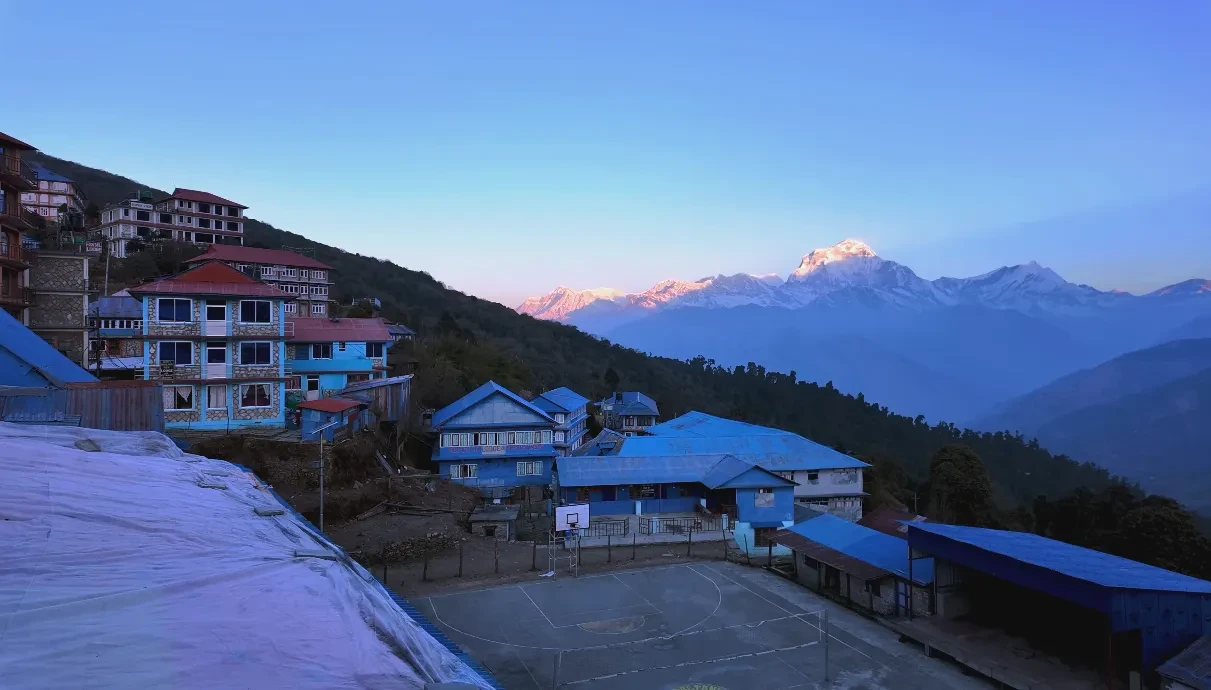
After breakfast at your guesthouse in Tikhe Dhunga, we will walk across the suspension bridge over the Tikhedhunga River. We will meet another river, the Bhurungdi Khola River, inviting us to swim in its blue waters. From there, we’ll continue our trek up a beautiful stone staircase.
Our short Poon Hill trek continues with over 3,000 stone steps leading to Ulleri. The steep ascent reaches the large Magar village of Ulleri (2,080 m). After the tiring climb, we can rest in a tea shop with a view of the valley below. The trail ascends in a gradual manner through pleasant pastures.
As we walk, we pass local fields of maize, buckwheat, and vegetables. The relaxing sound of the flowing river accompanies us along the way. We’ll pass through refreshing oak and rhododendron forests. Before reaching Ghorepani, we’ll climb hills through a jungle with the soothing sound of the rivers.
Walking Day
5- 6 hrs
Accommodation
Guest House
Meals
Breakfast, Lunch, Dinner
Altitude
Ghorepani (2,775m)
DAY
03
03
Day 03: Ghorepani trekking to Poon Hill and trek to Tadapani
It is the third day of our Poon Hill trek journey. Most people rise before dawn today to make the early-morning excursion to Poon Hill (3210 m). It is one of the best Himalayan viewpoints in Nepal, offering an unobstructed view of the sunrise over the high Himalayas.
After waking up early in the morning, the hike to Poon Hill begins. In the first part of the walk, we will climb to the Deurali Pass. This pass provides a spectacular panorama over Dhaulagiri and Annapurna. From Deurali, the trail starts descending through the dense moss-covered forest.
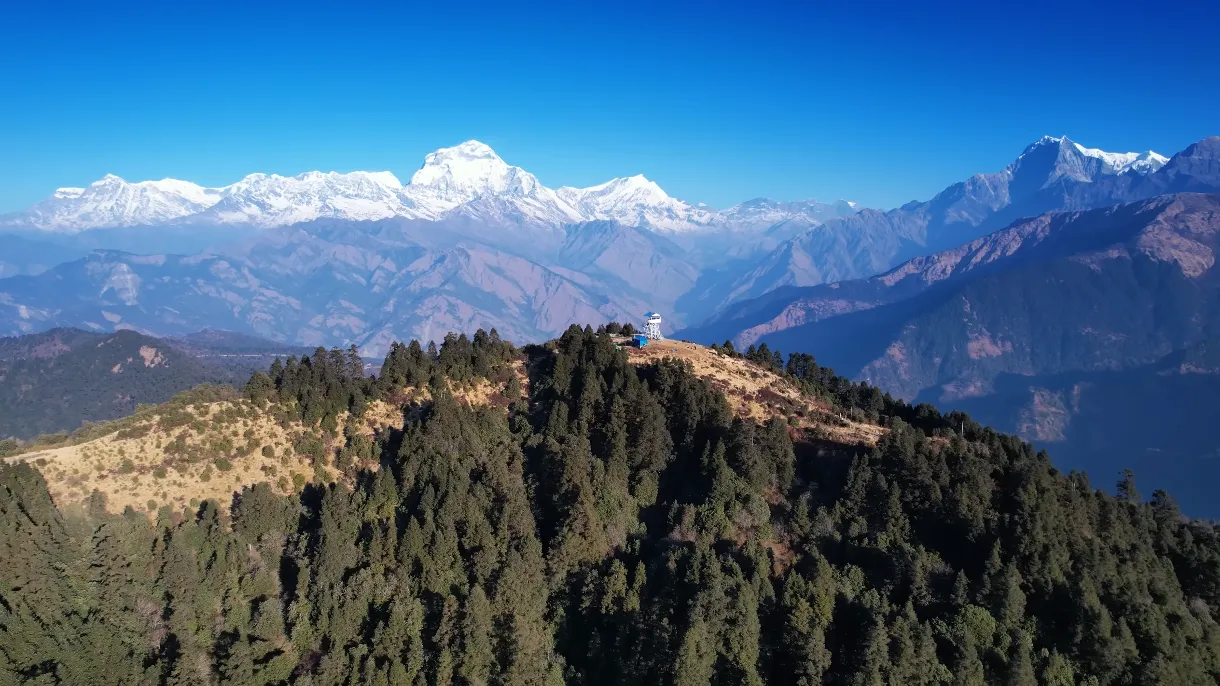
We will get magnificent views of the whole range of white mountains. We can see Mount Dhaulagiri I (8167 m), Tukuche (6920 m), Nilgiri (6940 m), Annapurna South, and Annapurna I (8091 m).
Additionally, we can view Hiuchhuli (6441 m), Tarke Kang (7193 m), Gangapurna (7454 m), Lamjung Himal (6986 m), and Mt. Fishtail (Machhapuchhre 6997 m). Watching the beautiful sunrise is a defining moment of pleasure and tranquility.
After spending some time at Poon Hill, taking photos, and enjoying the views of the Himalayas, we will descend back to Ghorepani.
Now, we will head to Tadapani after having breakfast at Ghorepani. We can see the different types of abundant birdlife on the way to Tadapani. It also provides a close-up sunset view. We will spend the night at the local guesthouse at Tadapani.
Walking Day
5-6 hrs
Accommodation
Guest House
Meals
Breakfast, Lunch, Dinner
Altitude
Tadapani (2,540m)
DAY
04
04
Day 04: Tadapani trekking to Nayapul. Drive back to Pokhara
After enjoying breakfast at Tadapani, we will begin our Poon Hill trek. The trail descends steeply through rhododendron forests to Bhaise Kharka. We might see monkeys and many birds on the way.
On the right side of the route, we will descend from the large rocks to Ghandruk. It is one of the largest Gurung villages in Nepal. It is known for its culture and stunning views.
You can explore the reasonable settlement of the Nepali village and get to know their culture. Ghandruk gives you the best glimpse view of Mount Annapurna and Fishtail.
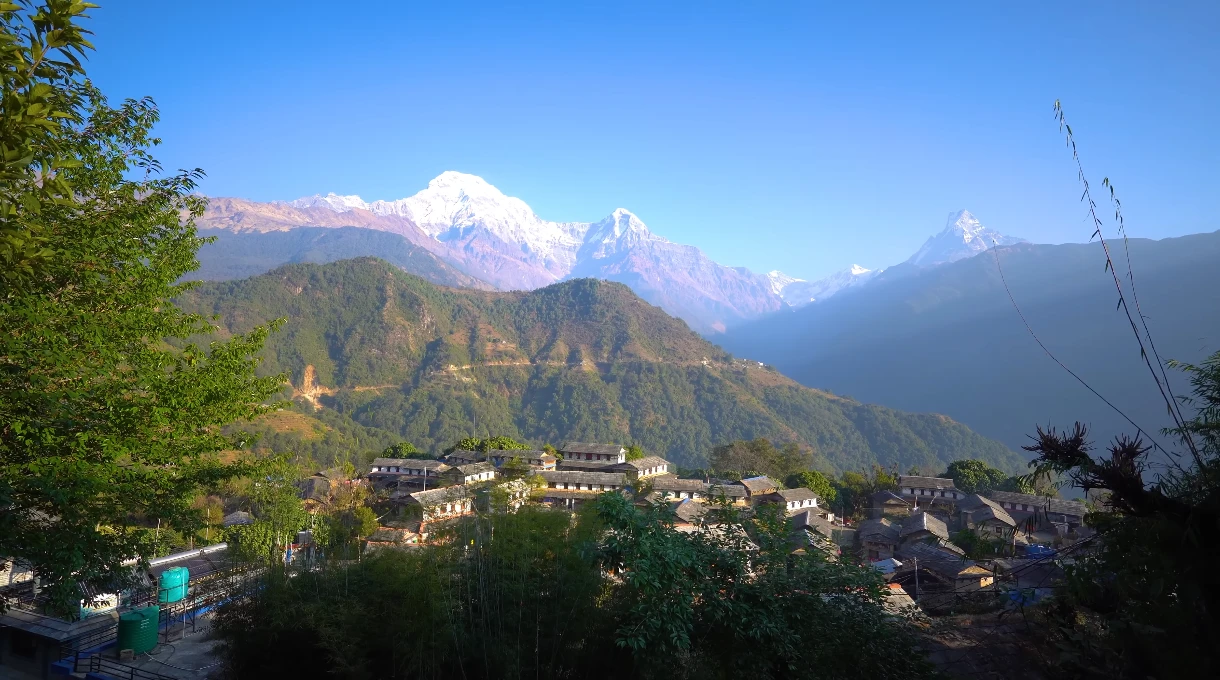
From Ghandruk, we can enjoy views of Lamjung and Manaslu in the distance. We’ll stop for an hour to have a nice lunch before we continue our descent to Birenthanti.
After lunch in Ghandruk, the trail makes a flat-steep descent alongside the stream. We walk to Nayapul and then take a private vehicle to Pokhara. There, we finish our 4-day Poon Hill trek, enjoying views of the Himalayas, villages, and beautiful landscapes.
We will transfer you to your hotel, and you will say goodbye to your guide and porter.
Multiple
Meals
Breakfast & Lunch
Altitude
Pokhara (822m)
Trip Extension
Suppose you have more time in Nepal after this trip. In that case, we can help you to extend your trip by running different treks in Nepal, tours in Bhutan and Tibet, Jungle safari tours at Chitwan, Bardia, and other National parks, Nepal luxury hotel booking, Rafting, Ultra-light flights, or any other travel-related services. You can get more information here.
Route Map & Altitude Chart

Most Asked Questions by Travellers
 General
Yes, the Poon Hill Trek is suitable for families with children who are comfortable walking for several hours a day. The path is also well made and has frequent tea houses making it easy with active children under good supervision.
Yes, quite a number of experienced travelers complete this trek annually. The journey is comfortable and pleasant as long as you are at the basic level of fitness and walk at a moderate pace.
The trail is popular and can be mentioned as moderately crowded during the peak seasons in the spring and fall. Nevertheless, the path is broad and well structured and even during the peak times the trekking process is enjoyable.
High season is good in advance booking so that one can get a good accommodation. During off season, one can typically book last minute but it is better to book early.
Yes, the itinerary would be customized per your time, pace and likes. You have the option of adding rest days, extending it to other routes or reducing the hours of walking.
Yes, it is said to be one of the best ways of getting introduced to trekking in Nepal. The controllable time and enjoyable scenery make it perfect to beginners.
No dependable ATM after Pokhara. Before trekking, it is recommended to pack enough local currency.
Yes, it can be done alone trekking, but it is better to have a guide, which will make it safer and increase the cultural experience. A guide also assists in logistics and local organization on its way.
 Preparation & Fitness
What are the physical preparations to the trek?
Experience in hiking before is useful, but not compulsory in this trek. It can be done by anybody with normal average physical exercise.
When you employ a porter, then your daypack would not exceed preferably 5 to 7 kilograms. Pack only necessities like water, snacks, light jacket and personal effects to last the day.
Trekking poles are optional but very necessary particularly in downhill areas. They make the knees relaxed and enhance stability on rocky paths.
Yes, it is right since endurance and breathing control are enhanced by practicing uphill walking or stair climbing. This training is a lot easier when the ascent to Ghorepani.
Warming up before and after daily walks ease the tension and pains experienced by the muscles. Back stretches and simple leg stretches can go a long way in making multi day trekking comfortable.
Strain on your knees can be minimized by wearing supportive trekking shoes and carrying trekking poles. Slow walking and not taking sudden steps is also beneficial to help your joints.
Having a positive attitude and being realistic is a way of enjoying the journey. Patience in weather changes and trail conditions helps in making the experience more smooth.
 Permits
Pokhara or Kathmandu has government offices where the permits may be bought. They are usually organized by a registered trekking company so that paperwork issues can be avoided.
Children, too, must have the required conservation permits. The fee is also alterable slightly based on age and nationality.
The permits remain valid for your trekking period within the Annapurna region. These are not tied to particular checkpoints throughout the day but need to correspond with your travel dates.
You require a copy of your passport and passport size photographs to do processing of permits. That matters the fact that your visa is valid throughout the time of trekking.
Once permit fees are issued, they are typically not refundable. Before the permits are processed, it is advisable to ensure that you check your travel dates.
Yes, there are official checkpoints where your permits will be checked. You are advised to carry your permits to the trek to ease the verification.
When you go further than the usual path in the Annapurna area with your conservation permit, you are generally still covered by your existing one. Several restricted zones would however be in need of different authorization.
Are there any possibilities of transfer of my permit to another?
 Insurance and Visa
Travel insurance is not obligatory according to law, yet highly suggested as a precaution. Unexpected health problems or travel inconveniences may arise even during shorter treks.
The policy that you should choose must cover trekking activities in Nepal. It is significant that the policy contains medical treatment and emergency help insurance.
Even though the trek is at a moderate level, evacuation cover is recommended in case of accidents or severe sickness. This cover helps to avoid high out of pocket costs in case of an emergency.
Before going on a trek, many trekking firms will ask you to provide a copy of your insurance. This will aid them in arranging within a short time should they be in need of emergency assistance.
Am I allowed to take travel insurance upon arrival in Nepal?
The majority of tourists are able to get a visa by landing at Tribhuvan International Airport in Kathmandu. It is simple and it needs a passport that is valid enough.
The duration of your stay in Nepal with your visa should include buffer days before and after the trek. You should always remember to include some additional days in case of delays by the means of transport.
Yes, it is possible to have visa extensions at Kathmandu immigration office. Extensions are charged extra fees and documentation is required.
 Guides & Support Staff
Yes, there are trained, government licensed professional trekking guides who receive first aid/mountain safety training. They practice working in various weather conditions on trails and supporting trekkers of all classes.
It depends on the size of the group, though small groups of people may have a specific guide. This guarantees increased concentration, surveillance, and co-ordination.
The primary luggage is carried by a porter enabling trekkers to walk easily with a light daypack. This aids in easing of physical stress, particularly in long stairways.
Generally, a single porter carries the luggage of two trekkers with the acceptable weight. The responsible companies adhere to appropriate guidelines to safeguard the welfare of porters.
In Nepal, tipping is a form of appreciating their efforts. It varies depending on your satisfaction and the trek duration.
Yes, you can have just a porter when you are sure you can manage the route. But numerous trekkers would want a guide to facilitate easier logistics and cultural knowledge.
Yes, guides do lodge reservations and daily organization in the trek. This will enable trekkers to take a back and be fully concentrated on the journey.
Yes, we have female guides too, but it is better to notice them beforehand. Most of the tourists feel free to select the guides depending on their own choice.
 Accommodation and Facilities
Singles, particularly off season, might be available in low end villages. During peak months however, twin sharing rooms are more prevalent because of high demand.
Yes, the majority of tea houses offer blankets to their visitors. Nevertheless, it is advisable to carry a light sleeping bag to provide additional warmth and comfort.
All bedrooms are usually not warm even in winter. A central heater is common in the dining hall in which the trekkers are seated during the evening.
Some of the lodges at the lower altitudes offer attached bathrooms, though not all. Shared bathrooms are more prevalent in more advanced villages.
Most lodges have hot showers which are normally charged extra. Availability can be determined by weather and energy supply.
Charging facilities are provided in most of the tea houses although in some cases, the dining accommodations are shared. There can be a small fee of a service per device.
It is strongly advised that bookings should be made ahead of time especially during peak trekking seasons. This guarantees a comfortable stay in such popular stops as Ghorepani.
Yes, there are tea houses on the way, which are regarded as safe and hospitable to families. Most of the lodges in the area are family-owned and are friendly.
 Food and Drinks
Yes, vegetarian meals can be found everywhere in the tea houses on the way. Vegetarian food is being taken by many trekkers because it is fresh and is made each day.
There are few gluten-free dining options but it is possible to organize such simple dishes as rice, lentils, vegetables, and eggs. Before going, it is suggested that you inform your guide about dietary restrictions.
Basic food items like noodles, chocolates, and biscuits are available in small shops and tea houses. But, the higher the altitude, the higher the prices because of transportation.
Yes, the majority of lodges have boiled water which they charge a small amount. Most trekkers will choose this alternative over purchasing bottled water.
Absolutely, you can bring protein bars, energy gels, or supplements at home. It can be useful to carry some personal snacks in case of more extended days of walking.
Most of the villages sell alcoholic beverages, both local and bottled. Drinking at elevation is however not encouraged.
Meals are prepared once you make your order, thus it is fresh. Strong demand might slightly increase the time it takes to prepare in case of busy seasons.
Yes, plain foods like noodles, fried rice, pancakes, and soups are generally appropriate to the children. Owners of tea houses are usually flexible and will make accommodation to the family requirements.
 Weather & Seasons
Nights can become very cold particularly in the higher villages such as Ghorepani. Even afternoons and early mornings are very chilly even in spring and autumn.
Yes, spring and autumn are popular seasons, hence the trail may be crowded. Reservation of accommodation prevents last minute challenges.
During winter it may fall snow, particularly in Ghorepani and the viewpoint. Light snow would form beautiful scenery and would cause some trails to be a little slippery.
What is the clearness of mountain-views during the year?
Yes, it can but often the rain can make the steps on the stones wet and muddy. Mountain visibility can also be curtailed by cloud cover at this period.
Sometimes the sunrise might be blocked by fog or clouds. Weather in mountains cannot be predicted and therefore there is need of flexibility.
Leeches can be found in the forest areas when there is heavy rainfall. Comfort can be attained by wearing good socks and trekking shoes.
There are occasions when it may be quite strong on the top of Poon hill in the early morning. The sunrise experience is comfortable when one is wearing a warm outer layer.
 Health & Safety
In a few larger villages there are some basic health posts, but there are not many advanced medical facilities. In severe cases, there may be a need to transfer to Pokhara.
The most prevalent problems are blisters, mild muscle soreness, and tiredness. With rest and hydration, they can be normally treated.
The walking pace with the help of the trekking poles and the steady pace can reduce the pressure on the knees. Evening stretching will reduce stiffness as well.
Tap water should not be used without its purification. Purification pills or filtered water are highly recommended.
Immediately notify your guide in case you experience discomfort or symptoms. Communication at an early stage is useful in addressing simple issues before they escalate into serious issues.
Yes, the trail is well marked in most places. Nevertheless, hiking through the forest with a guide is safer and easier to navigate.
The path is mostly secure and often popular with mountain passers. Nevertheless, paying a guide will enhance an additional point of safety and local assistance.
The tea houses are secure and run by the local families. There is the ability to lock rooms and the community based environment is generally friendly.
 Packing & Gear
Technical or expedition level gear is not needed but warm clothes are necessary particularly in early mornings. Temperatures at the high altitude may fall considerably before sunrise.
The use of trekking poles comes in handy particularly on long staircases and steep descents. They decrease pressure on knees and enhance steadiness on unstable surfaces.
A lightweight daypack of 20 to 30 liters is typically sufficient to hold day necessities. Your main luggage can be carried by porters provided that it is included in your package.
Yes, a light waterproof jacket or poncho should be used. The weather in the hills is unpredictable even when the seasons are steady.
The tea houses offer blankets but this is optional as a lightweight sleeping bag liner is an added comfort and hygiene. A three-season sleeping bag can be handy during colder months.
Good hiking shoes with a good grip are recommended in stone steps and forest trails. Before the trek, make sure that your shoes are already broken in.
Snacks can be found along the route but may be more costly. It is easy to carry energy bars or light snacks that are available in Pokhara.
Yes, it is better to have basic personal medication and blister care. Your guide might be able to bring group medical supplies but you are advised to carry personal necessities.
 Booking & Payment
During peak seasons such as spring and autumn, it is always good to reserve a few weeks in advance. Early booking will guarantee good accommodation and easy planning of trips.
Yes, in most trekking companies, you need some little deposit to secure your booking. The rest of the balance is normally paid prior to the trek.
Yes, there is the last-minute booking especially in the off seasons. Guides and rooms, however, might not be as available during high months.
Most of the businesses will handle bank cheques, credit, or cash in large cities such as Kathmandu and Pokhara. Always, it is better to make sure that you are sure about the payment options before making your trip.
No, we specify all the package inclusions and exclusions. Extra expenses like drinks, tips, or optional services are typically charged separately.
Cancellation is different based on the company and season. Before paying the terms it is important to read them carefully.
Yes, in most cases, the overall cost is determined by the number of participants. Smaller groups might be offered a lower rate per individual.
Once you secure your reservation, you need to have a confirmation invoice and trip details. The maintenance of these documents will assist in making the communication clear and easy before departure.
 Transportation & Flight
Traveling can be done by tourist bus, personal vehicle or through a short domestic flight. Both alternative solutions have varying degrees of comfort, time savings, and cost.
There is no compulsory flight, as there is a great availability of road transport, which is generally popular. But flying is faster and offers aerial views of the Himalayas.
The Pokhara to Nayapul drive normally takes a one or one and a half hour drive. The roads are mostly favorable and do not require a four-wheel drive.
Yes, the cars or jeeps may be arranged privately, to be more comfortable and flexible. It is the best alternative when it comes to families or small groups who wish to have their own timetable.
The majority of the standard packages involve transfers between the starting and ending points of the trek and Pokhara. Before making a reservation, it is always advisable to verify the details of transport.
Yes, there are weight limits of both the checked and hand luggage in the domestic airlines of Nepal. Additional fee might be paid at the airport due to additional baggage.
Sometimes it might have delays on travel because of heavy rain or road repairs. A flexible timetable is also wise to have especially during peak seasons.
We also provide airport pickups. This helps in the convenient arrival procedure and subsequent journey to Pokhara.
Reviews on Poon Hill Trek – 4 Days





Jamie woods
New Zealand
Best company for Poon hill trek

To Dhampus via Ghorepani, the cultural and landscape variety of this Poon hill trek was excellent, with plenty of physical challenges to mark it a superb and memorable Experience. It all enhanced through my guide, Ramesh’s professional and efficient support.
My thanks go to the company Above the Himalaya trekking company for providing information regarding treks at such short notice.
Jamie woods
Christopher Snape
44 Harrison RD , Sheffield Uk
Great trekking to Ghorepani Poon hill
Nepal Overland Tour + Poon hill Trek September 2024
Hi,
We had an exciting and busy sightseeing tour all around Nepal. At the last minute, we decided to change plans and trek up to Poonhill. Puru was great at changing the strategies; my guide sorted it out for us. The trek was excellent.
Thanks
Christopher Snape
Nagisa Nguyen
Seattle USA
Poon hill trek in October- Best Mountain view
I had a wonderful time with Above The Himalayan Trekking Company for my Poon Hill trek. The guide and porters were amiable and were patient with us. The tea houses we stayed at were lovely, and the food choices were excellent.
Thank you for being flexible with the tour/trekking and adding one extra person at the last minute. I appreciate it.
I recommend this company to others and will use it again for future treks.
Nagisa Nguyen
SHLOMO,ORY, SHLOMON
DOR, ISRAEL
Annapurna Poonhill Trekking September
Dear Puru,
We want to thank you for the Poon hill short trek that is not forgotten. I want to thank the excellent organization and the reception we got—especially the wonderful staff headed by Mr. Ramesh- for giving us answers to everything.
WE RECEIVED 100% OF WHAT PROMISED US.
THANK YOU
SHLOMO, ORY, SOLOMON
Farah Iqbal
Singapore
Annapurna Poonhill Trekking
We’ve just returned from a 9-day vacation in Nepal, where my friend and I (both female) went paragliding in Pokhara and did a five-day trek to Poon Hill (3210m).
We booked with Above the Himalayas because the managing director, Puru, replied to our emails promptly and answered our every query. No regrets at all.
Paragliding was beyond anything I could imagine, with kind, reassuring, experienced pilots. The trek guides, Phurba Sherpa and Guide/Porter Basu, were terrific. I don’t know how we got so lucky to have two directions who looked out for our every need at every step. They never got angry, always with smiles on their faces.
Phurba had done the Poon Hill trek more than 50 times and worked as a porter, cook, and guide for over 20 years.
We always felt safe with them. And despite the tough upward climb (we are weak Singaporeans!), I had a terrible muscle pull on my legs on the second day of trekking, and they let us stop many times and helped rid me of the muscle pain by massaging.
I pushed through because of them. And there was always laughter, jokes, and some dancing from Basu 🙂 I highly recommend booking with Above the Himalayas. We had never trekked before and are considering returning in the next few years.
Farah Iqbal
Kam yew Loon
Australia
Poon Hill trek (5 days)
It was an enjoyable Poon hill short trek. Our guide and porter have been beneficial and appreciable. Our guide, Sitaram, is very caring and ensures that our stay in the tea house/ lodge is comfortable.
He is very experienced and knowledgeable about the mountains and trek. I will return and recommend our friends come.
Kam yew Loon
Becky Fischer
USA
Poon Hill Trek
We enjoyed our Poon hill short trek immensely. Basu took great care of us from start to finish. The views were magnificent.
We would not have had a better time! Our guide and porters had smiles and altitudes the whole time!
Becky Fischer
Zachary Fischer
USA
Pooh Hill with Basu, Ram and Suraj
It is a fantastic trip. I highly recommend this Poon hill short trek and the services of the Above the Himalaya Trekking (p) Ltd company.
Zachary Fischer
Jeff Fischer
USA
Pooh Hill with Basu, Ram and Suraj
We had a great time. The guide (Basu) and porters were always amiable. We saw amazing views. I would highly recommend the whole Poon hill short trek to my friends.
Jeff Fischer
Anna Tkaczyk
UK
Ghorepani Poon Hill - April
It was a wonderful trek. We are delighted with our tour guide and porter. They both were very professional and friendly. I recommend your company to family and friends for Poon hill short trek.
Thanks
Anna Tkaczyk
20% OFF
Best Price Guaranteed, Easy to change Date, Instant Confirmation
Book This TripBook with Confidence
- Flexible bookings and easy trip date changes
- Personalized service and customized group sizes
- Safe travels with owner-operated services and highly experienced guides
- Best price guarantee for the most value for your money
- Secure & easy online booking
Your Trek Leader
 Enjoy Himalayan scenery with the help of Nepal’s best guides with Government license holders and got training in first-aid, our Trip Leaders, know where you’ll find the best photos, most fascinating wildlife, and the best stream crossings.
Have Questions?Talk to Expert
Meet Mr. Purushotam Timalsena (Puru), Nepal's best trek and tour organizer, who has been working in the Himalayas for more than 24 years.
WhatsApp/Viber +977 98510 95 800



You May Like


Trips for All
Private Trip
Peaceful tour with your travel buddy and guide
Small Group Travel
Travel with people having similar adventure dreams
Trips for Kids
Calling all young adventurers - join us for a journey of a lifetime!
Trips for Adventurers
Climbing & mountaineering adventures for thrill-seekers