Customize Your Trip
 Need Help? Let's Talk
+977 985-1095800Central Bhutan Tour




Trip Duration 13 Days
Group Size 2-16 People
Maximum Altitude 3,988 m
Difficulty Grade Moderate
Start & End Point Bhutan / Bhutan
Trip Highlights of Central Bhutan Tour
- Hike to iconic Tiger’s Nest Monastery in Paro.
- Light butter lamps at the sacred Burning Lake in Bumthang.
- Enjoy Himalayan panoramas from Chele La and Dochula passes.
- Relax in a traditional hot stone bath after hiking.
- Try archery, Bhutan’s national sport, and taste local red rice beer.
- Visit Punakha Dzong, the stunning “Palace of Great Happiness.”
- Wander Phobjikha Valley to spot rare black-necked cranes (winter).
Overview of Central Bhutan Tour
The middle part of Bhutan, commonly referred to as the cultural center of the country, consists of ancient monasteries, fortresses, and fertile valleys. This Central Bhutan Tour is a 13-day journey offering a deep dive into the kingdom’s heritage and natural beauty. Since the moment you arrive in Paro, our guide will lead you on a schedule of historic sites, hiking alongside beautiful scenery and pure culture in a carefully balanced tour.
Throughout the course of close to two weeks, you will explore the west of the valleys of Paro and Thimphu into the green heart of Bhutan including Trongsa and Bumthang. Every day brings a new experience: hike to the legendary Tiger’s Nest Monastery, which is hanging on a cliff, light butter lamps at the Burning Lake site, and view the ornate fortresses (dzongs) which have served as the guards of the history of Bhutan.
The road goes through high mountain routes Chele La and Dochula, which offer panoramic views of the Himalayas and provide a glimpse on sacred peaks like Jomolhari when the weather is clear. This Central Bhutan Tour also immerses you in local life. Explore quiet countryside villages and get a chance to experience archery, the national sport in Bhutan, and wear Bhutanese traditional clothes for a memorable photo.
Evenings are also a source of pleasure – maybe a relaxing hot stone bath to get rid of the hardships of the day, or a glass of red rice beer to drink during your meal of spicy Bhutanese dishes. During the trip, an experienced local guide offers his or her understanding of the Buddhist culture of Bhutan making sure that there is no question about local traditions or past left unanswered.
In summary, the 13-day Central Bhutan Tour offers an enriching travel experience with no detail overlooked. It includes the same attractions that people must see in Paro, Thimphu, and Punakha with the religious atmosphere of the ancient temples of Bumthang and the clear nature of Phobjikha Valley. In this all inclusive tour, you can have a fulfilled exploration of the Bhutan treasure that will give you a memorable experience of the Thunder Dragon Kingdom.
Itinerary of Central Bhutan Tour
DAY
01
01
Day 01: Arrival in Paro (National museum, Paro Dzong)
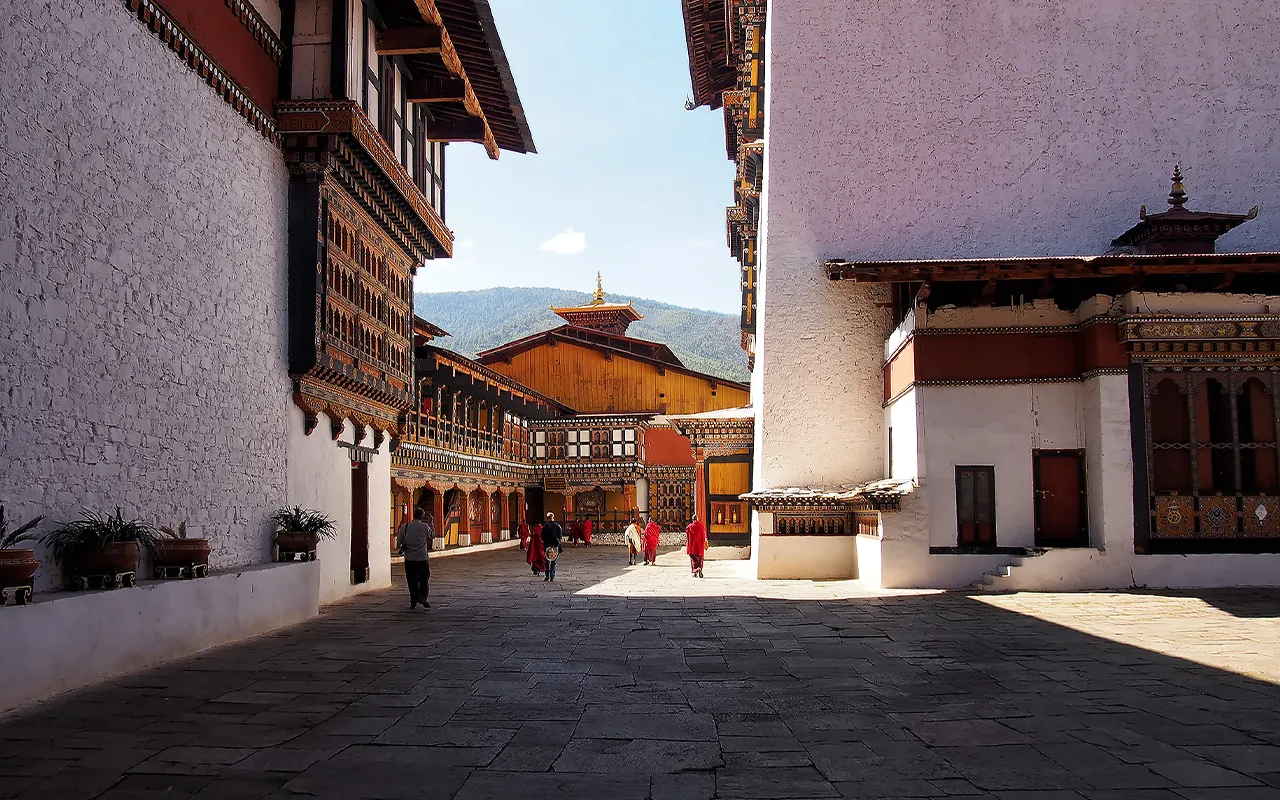
You will arrive in Paro and meet our guide at arrivals. After the hotel check in and a short rest, you will visit the round Ta Dzong (The National Museum) to get a brief introduction to Bhutan’s history, culture, and natural beauty. Then you will walk or drive down to Paro Dzong (Rinpung Dzong) by the cantilever bridge made of wood.
You will visit its serene courtyards, local worshippers and have excellent views of the Paro Chu and valley. When you come during spring you will quite often encounter the courtyard preparations of Paro Tshechu.
You will have a warm welcome dinner in the evening with traditional Bhutanese meal. You will spend the night in Paro, along the river and in the old town streets, preparing to hike tomorrow to Taktsang (Tiger Nest).
Accommodation
Hotel
Meals
D
Altitude
2,200 m
DAY
02
02
Day 02: Paro - Hike to Tiger’s Nest Monastery and visit farmhouse
In the morning, after breakfast, you will drive to the trailhead and walk to Taktsang (Tiger’s Nest). The round trip takes 4-6 hours, the trail is approximately 6–8 km round trip (4–6 hrs), with an ascent of about 500–600 meters and final stairways towards the monastery at the end.
At the halfway point, there is a tea house viewpoint where you can rest, enjoy a warm drink, and take in beautiful views of Tiger’s Nest Monastery and the valley below. You will walk around the monastery silently and in accordance with the local customs (photography will not be allowed in the monastery).
You will go to a farmhouse after the descent meeting one of the local families, trying butter tea, and ema datshi. You can enjoy a warm bath with hot stones (not obligatory, better to book it beforehand). You will go back to your Paro hotel to have dinner and sleep.
Accommodation
Hotel
Meals
D
Altitude
3,100m
DAY
03
03
Day 03: Paro - Chele La Pass & Kila Gompa
Today you will travel approximately 36-40 km (1-1.5 hrs) between Paro and Chele La Pass (3,988 m), one of Bhutan’s highest road passes, with prayer flags fluttering along and panoramic Himalayan sceneries on a clear day. On a good day, you will be able to see Jomolhari and broad wooded valley.
On the pass you will have an easy walk down through rhododendron and hemlock to Kila Gompa, a cliffside nunnery, which is variously referred to as the second Tiger’s Nest Monastery. You will meet your driver at the monastery, and resume the road to Paro. This route includes a short descent to the cliff-side Kila Gompa nunnery; your vehicle meets you at the lower trailhead. In the evening, you will walk old Paro or take a rest at the hotel.
Accommodation
Hotel
Altitude
3,988 m
DAY
04
04
Day 04: Fly to Bumthang -Ancient Monasteries
After breakfast, you will board a short domestic flight to Bumthang (Bathpalathang Airport, BUT), which will save you from an entire day of road travel. Bumthang is located at an altitude of 2,600-2,700 m and it is referred to as the spiritual centre of Bhutan.
After arrival, you will explore the Jambay Lhakhang (associated with the 7 th -century temples of Songtsen Gampo), Kurjey Lhakhang (location of a cave with Guru Rinpoche body imprint), and Konchogsum Lhakhang (rebuilt after fire). Evening you will have Bumthang buckwheat noodles or cheese and sleep in your comfortable lodge.
Accommodation
Lodge
Altitude
2,700m
DAY
05
05
Day 05: Bumthang - Mebar Tsho (Burning Lake) and Jakar Dzong
After having your breakfast, you will drive to Mebar Tsho, or the Burning Lake, which is located in Tang Valley. It was said that Saint Pema Lingpa found hidden treasures here while keeping his butter lamp burning underwater. The lake is calm and spiritual, with colourful prayer flags fluttering gently in the wind.
Later, you will return to Jakar and visit Jakar Dzong, the “Castle of the White Bird,” which overlooks the valley and from which there are wonderful views. You will also have some time to go into the small local shops selling yathra, the colourful woollen textile unique to Bumthang. In the evening, you will have dinner at your lodge and get a good night’s rest after the next day’s journey.
Accommodation
Lodge
Altitude
2,615 m
DAY
06
06
Day 06: Bumthang to Trongsa - Tharpaling Hike & Scenic Drive
This morning, you will drive to the Tharpaling monastery (at about 3,600m), which is an important meditation place with great views of the valley. From here, you will have a pleasant walk in the forest through rhododendron and bamboo to Lamey Goempa where you meet your driver. You will then continue the drive over Yotong La Pass (3,400 m) towards Trongsa, some 68 km during 2-3 hours.
Along the way, you may see some of the grazing yaks or the langur monkeys. On the way to town you will stop at a viewpoint to see the best panorama of the wonderful Trongsa Dzong, situated high on a ridge above you. You will spend the night in Trongsa, and enjoy your warm dinner at your hotel.
Accommodation
Hotel
Meals
D
Altitude
3,600 m
DAY
07
07
Day 07: Trongsa to Phobjikha (Gangtey) - Nature Trail & Cranes
After breakfast, you will travel west through a forested area of hills crossing Pele La Pass (3,420 m) into the beautiful glacial valley of Phobjikha. This wide bowl shaped valley is around 3,000 m and is the winter home of the rare black necked cranes.
You will follow the easy Gangtey Nature Trail (about 4km, 1.5-2 hours) from Gangtey Goemba down through pine woods and meadows, with views of traditional farmhouses and open fields. Later you will stop at the Black necked Crane Information Centre where you will learn more about these graceful birds. You will spend the night in one of the cozy guesthouses in Phobjikha with surrounded by stillness and a sky full of stars.
Accommodation
Guesthouse
Altitude
3,000m
DAY
08
08
Day 08: Phobjikha to Punakha - Chimi Lhakhang & Punakha Dzong
You will leave the high valley of Phobjikha and drive for about 3 hours (about 70-80 km) and reach the warm and fertile Punakha Valley. In the afternoon, you will go for a short and pleasant walk through fields to Chimi Lhakhang, or the Fertility Temple, dedicated to the “Divine Madman”, Drukpa Kunley.
In this section, you will hear about his playful but serious teachings on compassion and happiness. Then you will visit the wonderful Punakha Dzong, spectacularly situated at the confluence of the Pho Chu and Mo Chu rivers. With its great courtyards, carved woodwork and flowering clusters of jacaranda trees in spring it is one of the most photogenic attraction in Bhutan. You will spend a night in Punakha.
Altitude
1,200 m
DAY
09
09
Day 09: Punakha - Khamsum Chorten Hike & Limbukha Village
After breakfast, we will cross a suspension bridge, then hike uphill 45–90 minutes each way to reach Khamsum Yulley Namgyal Chorten, which was built to promote peace and harmony. From the top, you will get a good view of the Punakha valley and the winding river Mo Chu.
After the descent, you will drive to Limbukha Village, where red rice terraces and the tradition of displaying white flags during festivals as a symbol of peace are the main attractions. You will have a peaceful walk around the village and talk with farmers if time permits. You will return to Punakha in the evening to relax and enjoy the dinner at your hotel.
Accommodation
Hotel
Altitude
3,988 m
DAY
10
10
Day 10: Punakha to Thimphu via Dochula - Memorial Chorten & Buddha Point
You will drive towards Thimphu, passing the Dochula Pass (3,100 m), where 108 white chortens are made in memory of Bhutanese soldiers. On a clear day, you will stop here, to enjoy tea and panoramic mountain views. Upon arrival in Thimphu, you will visit the National Memorial Chorten: People circumambulate clockwise while spinning prayer wheels and softly chanting.
Later you will drive to Kuensel Phodrang where you will see a giant golden Buddha Dordenma statue overlooking the valley. From this hill top you will have a wonderful view of the capital below. You will spend the evening exploring the small shops of Thimphu or the weekend market before spending the evening in a hotel in Thimphu.
Accommodation
Hotel
Altitude
2,248 m
DAY
11
11
Day 11: Thimphu - Arts School, Folk Museum & Tashichho Dzong
In the morning, you will visit the Institute for Zorig Chusum (Institute for the 13 Traditional Arts) where students learn the 13 traditional arts of Bhutan from painting, sculpture and wood carving. Next, you will visit the Folk Heritage Museum which is housed in a 19th-century house that displays how Bhutanese families lived.
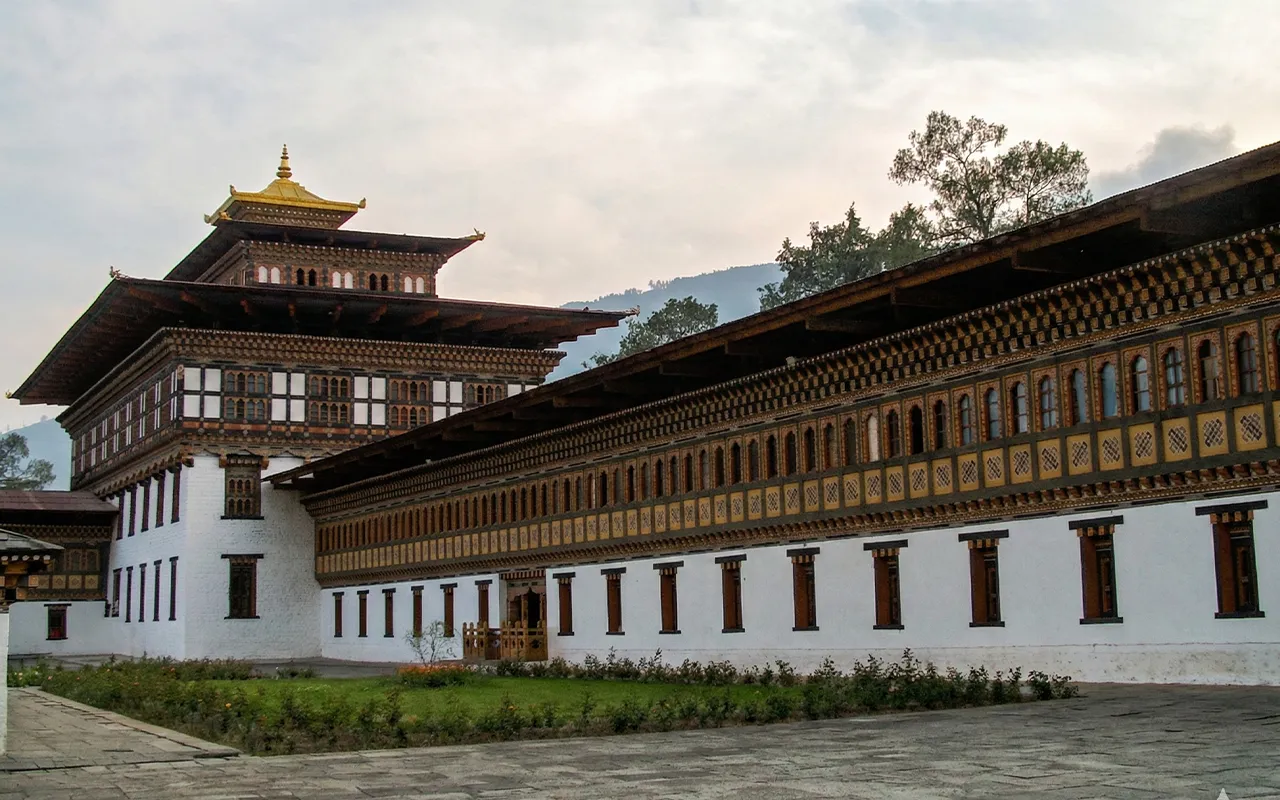
Next, you will visit Changangkha Lhakhang, a very ancient temple which is frequently visited by families to get blessings for their children. In the late afternoon, you will go to Tashichho Dzong, seat of Bhutan’s royal and religious offices, and walk through its courtyards and gardens. You will have dinner at your hotel or local restaurant and rest for the night.
Accommodation
Hotel
Meals
D
Altitude
2,248 m
DAY
12
12
Day 12: Thimphu - Tango Monastery Hike & Free Afternoon
After breakfast you will take about 30 minutes drive north of Thimphu and hike uphill for about an hour (2.5 km one way), through forest, to reach the Tango Monastery. This historic site, established in the 13th century, is a Buddhist learning and meditation centre. You will stroll around its quiet courtyard, explore small chapels and get a view of the green valley below.
You will take a hike down and then you will head back to Thimphu for lunch. The afternoon is free time to explore at your own pace,you can do some shopping for souvenirs, visit the Textile Museum or relax in a cafe. In the evening, you can have a farewell dinner with our guide and companions before your last night in Bhutan.
Accommodation
Hotel
Meals
D
Altitude
3,000 m
DAY
13
13
Day 13: Thimphu to Paro – Departure
After an early breakfast, you will drive to Paro International airport which is about one hour drive from the city for your departure flight. Our guide and driver will help you with the check in and luggage and wish you a warm “Tashi Delek” (good luck and blessings).
As your flight starts to take off you will see the valleys, rivers and mountain peaks of Bhutan for the last time. You will carry home warm memories of the Land of the Thunder Dragon, peaceful monasteries, the kind people, and the deep sense of happiness Bhutan is known for.
Altitude
2,200 m
Trip Extension
Suppose you have more time in Nepal after this trip. In that case, we can help you to extend your trip by running different treks in Nepal, tours in Bhutan and Tibet, Jungle safari tours at Chitwan, Bardia, and other National parks, Nepal luxury hotel booking, Rafting, Ultra-light flights, or any other travel-related services. You can get more information here.
Includes/Excludes
We are updating the contents.
We are updating the contents.
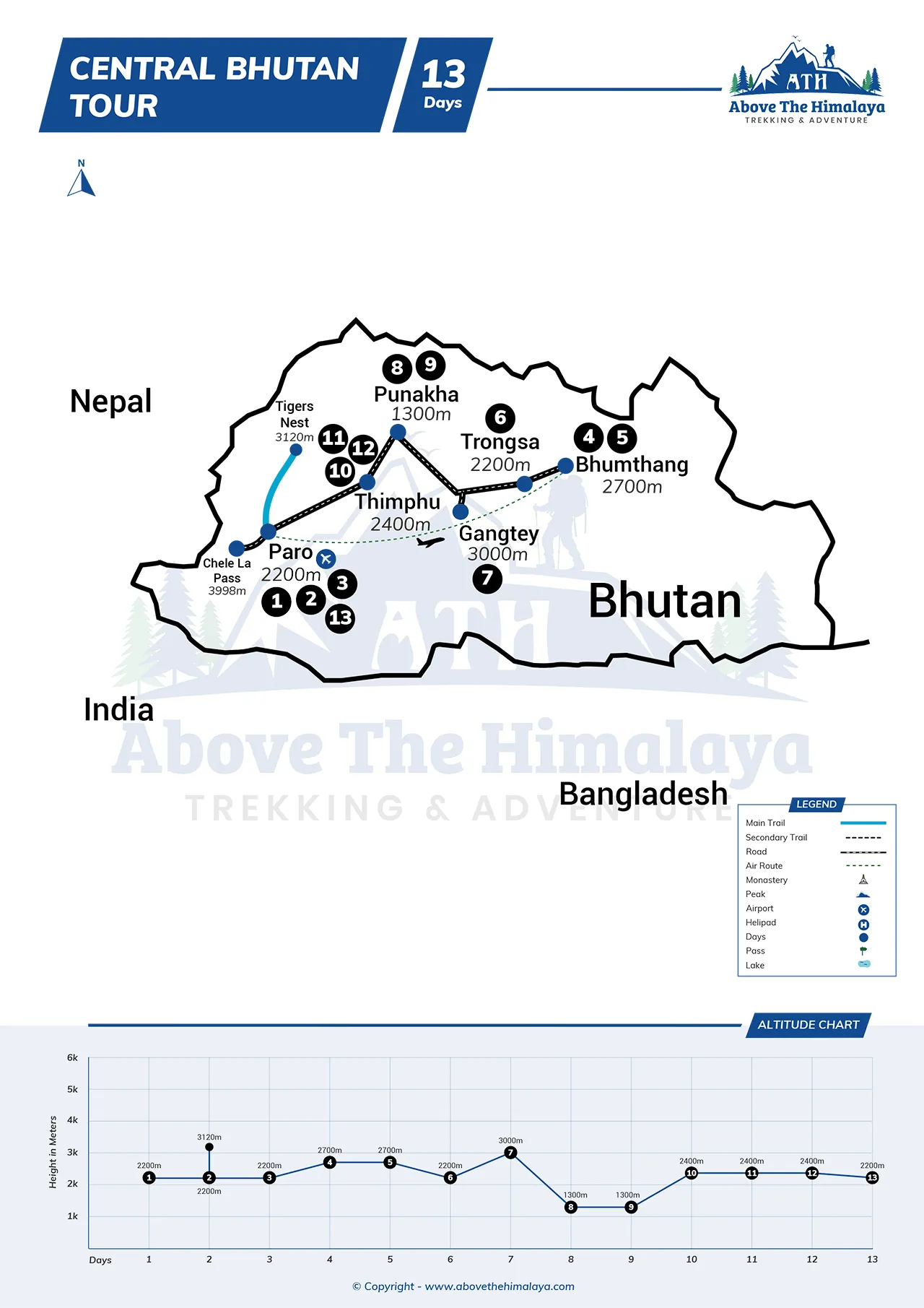
Route Map & Altitude Chart
Best Season
Bhutan’s climate varies by region and altitude, but generally the best seasons to undertake a Central Bhutan Tour are spring (March to May) and autumn (late September to November). These are the seasons that are cool and stable and the weather has good views and is pleasant to travel and hike.
Spring (March-May): Spring is characterized by moderate weather (cold mornings and hot afternoons) and blossom flowers. Rhododendrons and wildflowers sprinkle the hilly slopes in the center of the valleys such as Bumthang, Phobjikha, and so on. There is usually good visibility (clouds becoming more of a feature towards May with the coming monsoon). Another event that can make your trip interesting is the major cultural festivals (Tshechus) in Bhutan that happen during the spring.
Autumn (late September – November): Autumn is a second best season. The air is clear and skies are usually crystal clear after summer rains. October is especially spectacular with snow-white Himalayan mountain ranges at elevated passes such as Dochula with some of the best mountain views of the year. The daytime temperature in central Bhutan is fair and pleasant and the post-harvest scenery of Bhutan is golden and beautiful. Autumn is also full of local festivals and usually well received by tourists (Bhutan never seems crowded because tourism in the country is controlled).
Winter (Dec-Feb): Winter is cold particularly at night, but is dry with sunny days and clear weather. A winter trip can be a satisfying one, however, whether you are prepared to face the cold or not, it is possible to get mountain views, and the number of tourists is also minimal (you can also find black-necked cranes in Phobjikha). Snow may block high passes, but most of the main routes in Bhutan are open in central Bhutan.
Summer (Jun-Aug): The least favorable period is monsoon with most of them being rainy and cloudy. Although the valleys are fertile, green and verdant, the trails may be muddy and there is danger of road disruptions due to landslides. The rainy season does not attract a good number of tourists.
In short, spring or autumn is the best time of the year to have pleasant weather and colorful scenery. These seasons offer the best balance of clear skies, moderate temperatures, and cultural events, ensuring you get the most out of your Central Bhutan Tour.
Transportation and Facilities
During your Central Bhutan Tour, all transportation (vehicles, drivers, flights) is pre-arranged, making travel hassle-free. The journey involves a mix of private road travel and a domestic flight.
Private Vehicle & Driver: You will have a dedicated private vehicle with a professional driver throughout the tour. For a small group or private tour, this is typically a comfortable SUV or minivan (for larger groups, a coaster bus) with heating/air-conditioning as needed. The driver is experienced in navigating Bhutan’s winding mountain highways, allowing you to sit back and enjoy the scenery.
Roads in Bhutan are generally well-maintained but can be narrow and curvy; travel between destinations often takes longer than the distance might suggest. Your driver will stop for rest breaks and photos as needed, ensuring flexibility during the journey. There is no use of public buses or shared transport – all overland travel is private and flexible to your needs.
Domestic Flight: This 13-day itinerary includes a short domestic flight from Paro to Bumthang. Typical flight time is 35 minutes (weather & schedule dependent), operated by Drukair/Bhutan Airlines. The flight, operated by Bhutan’s national airlines, offers stunning aerial views of the mountains on clear days. Our guide will assist with check-in and transfers, making the flight smooth and convenient.
Accommodation & Facilities
Throughout your Central Bhutan Tour, you will stay in government approved hotels or lodges (usually 3 star standard, unless you request an upgrade). These hotels are located in areas such as Paro, Thimphu, Punakha and Bumthang with comfortable rooms equipped with private bathrooms, hot showers and traditional style.
In areas which are more rural, facilities may be modest but they are clean and comfortable. Hotels generally have Wi-Fi and standard electrical power points (230 V) so you plug in your chargers without problems. Hotels in larger towns can be used in case of necessity to arrange laundry service.
Meals: Breakfast, lunch and dinner will be provided on a daily basis. Most of your meals will be in your hotel or at approved local restaurants, and menus will be a blend of Bhutanese, Indian and continental. Dining is usually done in buffet form and food prepares to meet the tastes of the tourists (moderate levels of spices, etc.). The entire trip has safe drinking water and in case you have any dietary limitations, our guide will make sure that he or she supplies what you need.
What to Expect
This Central Bhutan Tour offers a pleasant mix of culture, nature, and gentle adventure. You will explore beautiful valleys, religious monasteries, and get to know nice local people. The tour is most suitable to most of the travelers with few hikes and moderate walking.
The ascent to Tiger’s Nest Monastery is the most difficult yet it is done gradually through rest and even horses can be hired along the way in cases of necessity. The altitudes vary between warm valleys with 1200 meters to cool mountain passes with 3800 meters and thus a layered dress will always make you feel comfortable.
Visitors to monasteries are expected to dress modestly and take off their hat and shoes when they get inside temples. People in Bhutan are very friendly and approachable and our guide will help you in this. All in all, you will be able to expect a relaxing and enriching experience of scenic beauty, cultural understanding, and authentic hospitality.
Guide and Staff
During your Central Bhutan Tour, our professional Bhutanese guide and a careful driver take good care of you. Our English-speaking guide is a certified member of the Tourism Council of Bhutan and has training in history, culture, and nature.
They will tell you stories describe traditions and make you comprehend the meaning of every place you visit. You get comfortable and safe transportation on the mountainous serpentine roads, and you get time to relax and enjoy the scenic view by your driver.
At restaurants and hotels, our guide will help in check in, meals, and communication and all that will be easy and smooth. They will deal with permits, timing, and daily plans throughout the journey and make everything work. Our guide and driver will provide you with a warm hospitality and your visit will be fruitful and memorable.
Altitude Sickness
Altitude sickness is rare on this Central Bhutan Tour because the highest point you reach is Chele La Pass (about 3,800 m), and you will not sleep at that altitude. The majority of the overnight stops are located between 2,200 m and 2,800 m, which is usually safe to most travellers.
Shortness of breath or mild level of fatigue in hikes may be present but tend to fade away quickly. The itinerary will allow your body time to adapt and our guide will tell you to walk slowly, drink lots of water and avoid hard liquor within the first few days. The altitude issues are extremely few in this route.
In case you are not feeling fine, our guide will carry a first aid kit and he will take good care of you. The mountain views can be enjoyed easily without any worry with a steady pace, proper hydration, and listening to what our guide advices.
Connectivity & Charging
It is not hard to keep your gadgets charged and connected throughout the tour, but the internet is often slow in remote valleys. Bhutan uses 230 V; sockets are commonly Type D/G (Type F sometimes found) and many hotels have multi-plug strips, carry a universal adapter.It is advisable to carry a universal adapter.
Electricity is available in all hotels in this tour and therefore you can recharge your phone and camera every night. The power supply is good and a power bank is convenient in case of a long drive. Most hotels have Wi-Fi, although in the countryside like Phobjikha, connection may be slow. To facilitate it, our guide can help purchase/activate a local SIM with data (often included in our packages; please confirm at booking).
Internet can be appropriate in messaging and email services, but uploading and streaming can be slow. The SIM will be configured at the beginning of the trip and organized by our guide. You will always remain well connected with minimal planning and remain charged on your devices during your trip.
Travel Rules / Permit Essentials
Bhutan’s SDF is US$100 per adult per night (concession: US$50 ages 6–11; under-6 free) and there’s a one-off visa fee of US$40 for most international visitors. Indian nationals pay Nu/INR 1,200 per person per night (6–11 half-rate; under-6 free). Bhutan’s visa and SDF (Sustainable Development Fee) procedures are handled by our company, so you don’t need to worry about formalities.
In order to travel outside Thimphu and Paro special route permits are required as well and these shall be arranged by our guide. Our guide will handle all paper work at any checkpoints between districts. A licensed Bhutanese guide is effectively required for sightseeing (dzongs/monasteries) and for travel beyond border towns, and will be listed on your permits and clearances.
During free time, you are free to visit markets or other areas nearby. Photography is usually prohibited inside chapels/inner sanctums of dzongs and monasteries (courtyards are generally fine). Drones are not permitted for tourists; BCAA authorizes government use only. You will not have to worry about any official issues as long as you listen to the advice of our guide, and you will be able to spend your time traveling and not worrying about any issues of the kind.
Your Extra Expenses
Your Central Bhutan Tour package covers most essentials, including accommodation, meals, transport, guide, and permits. But it is prudent to budget out a little money on personal expenses. Flights to and out of Bhutan are not part of the tour price though we can help you with making a reservation. Peace of mind strongly suggests the use of travel insurance.
Snacks, alcohol, and soft drinks during the non-meal time are your own expense. You can also consider purchasing souvenirs like textiles or handicrafts and in that case, it is better to carry a little cash in your hand as not all the smaller stores accept card payments.
Tipping is welcome but not mandatory – most travellers tip USD 10 per day to the guide and USD 5 per day to the driver, and this is distributed at the trip end. Minor personal expenditure is laundry, phone calls or additional data.
Attractions
This 13-day Central Bhutan Tour includes some of the country’s most beautiful and meaningful places, blending culture, nature, and local life:
- Tiger’s Nest Monastery (Paro Taktsang): Visit Bhutan’s most famous monastery, built on a cliff with breathtaking views and deep spiritual importance.
- Paro & Thimphu Dzongs: Explore grand fortress-monasteries that show Bhutan’s rich history and unique architecture.
- Punakha Dzong: Admire the “Palace of Great Happiness,” a riverside fortress known for its elegant design and blooming jacaranda trees in spring.
- Chimi Lhakhang: Walk through rice fields to this small fertility temple, famous for its blessings and stories of the Divine Madman.
Dochula Pass: Stop at this scenic viewpoint with 108 white chortens and wide views of the Himalayan peaks.
- Phobjikha (Gangtey) Valley: Enjoy this peaceful glacial valley, home to black-necked cranes in winter and the lovely Gangtey Monastery.
- Bumthang Region: Discover Bhutan’s spiritual heart with ancient temples and the hilltop Jakar Dzong.
- Trongsa Dzong: See Bhutan’s largest fortress, built on a ridge and linked to the country’s royal history.
- Villages & Farmhouses: Meet local families, visit markets, and learn about daily Bhutanese life and traditions.
Most Asked Questions by Travellers
Yes, the pace is gentle. Guides can adjust activities as needed. Families and active seniors often enjoy this trip, just be prepared for some walking and higher altitudes.
No specific vaccinations are required for Bhutan (aside from COVID-19 guidelines if applicable). It’s good to be up to date on routine vaccines. If you have altitude concerns, consult your doctor, but most travelers don’t need any special medication for this tour.
Yes. Bhutan is known as one of the world’s greenest countries, maintaining over 70% forest cover and being carbon-negative. Littering and plastic waste are strongly discouraged, so please help keep the environment clean.
Bhutan’s currency is the Ngultrum (Nu). USD is widely used for tour payments, but for shops/markets carry Nu (INR is accepted in many places). Cards are taken at some hotels/shops and ATMs exist in major towns, still plan to use cash for most expenses.
Absolutely. Bhutanese cuisine includes rice, vegetables, and meats, but tourist hotels can prepare meals for various needs (vegetarian, gluten-free, etc.). Inform our guide in advance so they can plan accordingly.
It’s not compulsory, but tips are appreciated. Many travelers tip around US $10 per day for the guide and $5 per day for the driver (from the group, at trip’s end). Small tips to hotel or restaurant staff are optional.
Bhutanese meals center on rice (often red rice) with vegetable or meat dishes, usually flavored with chili and cheese. The national dish is ema datshi (chili-cheese stew). Tourist meals are generally mild, and cooks can adjust spice levels if you prefer less heat.
Yes! If your trip coincides with a festival (Tshechu), our guide will include it in your schedule. You can watch traditional masked dances, music, and ceremonies. You may also visit a farmhouse to try local cooking or join a friendly archery match.
Yes, but our guide will arrange it for you at the start of the trip. A local SIM with data is often included in your tour package. You just need to show your passport, and our guide will help set up mobile internet on your phone.
Public toilets are limited, especially in rural areas, but our guide will plan regular stops at hotels, restaurants, or clean facilities along the route. Carrying tissues and hand sanitizer is recommended.
Reviews on Central Bhutan Tour
Be first to post a review in this trip.
Posted on Tripadvisor
 H H9 December 2025
Verified
Thank you for the best tour we have ever had! I planned to stay at the Everest View Hotel this time and travel there because I wanted to see Everest, the highest mountain in the world, slowly, but despite the short schedule due to my children's school, all I got was a response that it was difficult to contact several tour companies. The Himaraya Trekking, Above, has worked out a smooth and safe schedule and had the best experience for me and my family. I will never forget the view of Mount Everest. Thank you very much.Posted on Tripadvisor Mike F26 November 2025Another Amazing Trip with Above the Himalaya This is my 3rd trip with Above the Himalaya and Puru. Each trip with Puru has exceeded expectation with the quality of the guides, porters and attention to detail. We were a team of 5 trekker and our ages were all above 67 years of age with the oldest being 73. We are all experienced hikers and trekker and our plan was to trek up the Khumbu Valley to the Cho La pass to Gokyo to the Renjo La pass to return to Lukla. However, the weather altered our plans as Cyclone Montha blanketed the country in rain at lower elevations and significant snowfall at the upper elevations. Due to the weather, no one was trekking and everyone was staying put in their current location during the storm. All the passes were closed due to the deep snow. We were in Namche when the storm was blanketing the country.This is where Above the Himalaya really shines is in the ability to adapt to the changing conditions and our safety. In conversation with our lead guide, we decided to alter our route to trek through the Gokyo valley to reach Gokyo and then do the Renjo La pass. Sitaram our lead guide and Dhurba our assistant guide was both attentive to the changing conditions and always kept a keen eye for how we were doing and feeling on the trek. The pacing was excellent as none of us had any hint of altitude sickness as we reached a maximum elevation of 5,365m.Having trekked and hiked all over the world with different tour companies, Puru’s company is simply the best. The communications, focus on safety, the guides and staff, the accommodations, and the food are all amazing. All you have to do is focus on the beauty of the mountains, enjoy the joyfulness of the Nepali people and have fun exploring the trails. I am planning my next trip with Puru for 2027 as there is no other trekking company to match Puru’s level of service.Posted on Tripadvisor
 Mie K. A.25 November 2025Take a small step into the Himalayas I went with Above The Himalaya Trekking’s Everest View Hike in November 2025 and can only recommend with my whole heart!I had never visited Nepal or the Himalayas before and had a life long dream of seeing Mt Everest. I had though, hiked a lot in various parts of the world, but never above 2000 m, so I went with the five day Everest View Trek to take a small step and see how I would handle the altitude. From first enquiry about dates and various questions, to my arrival back from the trip, Puru has been an invaluable help, always standby on mail and WhatsApp, pulling strings and making things happen.Also big shout out to the amazing guide I was teamed with, Kamal, who did everything he could to answer all my curious questions about vegetation, animal life, Nepalese culture and everything in-between :) Kamal was the perfect gentleman, offering little treats and reminding me to take breaks, and all in all I felt very safe and in good hands all the time. He also had good banter and jokes, which lifted the spirit of even the hardest climb.It was cold most nights and mornings and even though the tea houses provided heavy blankets (and I could borrow extra) I was glad I had the sleeping bag with me, which I rented through Puru. But I could definitely have survived without and saved the space in my pack.In total, I’m very pleased I’ve got to experience this lovely country with Above the Himalaya Trekking and if I ever come back for the big leap into the mountains, I’ll chose Kamal and Puru all over again :)Posted on Tripadvisor
 nameless25 November 2025Nepal trek-Gokyo Second trek with Above the Himalaya, this time to Gokyo and over Renjo La. Our lead and assistant guides (Sitaram and Dhurba) were excellent. Due to several days of rain at lower elevations and snow higher we needed to change our plans while in the midst of our trek. Above the Himalaya accomplished this smoothly and flawlessly, which ultimately resulted in a better experience. We’ll be back!Posted on Tripadvisor
 Yu S22 November 2025Great Experience and Friendly people. We had a great time with Above the Himalayas tour company in Oct. Ajay, the tour guide in Kathmandu is very friendly and knowledgeable. He took us to a lot of places that we can experience local authentic daily life. Puru, the owner, arranged and organized our trip in such way that we really feel comfortable and enjoyable. We are specially impressed by his quick action and management skills. Our flight to Pokhara got cancelled due to bed weather. Within minutes, Puru was able to arrange a car and a driver to drive us to Pokhara! It saved out trip.Posted on Tripadvisor
 Sally M14 November 2025Glorious trekking experience - ABC We had the most wonderful experience doing the Annapurna Base Camp trek with our fabulous guide, Tanka, and porter, Ravi. The trek was glorious, despite some rainy days, and although we weren't sure we would get to see the peaks at ABC, the weather cleared just in time and we had an amazing sunrise there. What made the whole trip so special, though, were Tanka and Ravi, who remained cheerful at all times and went out of their way to make everything as good as it could be. This included setting a pace with regular breaks which made the walking completely manageable, modifying the itinerary so we could visit additional villages, getting up in the middle of the night to see if the sky would be clear for sunrise, and bringing a sense of ease and humour to all our interactions. We just loved the whole thing and are keen to return to Nepal for another trek. It was magical!Posted on Tripadvisor
 Peter E27 October 2025Above the Himalayas goes above and beyond expectations! From start to finish everything was perfect! Puru, the managing director, was always quick with his responses to my questions when I first contacted him about planning our trek, and he continued to check to see that everything was going well throughout.Our guide Tanka and porter Ravi were fantastic! Their friendly demeanor kept our experience lively and interesting the entire time and made sure that we were well taken care of. Even small details like Ravi coming in and double checking our rooms to see that we had left nothing behind before leaving each morning, and seeing that meals were prepared the way we liked them weren't overlooked. Tanka was also quite knowledgeable about the mountains, the people, and just about everything "Nepal". He enthusiastically shared stories about his family and Nepalese life in a general way.Although there was a clear itinerary each day, and for the whole trek, Tanka allowed for flexibility in terms of time and where to stay. He was even willing and able to make changes to same-day accommodation based on how far we anticipated hiking that morning. I can't say enough about how much we enjoyed our hike and I would definitely recommend Above the Himalayas for anyone considering a trek.Posted on Tripadvisor
 Akane U25 October 2025Amazing tour For me and my son, Pru thought of a four-day trekking tour.His interaction was very smooth.On the first day, I went with my son to Gandrouk, and on the second day, he went to a higher place (mulde view point, Poon hill) with his guide Ashok. Ashok was very kind and took me to various local places. The food was also very good.My guide, Tangka, was very kind and helped me a lot.I recommend this travel agency because it's great.Posted on Tripadvisor
 Daniel F24 October 2025Everest Base Camp Trek My friends and I just completed the EBC trek. From the time I met Puru at the Canada Place trade show in Vancouver BC, Canada I felt comfortable going to Nepal. His communications via WhatsApp were seamless answering all our questions. Everything went exactly according to plan. Our guide Suresh was amazing. He took very good care of us the whole time. From guiding us to making sure we had everything we needed to be happy. The food the whole way up and back was amazing! 5 ⭐️. Our 2 porters were great as well. I have a whole new respect and appreciation for what they do. They are the true hero’s to what we can do as a team. We chose the basic trek the lodging was to be expected. If I was to do again I would choose the luxury trek. The hotels in Kathmandu at the Hotel Aloft and the Hotel Lo Mustang were top notch as well as the buffets. Highly recommend this local company!Posted on Tripadvisor
 adrienne h24 October 2025Great tour, would recommend! My friend and I completed the 10 day Annapurna circuit with Above Trekking Himalaya. Buddha our porter was a little mountain goat, pocket rocket. When I got altitude sickness he carried my bag, as well as mine and my friend’s big pack. He was friendly and loved to played cards with us, always with a cheeky smile on his face. Sitaram our guide was very knowledgeable of the area and quite serious. He was always available if we had any questions and went above and beyond to try get us the best/quietest rooms in the tea houses. Puru was fabulous working behind the scenes to ensure our trip was as smooth as possible. He was very quick to respond to any messages. It was a great experience to see Nepal with some locals and I certainly appreciated their support when I succumbed to altitude sickness. They stayed close to us the whole time and checked in frequently making us feeling safe and supported the entire time.Verified by TrustindexTrustindex verified badge is the Universal Symbol of Trust. Only the greatest companies can get the verified badge who has a review score above 4.5, based on customer reviews over the past 12 months. Read more
Best Price Guaranteed, Easy to change Date, Instant Confirmation
Book This TripBook with Confidence
- Flexible bookings and easy trip date changes
- Personalized service and customized group sizes
- Safe travels with owner-operated services and highly experienced guides
- Best price guarantee for the most value for your money
- Secure & easy online booking
Your Trek Leader
 Enjoy Himalayan scenery with the help of Nepal’s best guides with Government license holders and got training in first-aid, our Trip Leaders, know where you’ll find the best photos, most fascinating wildlife, and the best stream crossings.
Have Questions?Talk to Expert
Meet Mr. Purushotam Timalsena (Puru), Nepal's best trek and tour organizer, who has been working in the Himalayas for more than 24 years.
WhatsApp/Viber +977 98510 95 800



Trips for All

Private Trip
Peaceful tour with your travel buddy and guide
Small Group Travel
Travel with people having similar adventure dreams
Trips for Kids
Calling all young adventurers - join us for a journey of a lifetime!
Trips for Adventurers
Climbing & mountaineering adventures for thrill-seekers