Customize Your Trip
 Need Help? Let's Talk
+977 985-1095800Bhutan Laya Gasa Trek – 18 days


Trip Duration 18 days
Group Size 2-20
Maximum Altitude 5,005 m
Difficulty Grade Difficult
Start & End Point Bhutan/Bhutan
Best Seasons Mar-May & Sep-Nov
Trip Highlights of Bhutan Laya Gasa Trek – 18 days
- The Himalayan range crosses spectacular passes such as Nyile La, Jare La, and Sinche La with spectacular views of the mountains.
- Camp in the beautiful Jangothang with close-ups of the Jomolhari and Jichu Drake mountains.
- Experience the culture and warm hospitality of the Layap people.
- Trek through clean forests, alpine meadows, and distant Himalayan valleys.
- Relax in the hot springs of Gasa after days of satisfying hiking.
- Optional hike to the historical Tiger Nest Monastery
- Have the ideal combination of adventure and culture in Punakha, Thimphu, and Paro.
Overview of Bhutan Laya Gasa Trek – 18 days
The Bhutan Laya Gasa Trek has been described as one of the best high-altitude tours in Bhutan, which is an incredible natural and cultural attraction.
The Laya Gasa trek usually takes 10 to 14 days, but including arrival, departure, and acclimatisation, takes 18 days and takes you through the flowered fields and the untamed Himalayan trails all the way to the remote village of Laya, and beyond that to the relaxing hot springs of Gasa. This trek is a demonstration of the wilderness in northern Bhutan, and it offers a unique experience with the warm and traditional communities.
The Bhutan Laya Gasa Trek introduces you to pine and rhododendron forests in the lowest part of Laya and alpine meadows and high passes in the ascent to Laya. You will pass through difficult passes such as Nyile La (4,890 m) and Sinche La (5,005 m), which will provide you with spectacular views of the soaring mountains such as Mount Jomolhari, Jichu Drake, and Tsherimgang.
The other thing making the Bhutan Laya Gasa trek interesting is the opportunity to have a glimpse of the highland culture of Bhutan. The trail goes through ancient villages such as Lingshi and the permanent settlement semi-nomadic village of yak herders. The trek also cuts through the ancient castles (dzongs) and Buddhist chortens, which provide the tourists with knowledge of Bhutanese spirituality and history.
This is the last leg of the Bhutan Laya Gasa Trek between Laya and the Gasa trek, which involves a downward slope through subtropical woodlands and farmlands, ending at Gasa. In this case, the days of hard trekking will be followed by the opportunity to enjoy a natural spa that has healing effects and is known as the Gasa hot springs.
Taking a dip in these warm and mineral-filled pools in the open sky is the ultimate payoff after the strenuous Bhutan Laya Gasa Trek. You can also visit Punakha and Thimphu before going back to Paro, giving your trekking experience a cultural tour of the highlights of Bhutan.
To conclude, the Bhutan Laya Gasa Trek is not easy but is an extremely rewarding trip. It is a blend of the adventure of multi-day trekking at high altitude and exploration of the culture and the amazing Himalayan landscape.
Itinerary of Bhutan Laya Gasa Trek – 18 days
DAY
01
01
Day 01: Flight to Bhutan—Paro (2,250 m).
Welcome to Paro! On arrival in Bhutan Laya Gasa Trek, your staff will pick you up at the airport.
You are only a few minutes away from your hotel, where you can rest and get over your trip.
When time allows, we can walk around Paro town during the evening, exploring the traditional architecture of Bhutan on the streets.
Your guide will inform you about your next trek, the Bhutan Laya Gasa Trek, and get you all the required permits and equipment.
Have a welcome dinner of Bhutanese foods and have a good night’s rest in the hotel. The adventure in Bhutan is really starting tomorrow!
Accommodation
Hotel
Meals
Welcome Dinner
Altitude
2250 m
DAY
02
02
Day 02: Paro Acclimatisation Hike to Tiger Nest Monastery (3,120 m).
This day of the Bhutan Laya Gasa Trek is focused on the process of acclimatisation and sightseeing of the most popular place in Paro.
In the morning, we walk to the famous Tiger Nest Monastery, which is located on a rocky cliff at an altitude of 3,120 m.
The hiking path goes up through a pine forest and a prayer flag trail and takes approximately 4-5 hours round trip.
We will go at a slow pace to enable your body to acclimatise to the altitude. When you get into the perspective, you will see the monastery hanging from the rock face. We enter the monastery and get to know about Guru Rinpoche and his legends.
The afternoon is at liberty after the descent and can be spent on some light sightseeing around Paro, like Paro Dzong or the National Museum. This acclimatisation day is to prepare you for the further days of trekking.
Bus
4-5hrs round trip
Accommodation
Hotel
Meals
B L D
Altitude
3120 m
DAY
03
03
Day 03: Drive to Drukgyel Dzong and Trek to Shana (2,850 m)
We have an early breakfast and then drive to the ruins of Drukgyel Dzong in the Paro Valley, which is the starting point of our trek. Here we find our trekking party and carry the equipment.
Our Bhutan Laya Gasa trek starts with a formal start, and firstly, after following a gently rising path along the Paro Chhu (river).
The road passes through fields of rich agricultural land and isolated hamlets and enters a pine and oak forest.
The road is also picturesque as the bird sings, and we can occasionally see snowy white mountains in the background.
Towards the end of the afternoon, we arrive at Shana, a clearing on the river. Your first night in camp will be with the starry Bhutan sky, and the sound of nature will put you to sleep.
Bus
Accommodation
Camp
Meals
B L D
Altitude
2850 m
DAY
04
04
Day 04: Hike from Shana to Thangthangka (3,750 m)
The trail on this day of the Bhutan Laya Gasa Trek goes upstream along the Paro River. Our beginning is by a valley of a river with rhododendron, birch, and fir.
The ground is now somewhat stiffer. There will be a few brief steep rises and a few sharp footings here and there where the path is rocky.
We eat a packed lunch by the river along the way. As we increase in elevation, the vegetation starts to become thin.
Assuming clear weather, we may get our first glimpse of Mount Jomolhari in the distance on the way.
We continue walking until we get to a meadow at Thangthangka. You’ll see there is a little hut of stone and a clearing, which is our camp. Mount Jomolhari may occasionally be spotted on a clear evening here in the sunset.
Accommodation
Camp
Meals
B L D
Altitude
3750 m
DAY
05
05
Day 05: Trek from Thangthangka and Jangothang (4,040 m)—Jomolhari Base Camp.
We begin our morning slowly climbing up, and as we come out of the tree line, the valley appears. Paro Chhu flows now in a broad U-shaped valley, and it is not unusual to see yaks grazing on scanty vegetation.
We pass Tegethang Valley, which is a winter refuge of nomadic herders, and we can see small yak herder huts. Watch out for the shepherds of blue sheep in the mountains, as the places are prone to wildlife sightings.
Within a few hours, the great mountain Jomolhari (7,314 m) enters the sight of view. By afternoon, we reach the base camp of Jomolhari, which is Jangothang.
It is a very beautiful campsite on the trek, and the Jomolhari and Jichu Drake mountains can be seen here.
We set up camp at about 4,040 m. Our hot meal is taken, and we are off to bed with majestic mountains behind us on our Bhutan Laya Gasa Trek.
Accommodation
Camp
Meals
B L D
Altitude
4040 m
DAY
06
06
Day 06: Rest Day at Jangothang (4,040 m)
We will have an acclimatisation day at Jangothang today. You can rest in bed and unwind, enjoying the fantastic mountain scenery, or you can go on a little excursion to become more acclimatised.
A common excursion is a walk to a ridge or a point of view that commands extensive views of Jomolhari and other nearby mountains. An alternative is to walk up to Tshophu Lakes when you feel like being active.
Always drink lots of water and have your rest. During the evenings, you can go to the camp of a yak herder in the neighbourhood, or you can just sit and watch the quietness. Tomorrow, fresh and new, we are carrying on our way.
Accommodation
Camp
Meals
B L D
Altitude
4040 m
DAY
07
07
Day 07: Trek from Jangothang and Lingshi (4,100 m)
The morning will be mostly an even ascent to our first high mountain pass on this day of our Bhutan Laya Gasa Trek. On the way up, move slowly, and enjoy the views as they change. Nyile La Pass at 4,890 m is reached around midday.
On the summit, the vistas are quite wide with the views of the Lingshi basin and the mountains around. The road that leads down the pass is switchbacking and somewhat steep in some spots.
In the Lingshi valley, we descend on the slopes of grass towards the village of Lingshi. The great Lingshi Dzong can be seen in the distance and was used to protect this trade route.
Late in the afternoon, we reach our Lingshi campsite. We will find some native people here and may even have a warm cup of butter tea.
Accommodation
Camp
Meals
B L D
Altitude
4100 m
DAY
08
08
Day 08: Trek from Lingshi to Chebisa (3,850 m)
Our day begins slowly because today the distance covered is less. We pass a village, Gom Yu, which is located between the ridge of the rocks, and then proceed through hilly land.
Close to Chebisa, there is a beautiful waterfall that flows down a limestone cliff, and the village is famous for it. It is early afternoon before we arrive at Chebisa.
Chebisa is a little village of rocky dwellings and acreage—a picturesque place that reminds one of the olden days.
Once you are in camp (around 3,850 m), there is time to have a look around. You may explore a local family or hike to the bottom of the waterfall to see excellent scenery.
Spend the night in a serene setting, with the relaxing natural noise during the Bhutan Laya Gasa Trek.
Accommodation
Camp
Meals
B L D
Altitude
3850 m
DAY
09
09
Day 09: Trek from Chebisa to Shomuthang (4,130 m)
We leave Chebisa and immediately begin to climb a steep uphill, which takes us to Gogu La Pass (about 4,400 m) during our Bhutan Laya Gasa Trek.
The climb over the grassy, hilly slopes may not be easy, but we do it slowly and steadily.
Rest here at the summit of the pass and have a glimpse at the scenes—as you look over your shoulder, you see Chebisa with a green bowl in it below.
We have lunch in a picturesque place and proceed with some ups and downs over ridges.
Late in the afternoon, we arrive in Shomuthang and pitch our camp. You can also view a fragment of the next big pass in the distance as seen from the campsite.
Accommodation
Camp
Meals
B L D
Altitude
4130 m
DAY
10
10
Day 10: Trek from Shomuthang to Robluthang (4,160 m).
We start with an ascent through the alpine mountains after breakfast to Jare La Pass (4,785 m).
The line of trees disappears, and the grasses of the Alps take their place. As you arrive at the pass, you will be welcomed by prayer flags blowing in the wind.
We then drop down with a steep path through the forested valley of Tsarigathang, the summer playground of the takin, the national animal of Bhutan. Crossing a stream at the bottom of the valley, we have lunch and then have a little climb.
At last, we reach the rocky meadow of a river called Robluthang. This is our camp for the night.
It has been a long day, taking another pass, and we rest ourselves with a good supper and an early bed in the Bhutan Laya Gasa Trek.
Accommodation
Camp
Meals
B L D
Altitude
4160 m
DAY
11
11
Day 11: Trek from Robluthang to Lingmithang (4,140 m)
It is one of the most difficult yet memorable days of the Laya Gasa trek today. Our day begins very early, and we are faced with a long climb to the summit of our entire trip—Sinche La Pass, some 5,005 m.
The uphill is a tough one, and the air becomes thin. Little by little, we wade on to the summit of the pass, where a pile of prayer flags is dancing in the icy wind. The Sinche La and the nearby mountain ranges, such as Gangchhenta and other snow-covered peaks.
Then gradually we start going down. The valley then leads to a pastureland known as Lingmithang after several hours of descent. It is topped by the dramatic peak of Gangchhenta (6,840 m) as we head to camp.
Our camp is established on a field of grass near a river (about 4,140 m). Have a good dinner here in this beautiful place, and sleep after successfully crossing the highest pass.
Accommodation
Camp
Meals
B L D
Altitude
4140 m
DAY
12
12
Day 12: Trek from Lingmithang to Laya (3,800 m)
It is not a very long distance today, and we have a unique aim to reach the village of Laya.
We go down the river in a beautiful valley. The path is running through wooded inclines, and the mosses and lichens on the trees are a hint that we are descending to a lower level.
As we approach Laya, prayer flags and some scattered huts are the signs that we are approaching civilisation once more. We cross Laya (3,800 m), the highest permanent settlement in Bhutan.
It is a lovely view with wood-and-stone houses with thatched roofs upon a hillside over the valley. We will camp close to the village. In the afternoon, you can do some sightseeing.
Layap people are warm and inquisitive; do not be surprised to see them pass by to greet you. You may go around the village and maybe come across locals dressed in their traditional wear of Layap.
Accommodation
Camp
Meals
B L D
Altitude
3800 m
DAY
13
13
Day 13: Laya Cultural Experience and rest day in Laya (3,800 m)
We take an additional day to rest in Laya after a gruelling day of high-altitude trekking and the need to experience local culture.
It is an excellent occasion to get physically fit as well as get familiar with the Layap lifestyle. You can sleep in the morning or roam around the village.
We can go to a house in the area—you will have butter tea or aar (home-brewed liquor) and have an opportunity to witness life.
When you are in a lively mood, you can take a brisk walk about the place and have some magnificent views of the mountains and the valleys that Laya is hiding in.
Otherwise, just go and have fun in the sun and fresh air in the mountains. Trekkers usually have the time of their lives during this cultural rest day due to the memories of friendship and exchange.
Accommodation
Camp
Meals
B L D
Altitude
3800 m
DAY
14
14
Day 14: Trek from Laya to Koina (3,800 m)
Our goodbyes to our new friends in Laya send us back into the wilderness. This path out of Laya is very steep at the beginning and leads us down to the valley. We trace the path of one of the rivers (the Mo Chhu) a way.
When we lose altitude, the landscape turns green and fertile, and there are ferns and bamboo below—a reminder that we are heading to the lower, warmer regions.
Several hours later, we start ascending once more over ridge divisions that separate side valleys.
Today, there are several steep up and down climbs, so it is something of a roller-coaster walk. We reach the river at a campsite location, Koina (3,800 m), in the afternoon.
This is our farewell camp on the trek. The forest around is quite peaceful—enjoy it, and celebrate with your crew. The next day, we finished the trekking part, and off to Gasa!
Accommodation
Camp
Meals
B L D
Altitude
3800 m
DAY
15
15
Day 15: Trek from Koina to Gasa via Mikma (2,900 m)
Our last day of trekking starts with a consistent ascent to the last of the passes. We climb fir trees, bamboo trees, and oak until we come to a bamboo forest called Bari La Pass (or Bale La, 3,900 m). The top is marked by a little chorten and prayer flags.
The road down is a long one and may be painful to the knees, but the thought of a hot spring soak is what drives us! Our descent becomes increasingly rich in oxygen, and the vegetation becomes a semi-tropical forest.
We may have glimpses of Gasa Dzong on a mountain much below. In the afternoon, we reach Gasa Tshachu, the hot spring that is famous (around 2,200 m).
Here, trekkers have a favourite rest in the warm, mineral-bearing pools—a kind of blissful rest after two weeks of trail.
Accommodation
Hotel
Meals
B L D
Altitude
2900 m
DAY
16
16
Day 16: Drive from Gasa to Punakha (1,300 m)
Our trekking crew accompanies us to breakfast, after which we part ways and jump into a vehicle as we drive to Punakha during our Bhutan Laya Gasa Trek. The trip by road is scenic, passing up and down mountain peaks and through forests.
When we enter the subtropical regions, we will find the climate is very different; it is more humid and warmer.
It is a few hours before we reach the former capital of Bhutan, Punakha. Go to your nice hotel and have a much-needed shower and sleep.
The afternoon will take us to the beautiful Punakha Dzong, which is one of the most beautiful fortresses in Bhutan and is situated at the meeting point of two rivers.
The sight of its great white walls and its highly painted wooden windows is worth seeing when framed by jacaranda trees.
The suspension bridge before the dzong also has nice views, and you can do a short walk.
Accommodation
Hotel
Meals
B L D
Altitude
1300 m
DAY
17
17
Day 17: Day trip from Punakha to Thimphu (2,320 m), then on to Paro.
We are going to the capital city of Bhutan this morning. Punakha roads lead to Dochu La Pass (3,100 m), whose 108 chortens (stupas) were constructed in honour of Bhutanese soldiers.
When the weather is clear, the Dochu La will provide a stunning panoramic view of the Himalayan range as the background of the chortens.
And, on arrival in Thimphu, we make a brief tour of the highlights of the city, the giant statue of the Buddha, and the Memorial Chorten.
In the late afternoon, we leave Thimphu and drive 1-1.5 hours back to Paro in another complete circle.
Have a goodbye dinner with your guide and driver in Paro. Consider the unbelievable paths that you have passed through—high mountain passes, hot springs, and Bhutan cultural heartlands. You have to be ready to go tomorrow and end our Bhutan Laya Gasa Trek here.
Accommodation
Hotel
Meals
B L D
Altitude
2320 m
DAY
18
18
Day 18: Depart Paro—Farewell Bhutan
This is the time to bid farewell to the Kingdom of Bhutan after having breakfast. We take you to the airport of Paro International.
Say goodbye to your guide and driver and make one more glance at the surrounding mountains of Paro.
We wish that you have enjoyed the lifetime experience during the Bhutan Laya Gasa Trek. Safe journey!
Trip Extension
Suppose you have more time in Nepal after this trip. In that case, we can help you to extend your trip by running different treks in Nepal, tours in Bhutan and Tibet, Jungle safari tours at Chitwan, Bardia, and other National parks, Nepal luxury hotel booking, Rafting, Ultra-light flights, or any other travel-related services. You can get more information here.
Includes/Excludes
What's Included?
- Airport pick up and drop off
- Accommodation at Paro and Thimpu on B & B basis (3 star category hotel) on twin sharing
- An experienced and Government license holder trekking guide
- Required trekking porter who assist you carrying your bag (2 trekkers:1 porter)
- Three time meals during the trek (Breakfast, Lunch & Dinner)
- Bhutan visa fee
- Bhutan travel and trekking permits
- All the entrance and permit fee for monuments and museums
- Tents and Kitchen utensils for trekking
- All the governmental and official charges
- Travel insurance for staffs
- Salary for guides, driver and porters
- All the land transportation as per itinerary
What's Excluded?
- International Flights
- High risk medical insurance
- Personal nature expenses like alcoholic beverages, shopping, phone calls etc.
- Emergency rescue evacuation charge
- Tipping for guides, porters and driver
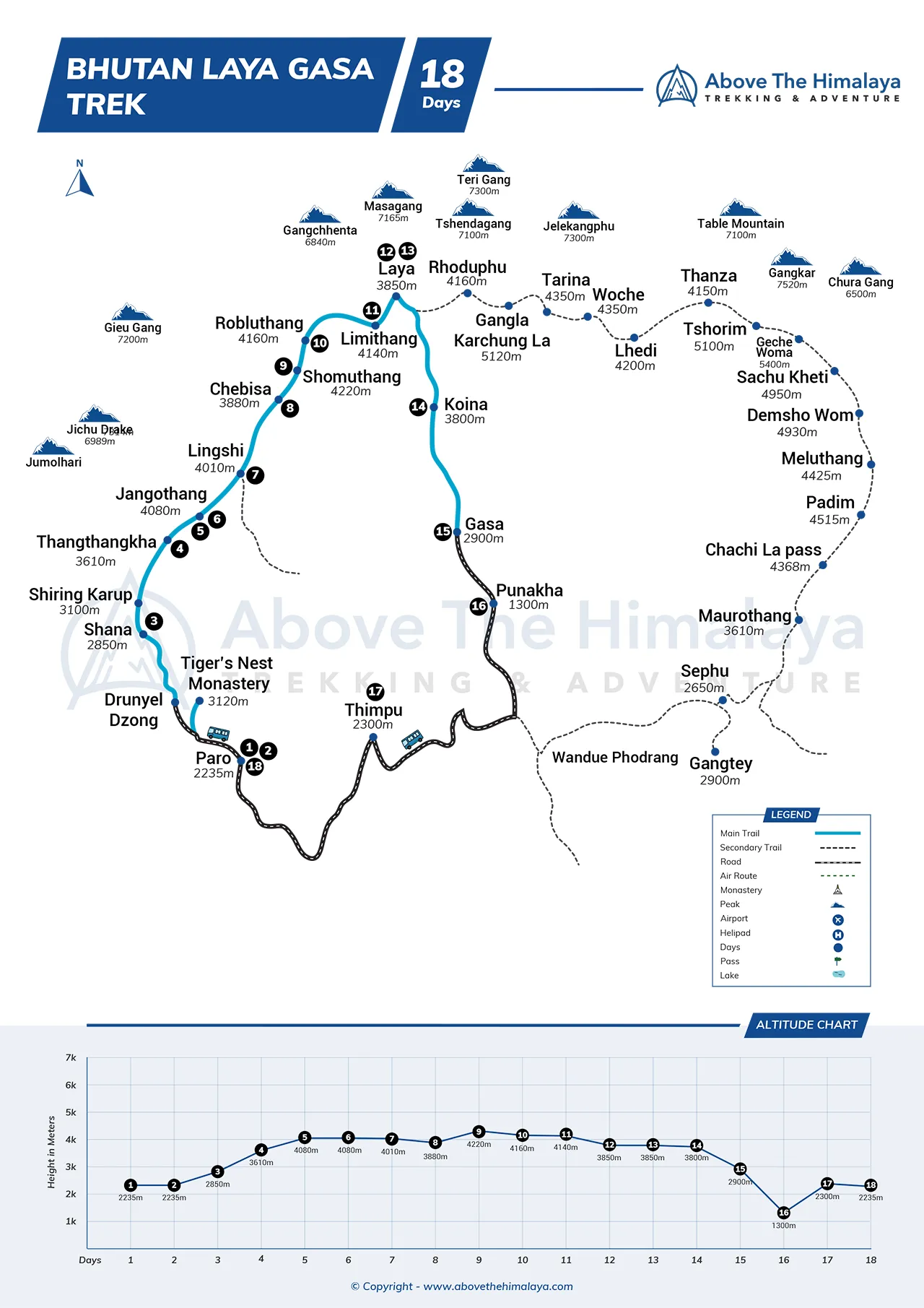
Route Map & Altitude Chart
Best Time
Bhutan has an extremely seasonal and altitudinal climate, which means that it is always important to plan your Bhutan Laya Gasa Trek in time. The most appropriate seasons to undertake this trek are spring (March to May) and autumn (late September to November).
These are months when the weather is most predictable, with blue skies in the daytime and relatively pleasant temperatures—perfect weather to do trekking and have a panoramic view of the mountain.
The months of June to August in Bhutan are in line with the monsoon. Such a lot of rainfall may cause the trails to be slippery and hazy. The Bhutan Laya Gasa trek is not as pleasant during the summer season since there are leeches in the lower forests and frequent downpours.
Winter (December to February) is also not advisable, as the temperatures drop significantly below freezing at high altitudes, and high passes such as Sinche La may be covered by snow.
A safe and joyful trip to Bhutan Laya Gasa requires you to plan your trip within the suggested seasons.
Foods and Drinks
There will be ample and hearty food to get you through the Bhutan Laya Gasa Trek. A mixture of Bhutanese and international cuisine is common in both the cities and at camp, especially in the menu.
You can take traditional red rice, vegetable and meat curries, soups, noodles, and bread as an example. As part of the trek, a support staff member or cook will prepare breakfast, lunch, and dinner every day. Hot tea, coffee, or hot lemon beverages are served to warm you up when it is cold in the mountains.
The crew boils and filters the drinking water at the campsites. It is safe to drink water, yet you can carry water purification pills or a filter to be sure of it on a day-to-day basis.
Difficulty and Altitude Sickness
The Bhutan Laya Gasa Trek is regarded as a difficult trek, and only trekkers with high-altitude experience or good fitness can do it. During this trip, you will walk a couple of days straight, in many cases 6-8 hours daily, on a path that may consist of sharp ups and downs and mountain passages.
The highest point of the trail is approximately 5,000 metres (16,400 ft) at the highest point (Sinche La). The altitude makes the thin air more taxing, therefore exerting more strain on the body, and presents the risk of altitude sickness at these altitudes.
Mild altitude sickness is characterised by such common symptoms as headache, dizziness, shortness of breath, or nausea. Our itinerary will ensure that you take time to acclimatise, such as having rest days (acclimatising days) at both Jangothang and Laya to acclimatise to the thinner air.
To remain safe at elevated levels, we recommend a slow pace of walking, proper hydration, and avoiding alcohol. Your knowledgeable guides will keep an eye on your well-being. In case any serious cases of acute mountain sickness arise, they will be able to react promptly—it can be either a reduction in the altitude or, in case of emergency, evacuation.
The Bhutan Laya Gasa trek has been accomplished by the majority of trekkers with rightful acclimatisation and care.
Preparation and Fitness
The Bhutan Laya Gasa Trek should be fun to enjoy, but it requires good preparation. We suggest that you begin training at least 2-3 months prior to your trip. Train your cardiovascular stamina and the strength of your legs because you will be walking long distances on days with only a day off in between. Hiking in hilly areas or stairs, jogging, cycling, and swimming are also good activities that enhance stamina.
Besides cardio training, light workouts on the strength routines can enable your muscles to survive steep climbs and descents. Exercises at elevations higher than your reach would be excellent for training your lungs. It is also crucially important that you break in your trekking boots and test your equipment before you hit the trail to prevent blisters or sore feet.
The psychological training is important as well. The Bhutan Laya Gasa Trek will see you experience remote locations with few amenities. Thus, you have to be prepared to accept rough conditions and possible weather variations.
Visa and Permits
The policy of tourism in Bhutan is very strict, and all foreign travellers (except those from India, Bangladesh, and the Maldives) are required to secure a visa prior to their arrival.
Bhutan visas can only be booked with the help of authorised tour operators like us via package tours.
After making your reservation with us, we will process your visa to Bhutan. You are provided with a visa clearance letter prior to your trip, and then present it at Paro Airport to have your visa stamped.
Besides the visa, trekking in the protected areas of Bhutan also requires a special permit. In the case of the Bhutan Laya Gasa trek, we have all the required permits, such as the Trekking Permit of the Tourism Council of Bhutan and access permits to such places as Jigme Dorji National Park and Gasa district. Most of these charges and permits are part of your package, and we will take care of all the visa arrangements and documents.
Health & Safety
The Bhutan Laya Gasa Trek is all about your safety. The trekking staff is supplied with trained, highly experienced guides who are well-informed about the route, high-altitude first aid, and emergency measures.
We have a first-aid kit and communications device, which are carried by our guides, and we will use these to check on your well-being every day. They are able to organise an evacuation in case of a critical health problem or injury, which is quite a rare case.
In case of an emergency, the helicopter evacuations are offered in Bhutan, and the travel insurance, which includes high-altitude trekking, is obligatory. We also behave proactively in the safety measures. The itinerary is planned and scheduled to have acclimatisation days in order to minimise altitude sickness.
Close attention is paid to weather conditions; in case any part of the plan is unsafe due to a storm or lots of snow, we will readjust the plan or wait it out instead of gambling.
Travel Insurance
A mandatory policy is that everyone who joins the Bhutan Laya Gasa Trek must have travel insurance. Since this is a far and elevated trek, you need trekking insurance that covers the trek up to 5,000 metres, and that incorporates emergency evacuation in the case of an emergency.
In choosing a policy, ensure that it includes medical treatment and evacuation in Bhutan, cancellation or interruption of the trip, and lost or delayed baggage. Carry a copy of your insurance certificate to Bhutan; at the briefing of the trip, our crew will record the emergency contact information on the insurance certificate.
Although we focus on safety and do all that is possible to avoid accidents, the thing is that good travel insurance gives you peace of mind. It will give you all the chances to enjoy your Bhutan Laya Gasa trek adventure, knowing that you are insured in all financial circumstances in case any emergency arises.
Your Extra Expenses
The package cost of our Bhutan Laya Gasa Trek is generally inclusive; however, you are expected to spend extra cash on other uninsured costs that you are expected to incur during your visit. International flights in/out of Paro, Bhutan, are not part of the trek price. These tickets have to be arranged and bought by yourself.
Travel insurance is also a mandatory cost that you have to do yourself, prior to the trip. Also, you will need to have a little money to spend on personal purchases. These are other snacks or drinks that we are not offering, such as soda, beer, or imported drinks during the trip; local handicrafts that you can buy as a souvenir; and any other shopping that you may have in the towns in Bhutan.
The other cost to consider is tipping, which is optional, but as a sign of appreciation, it is customary to tip your guide, drivers, and trekking crew at the end of a successful trip.
Incidentally, be sure to bring cash to tip and buy little things, and the ATMs will not be available on the trek. You should plan your additional budget such that you are very prepared with these items not provided in the budget.
Mobile Network, Internet, and Charging Facilities.
Among the refreshing things about the Laya Gasa Trek is the fact that you will be able to unplug from the digital world since, for the majority of the trek, you will not be connected to the grid.
Mobile networks will be available to you in big towns such as Paro, Punakha, and Thimphu, and your hotel is likely to have Wi-Fi. But as soon as you start hiking in the mountains, there is poor signal and no signal at all. It is a good time to take a good look at nature and the moment without any distractions.
No regular sources of electricity along the trail since the camping will be in remote areas. We have suggested carrying a power bank or additional batteries to ensure that your camera or phone can be charged to take photos. Make arrangements to be independent in terms of power and connectivity on this trip.
Attractions
It is not merely a walk through beautiful scenery; it is also combined with some of the most recognised cultural and natural sites around Bhutan on this Bhutan Laya Gasa trek. Your journey will start with the Tiger’s Nest Monastery (Taktsang), which is a Buddhist monastery built on the edge of a mountain rock and one of the leading attractions in Bhutan.
On the trail, it is nature that offers the attractions. You are going to see Himalayan peaks close at hand – it is an experience to recall when seen through Jangothang Base Camp, whether it is Mount Jomolhari (7,314 m). The road passes through the Jigme Dorji National Park and thus has an opportunity for wildlife, including blue sheep, takin (the national animal of Bhutan).
Another attraction is cultural encounters. Going to far-off areas such as Laya provides one with a glimpse into the world of the traditional high-mountain life.
Lastly, having the Gasa Hot Springs as the final reward of the trek, as well as the greatness of Punakha Dzong (a gorgeous riverside fortress of Bhutan), is a dream – a combination of adventure and cultural exploration.
Is it a beginner-friendly trip?
The Bhutan Laya Gasa Trek is longer and more difficult in Bhutan and is therefore not an ideal first trek for a complete beginner. Nonetheless, it is still possible to do it with trekking beginners who are highly enthusiastic and well-equipped.
The thing is that, in case you have never travelled on foot before, we recommend gaining some experience in terms of shorter multi-day tramps or high-altitude excursions before attempting Laya Gasa.
Most Asked Questions by Travellers
You will be walking between 5 and 8 hours on most days. There are also shorter days (3-4 hours), and some long days may go up to 8 hours of hiking.
Yes. We provide built-in rest/acclimatising days so that you can get accustomed to the altitude before proceeding to a higher altitude.
The trek is mostly camping. We offer tents and camping equipment. Hotels will be used in cities (Paro, Punakha, and Thimphu).
No, you just bring a daypack with all the necessities. Your main luggage, camping equipment and supplies, pack animals (yaks or horses), and porters will carry them.
Our staff are first aid trained. In case of necessity, we should be able to go down to the lower altitude or even organise the emergency evacuation (horse or helicopter), depending on the circumstances.
There’s no strict age limit. Age is not as important as good fitness and health in the Laya Gasa Trek.
Yes, we do have safe drinking water. At camps, our crew boils or filters water. You are supposed to carry a refillable bottle.
After leaving Paro, you will not have it easy finding stuff to purchase. In isolated places such as Laya, they only have small stores with simple items. To carry along any additional snacks or supplies is always good.
At the higher altitudes, you can come across such animals as yaks and blue sheep. The forests of Bhutan have takins, several kinds of deer, and a great number of birds.
Absolutely. Bhutan is quite a safe nation that has low rates of crime.
The ATM is located only in the cities of Paro and Thimphu and not in the mountains.
Tipping is not obligatory, yet welcome. At the end of the trek, many trekkers presently offer a group tip to the guide, porters, and the crew as a form of thank-you.
Carry Ngultrum or US dollars. The US dollars are readily exchanged or accepted in Bhutan.
Yes. The expedition finishes in Gasa Tshachu (Gasa hot springs). We normally get here in the afternoon, and you have time to relax or have a swim in the warm, mineral-laden pools.
According to Bhutanese regulations, one cannot do independent trekking without a guide. You have to walk with a licensed tourist guide.
We offer tents and sleeping pads. But you will need a good cold-weather sleeping bag (around -10°C). We supply all the other camping equipment.
Yes. Dress decently, but never take off your hat in places of worship. Request permission to shoot locals.
During the whole Laya Gasa Trek, you are going to walk approximately 200 kilometres (approximately 125 miles). This is distributed over approximately 14 days of actual trekking with different distances each day.
Reviews on Bhutan Laya Gasa Trek – 18 days
Be first to post a review in this trip.
Posted on Tripadvisor
 H H9 December 2025
Verified
Thank you for the best tour we have ever had! I planned to stay at the Everest View Hotel this time and travel there because I wanted to see Everest, the highest mountain in the world, slowly, but despite the short schedule due to my children's school, all I got was a response that it was difficult to contact several tour companies. The Himaraya Trekking, Above, has worked out a smooth and safe schedule and had the best experience for me and my family. I will never forget the view of Mount Everest. Thank you very much.Posted on Tripadvisor Mike F26 November 2025Another Amazing Trip with Above the Himalaya This is my 3rd trip with Above the Himalaya and Puru. Each trip with Puru has exceeded expectation with the quality of the guides, porters and attention to detail. We were a team of 5 trekker and our ages were all above 67 years of age with the oldest being 73. We are all experienced hikers and trekker and our plan was to trek up the Khumbu Valley to the Cho La pass to Gokyo to the Renjo La pass to return to Lukla. However, the weather altered our plans as Cyclone Montha blanketed the country in rain at lower elevations and significant snowfall at the upper elevations. Due to the weather, no one was trekking and everyone was staying put in their current location during the storm. All the passes were closed due to the deep snow. We were in Namche when the storm was blanketing the country.This is where Above the Himalaya really shines is in the ability to adapt to the changing conditions and our safety. In conversation with our lead guide, we decided to alter our route to trek through the Gokyo valley to reach Gokyo and then do the Renjo La pass. Sitaram our lead guide and Dhurba our assistant guide was both attentive to the changing conditions and always kept a keen eye for how we were doing and feeling on the trek. The pacing was excellent as none of us had any hint of altitude sickness as we reached a maximum elevation of 5,365m.Having trekked and hiked all over the world with different tour companies, Puru’s company is simply the best. The communications, focus on safety, the guides and staff, the accommodations, and the food are all amazing. All you have to do is focus on the beauty of the mountains, enjoy the joyfulness of the Nepali people and have fun exploring the trails. I am planning my next trip with Puru for 2027 as there is no other trekking company to match Puru’s level of service.Posted on Tripadvisor
 Mie K. A.25 November 2025Take a small step into the Himalayas I went with Above The Himalaya Trekking’s Everest View Hike in November 2025 and can only recommend with my whole heart!I had never visited Nepal or the Himalayas before and had a life long dream of seeing Mt Everest. I had though, hiked a lot in various parts of the world, but never above 2000 m, so I went with the five day Everest View Trek to take a small step and see how I would handle the altitude. From first enquiry about dates and various questions, to my arrival back from the trip, Puru has been an invaluable help, always standby on mail and WhatsApp, pulling strings and making things happen.Also big shout out to the amazing guide I was teamed with, Kamal, who did everything he could to answer all my curious questions about vegetation, animal life, Nepalese culture and everything in-between :) Kamal was the perfect gentleman, offering little treats and reminding me to take breaks, and all in all I felt very safe and in good hands all the time. He also had good banter and jokes, which lifted the spirit of even the hardest climb.It was cold most nights and mornings and even though the tea houses provided heavy blankets (and I could borrow extra) I was glad I had the sleeping bag with me, which I rented through Puru. But I could definitely have survived without and saved the space in my pack.In total, I’m very pleased I’ve got to experience this lovely country with Above the Himalaya Trekking and if I ever come back for the big leap into the mountains, I’ll chose Kamal and Puru all over again :)Posted on Tripadvisor
 nameless25 November 2025Nepal trek-Gokyo Second trek with Above the Himalaya, this time to Gokyo and over Renjo La. Our lead and assistant guides (Sitaram and Dhurba) were excellent. Due to several days of rain at lower elevations and snow higher we needed to change our plans while in the midst of our trek. Above the Himalaya accomplished this smoothly and flawlessly, which ultimately resulted in a better experience. We’ll be back!Posted on Tripadvisor
 Yu S22 November 2025Great Experience and Friendly people. We had a great time with Above the Himalayas tour company in Oct. Ajay, the tour guide in Kathmandu is very friendly and knowledgeable. He took us to a lot of places that we can experience local authentic daily life. Puru, the owner, arranged and organized our trip in such way that we really feel comfortable and enjoyable. We are specially impressed by his quick action and management skills. Our flight to Pokhara got cancelled due to bed weather. Within minutes, Puru was able to arrange a car and a driver to drive us to Pokhara! It saved out trip.Posted on Tripadvisor
 Sally M14 November 2025Glorious trekking experience - ABC We had the most wonderful experience doing the Annapurna Base Camp trek with our fabulous guide, Tanka, and porter, Ravi. The trek was glorious, despite some rainy days, and although we weren't sure we would get to see the peaks at ABC, the weather cleared just in time and we had an amazing sunrise there. What made the whole trip so special, though, were Tanka and Ravi, who remained cheerful at all times and went out of their way to make everything as good as it could be. This included setting a pace with regular breaks which made the walking completely manageable, modifying the itinerary so we could visit additional villages, getting up in the middle of the night to see if the sky would be clear for sunrise, and bringing a sense of ease and humour to all our interactions. We just loved the whole thing and are keen to return to Nepal for another trek. It was magical!Posted on Tripadvisor
 Peter E27 October 2025Above the Himalayas goes above and beyond expectations! From start to finish everything was perfect! Puru, the managing director, was always quick with his responses to my questions when I first contacted him about planning our trek, and he continued to check to see that everything was going well throughout.Our guide Tanka and porter Ravi were fantastic! Their friendly demeanor kept our experience lively and interesting the entire time and made sure that we were well taken care of. Even small details like Ravi coming in and double checking our rooms to see that we had left nothing behind before leaving each morning, and seeing that meals were prepared the way we liked them weren't overlooked. Tanka was also quite knowledgeable about the mountains, the people, and just about everything "Nepal". He enthusiastically shared stories about his family and Nepalese life in a general way.Although there was a clear itinerary each day, and for the whole trek, Tanka allowed for flexibility in terms of time and where to stay. He was even willing and able to make changes to same-day accommodation based on how far we anticipated hiking that morning. I can't say enough about how much we enjoyed our hike and I would definitely recommend Above the Himalayas for anyone considering a trek.Posted on Tripadvisor
 Akane U25 October 2025Amazing tour For me and my son, Pru thought of a four-day trekking tour.His interaction was very smooth.On the first day, I went with my son to Gandrouk, and on the second day, he went to a higher place (mulde view point, Poon hill) with his guide Ashok. Ashok was very kind and took me to various local places. The food was also very good.My guide, Tangka, was very kind and helped me a lot.I recommend this travel agency because it's great.Posted on Tripadvisor
 Daniel F24 October 2025Everest Base Camp Trek My friends and I just completed the EBC trek. From the time I met Puru at the Canada Place trade show in Vancouver BC, Canada I felt comfortable going to Nepal. His communications via WhatsApp were seamless answering all our questions. Everything went exactly according to plan. Our guide Suresh was amazing. He took very good care of us the whole time. From guiding us to making sure we had everything we needed to be happy. The food the whole way up and back was amazing! 5 ⭐️. Our 2 porters were great as well. I have a whole new respect and appreciation for what they do. They are the true hero’s to what we can do as a team. We chose the basic trek the lodging was to be expected. If I was to do again I would choose the luxury trek. The hotels in Kathmandu at the Hotel Aloft and the Hotel Lo Mustang were top notch as well as the buffets. Highly recommend this local company!Posted on Tripadvisor
 adrienne h24 October 2025Great tour, would recommend! My friend and I completed the 10 day Annapurna circuit with Above Trekking Himalaya. Buddha our porter was a little mountain goat, pocket rocket. When I got altitude sickness he carried my bag, as well as mine and my friend’s big pack. He was friendly and loved to played cards with us, always with a cheeky smile on his face. Sitaram our guide was very knowledgeable of the area and quite serious. He was always available if we had any questions and went above and beyond to try get us the best/quietest rooms in the tea houses. Puru was fabulous working behind the scenes to ensure our trip was as smooth as possible. He was very quick to respond to any messages. It was a great experience to see Nepal with some locals and I certainly appreciated their support when I succumbed to altitude sickness. They stayed close to us the whole time and checked in frequently making us feeling safe and supported the entire time.Verified by TrustindexTrustindex verified badge is the Universal Symbol of Trust. Only the greatest companies can get the verified badge who has a review score above 4.5, based on customer reviews over the past 12 months. Read more
Book with Confidence
- Flexible bookings and easy trip date changes
- Personalized service and customized group sizes
- Safe travels with owner-operated services and highly experienced guides
- Best price guarantee for the most value for your money
- Secure & easy online booking
Your Trek Leader
 Enjoy Himalayan scenery with the help of Nepal’s best guides with Government license holders and got training in first-aid, our Trip Leaders, know where you’ll find the best photos, most fascinating wildlife, and the best stream crossings.
US$ 7200 Per Person
Have Questions?Talk to Expert
Meet Mr. Purushotam Timalsena (Puru), Nepal's best trek and tour organizer, who has been working in the Himalayas for more than 24 years.
WhatsApp/Viber +977 98510 95 800



Trips for All

Private Trip
Peaceful tour with your travel buddy and guide
Small Group Travel
Travel with people having similar adventure dreams
Trips for Kids
Calling all young adventurers - join us for a journey of a lifetime!
Trips for Adventurers
Climbing & mountaineering adventures for thrill-seekers