notification-icon
Booking open for Kailash Mansarovar Yatra 2026 & 2027 View Dates

Mardi Himal and Khopra Danda Trek – 13 Days

Best Price Guaranteed, Easy to change Date, Instant Confirmation

Book This Trip
Trip Duration 13 days
Group Size 1-16
Maximum Altitude 4500 m
Difficulty Grade Moderate
Start & End Point Kathmandu/Kathmandu
Best Seasons Mar-may & Sep-Nov

Trip Highlights of Mardi Himal and Khopra Danda Trek – 13 Days

  • Off-the-beaten-path Annapurna journey: Mardi Himal with Khopra Danda trek ridges
  • Stunning sunrise panorama from Poon Hill (3,210m) and Mardi Himal Base Camp (featured on this Mardi Himal with Khopra trek)
  • Breathtaking views of Annapurna, Dhaulagiri, Machhapuchhre (Fishtail), Nilgiri, and more
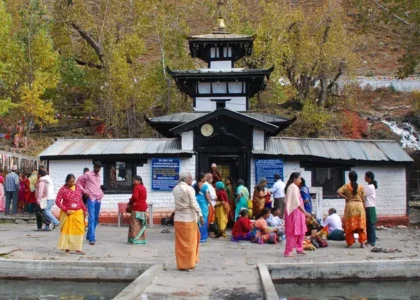
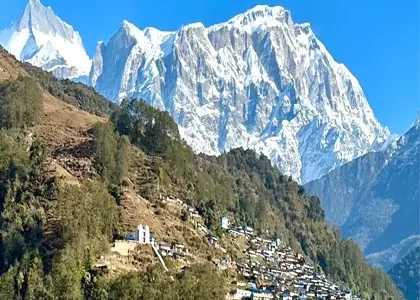
  • Cultural experience in Ghandruk (Gurung heritage village) and Swanta (Magar community)
  • Optional visit to relaxing natural hot springs at Jhinu Danda on extended Mardi Himal and Khopra Danda Trek itineraries
  • Comfortable mountain lodges and Nepali meals en route

Overview of Mardi Himal and Khopra Danda Trek – 13 Days

The Mardi Himal and Khopra Danda Trek is a peaceful and beautiful 13-day journey in the Annapurna region of Nepal. This journey is a combination of the two fantastic ridge walks in a single circuit and provides you with close mountain breaths, serene woods, and cordial village warmth. The hike will bring you to the Mardi Himal Base Camp at an altitude of four thousand five hundred meters and Khopra Danda at an elevation of three thousand six hundred sixty meters.

In either location, you have the sunrise view of Annapurna South, Machhapuchhre, also known as Fishtail, Dhaulagiri, and most of the other high mountains. You begin your trip in Kathmandu and then move to Pokhara, where you have a night’s rest before the walking starts.

The name of the company can be mentioned in the second paragraph. Above The Himalaya organizes the Mardi Himal and Khopra Danda Trek with experienced guides who manage permits, logistics, and daily planning.

You drive to Dhampus village after spending time in Pokhara to begin the walk. This hike is said to be medium-level, and most days are five to seven hours of hiking leisurely. It would be appropriate for those who are active travelers who like mountainous and peaceful nature paths. During the first week of the Mardi Himal and Khopra Danda Trek, you walk through

Dhampus, Landruk, and Ghandruk. The lower sections of the trail are in rhododendron and oak forests. On your way up the mountain, you pass Forest Camp and High Camp at three thousand six hundred meters.

On the fifth day, you get up early in the morning and walk to Mardi Himal Base Camp. It has an open view that offers a peaceful and memorable view of the sunrise with high mountains. You descend to Low Camp at three thousand five hundred meters after having enjoyed the view. The second part of the Mardi Himal and Khopra Danda Trek takes you toward Bayeli Kharka and then gently up to Khopra Danda.

This ridge is characterized by broad sights of the Annapurna, Nilgiri, and Dhaulagiri ranges. You spend your night in basic and welcoming teahouses and have had a warm meal made by the local Gurung and Magar communities. Their hospitality provides you with a close-up view of everyday mountain life and makes the trip more personal.

The route starts at Khopra Danda and descends to Swanta village and then to Ghorepani. On the twelfth day, you hike to the renowned Poon Hill view at three thousand two hundred and ten meters. The Himalayan ranges are fully visible at sunrise here.

Following this, you take a walk down to Ulleri and Birethanti and drive back to Pokhara, then return to Kathmandu on the final day to conclude the Mardi Himal and Khopra Danda trek.

The Mardi Himal and Khopra Danda Trek is a wonderful blend of nature, culture, and peaceful walking trails. The gradual acclimatization and the assistance of the team every day enable you to have fun in the mountains in a safe and comfortable manner. This is an ideal trip for those who seek a secluded and satisfying trekking activity in the Annapurna area.

Itinerary of Mardi Himal and Khopra Danda Trek – 13 Days

DAY
01

Day 01: Kathmandu to Pokhara

Mardi Himal and Khopra Danda Trek begin early with pickup from your Kathmandu hotel for the drive to Pokhara.

The journey to Pokhara is scenic: you will descend the Kathmandu Valley and follow the Prithvi Highway through terraced farmland, pine forests, and small villages.

Keep your camera ready — on a clear day, you may glimpse peaks like Manaslu and Ganesh Himal as you leave Kathmandu.

You will enjoy a roadside lunch en route (often included), then continue the winding drive. You will pass rural towns and valleys, making stops as needed. The bus has large windows, so be sure to look around at hillside villages and river gorges.

On a clear morning, you may even see Machhapuchhre (Fishtail) reflected on Phewa Lake as you approach Pokhara.

You will arrive in Pokhara in the late afternoon. Pokhara is the gateway to the Annapurna Conservation Area and sits beside the beautiful Phewa Lake (820m).

In the evening, you are free to explore Lakeside Bazaar: stroll by the lake, shop for trekking gear or souvenirs, or dine in a lakeside restaurant with mountain views. You will sleep overnight at a hotel in Pokhara.

Jeep 6-7 hrs
Accommodation Hotel
Meals Lunch & Dinner
Altitude 1350 m
DAY
02

Day 02: Pokhara to Dhampus, Trek to Deurali

After breakfast in Pokhara, you will drive northeast for about 2 hours to the hillside village of Dhampus (1,640m).

The Jeep road offers panoramic views of the Annapurna peaks and Machhapuchhre above terraced fields. From Dhampus, the trail begins on stone steps through local farms.

There is a small viewpoint cafe that overlooks the mountains, a good spot for photos. You will continue on a gentle climb, passing traditional Gurung houses, prayer flags, and emerald forests. Soon, the path enters dense oak and rhododendron woods.

As you ascend, you feel cool air and the trail winds among bamboo groves. Mid-morning, you will cross a bridge over a stream and see a small waterfall.

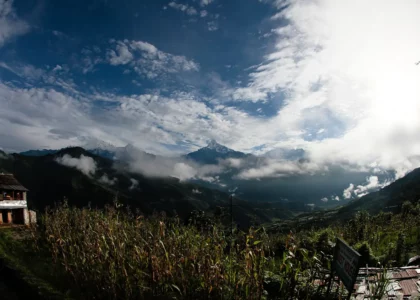
By mid-afternoon, you will reach Deurali (2,100m), a peaceful meadow with broad views of the Annapurna range. Machhapuchhre (Fishtail) often leads the skyline from here.

There are a bunch of tea houses in Deurali. You can relax in the lodge with hot tea and watch the clouds on the peaks. You will sleep overnight at the Deurali lodge.

Jeep 2 hrs
Accommodation Teahouse
Meals B L D
Trek Duration 4-5 hrs
Altitude 2100 m
DAY
03

Day 03: Trek Deurali to Forest Camp

Today you will enter the silent forest. The path ascends with maple, birch, and bright red rhododendron trees. Such flowers are the national flower of Nepal, and they are quite beautiful during the month of April and May.

There will be birds singing overhead, and the sunlight going gently through the leaves. Cowbells or a little stream, you will hear at times. You will then have lunch after a couple of hours at a plain teahouse and a good view.

Then, after lunch, you will walk a ridge, past a small wooden bridge over a creek. The ascent is gradual yet not extreme. The path goes a little down and then up again.

You will soon have a sunny clearing at Forest Camp, two thousand six hundred meters. It is a silent field and some stone lodges.

Here we start seeing Annapurna South and Hiunchuli. The Machhapuchhre peak also sometimes appears behind a hill. The mountains are usually coloured pink by the evening light.

You will rest in the lodge and take tea in the fresh mountain air. Overnight Forest Camp lodge.

Accommodation Teahouse
Meals B L D
Trek Distance 6 km
Trek Duration 5-6 hrs
Altitude 2600 m
DAY
04

Day 04: Forest Camp to High Camp

You will leave Forest Camp and keep climbing. The route goes up the mountainous region of the final forest and into the alpine open land.

At the midway you will come to Low Camp at an elevation of approximately three thousand and fifty meters, and you will have a brief rest.

Rocky Ridge: The trail is steeper after Low Camp. Here air is thinner, and trekking poles will assist you. By afternoon, you will get to High Camp. High Camp has a simple but cozy lodge, which has a single main dining room and a wood stove.

This is where you will have expansive glimpses of Annapurna South, Hiunchuli, and Machhapuchhre. This height is typically characterized by a sky which is very clear.

You will spend your time outside in the air, and perhaps see big birds such as vultures in the air or lammergeier flying above. It is cold at High Camp by night, but the warm dinner will be nice. When the sky is clear, the stars will shine brightly and beautifully.

Accommodation Teahouse
Meals B L D
Trek Distance 8.5 km
Trek Duration 4-5hrs
Altitude 3600 m
DAY
05

Day 05: Mardi Himal Base Camp (4,500m) and down to Low Camp

You will get up very early before sunrise and start the last ascent to Mardi Himal Base Camp. The initial two hours are steep, and thus you will be using a headlamp until the sky is bright.

By daybreak, you will get to the base camp, four thousand five hundred meters. These mountains are high and enclose this broad field.

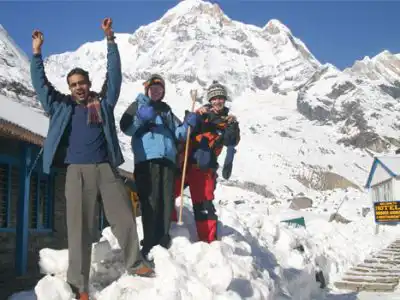
You will find Annapurna One, Annapurna South, Hiunchuli, Tent Peak, and the sharp top of Machhapuchhre gleaming in the morning sun. You will take some photos and admire the calm scene.

Then you will go down the same path you have come. The stroll is extensive but less difficult than the ascent. Hot dal bhat and tea will be delicious when you reach Low Camp in the evening. Here you will sleep much better, as this air is not so cold.

Accommodation Teahouse
Meals B L D
Trek Distance 10 km
Trek Duration 7 hrs
Altitude 4500 m
DAY
06

Day 06: Low Camp to Landruk

You will go through a pine and bamboo forest. The initial section is hilly, so trekking poles will support your knees. The trees reappear with Annapurna South.

You will go on until you arrive at the big Gurung village of Landruk at one thousand five hundred and sixty-five meters. There are stone houses and small fields, and friendly people of Landruk.

In the afternoon, you will have a look around the village. You can go and see the little Gurung Museum to know more about the local culture.

You will stay in a small teahouse and have a warm dinner as the mountains change in the evening.

Accommodation Teahouse
Meals B L D
Trek Distance 8 km
Trek Duration 5hrs
Altitude 3050 m
DAY
07

Day 07: Landruk to Tadapani (via Ghandruk)

After breakfast, you will start by walking down a stone staircase towards the river called Modi Khola. You will walk on a wooden suspension bridge, and you will then begin to climb through dense trees.

You will reach one of the beautiful villages in the country, Ghandruk, by mid-morning. Ghandruk is associated with stone paths and an incredible view of Annapurna South. Here you will have tea or a brief visit. You will resume climbing after lunch to Tadapani.

The path cuts through rhododendron and oak. You will reach Tadapani towards the end of the afternoon after a gradual uphill climb.

Sunset colors can be observed on Annapurna South and Hiunchuli seen through the lodges. At night, you will camp in Tadapani.

Accommodation Teahouse
Meals B L D
Trek Distance 10.9 km
Trek Duration 6-7hrs
Altitude 2610 m
DAY
08

Day 08: Tadapani to Bayeli Kharka

After breakfast, you will go out of Tadapani. The path cuts through wood, then gradually clears into the upland. You will ascend a ridge having broad horizons. There are moments when you can come across yaks or blue sheep.

By noon, you will arrive at the open grass of Bayeli Kharka, three thousand four hundred and fifty meters. Herders use this meadow during the summer and provide beautiful scenery, especially the west view of Dhauligiri.

Here you will remain at a small community lodge. It can be a windy, clear afternoon. You will have the scenic environment and can share tea with the other trekkers in the dining room. On a clear night sky, you will gaze at the stars and then go to sleep.

Accommodation Teahouse
Meals B L D
Trek Distance 5.8 km
Trek Duration 5-7 hrs
Altitude 3450 m
DAY
09

Day 09: Bayeli Kharka to Khopra Danda Ridge

After breakfast in Bayeli Kharka, you will trek up to Khopra Danda (3,660m). The trail is mostly grassy with occasional patches of forest and bamboo.

As you climb, the panorama expands: you’ll see the 1,000-meter faces of Annapurna South, Nilgiri, and towering Dhaulagiri. The final ridge walk is beautiful and takes about 4-5 hours.

Along the way, you might see herds of yaks and local shepherds. By midday, you will reach Khopra Danda, a long grassy ridge topped by a small community lodge.

This is one of the trek’s most satisfying spots: a 270° panorama of Himalayan giants. You’ll see the mountains turn purple and pink as the sun lowers.

You will spend the afternoon walking up to the highest points on the ridge. You will stay overnight at the Khopra Danda lodge.

If you have an extra day, you can also hike from Khopra Danda to the sacred Khayar Lake on a long full-day excursion (about 6–9 hours round trip) and return to sleep again at Khopra Danda.

Accommodation Teahouse
Meals B L D
Trek Distance 8 km
Trek Duration 5 hrs
Altitude 3660 m
DAY
10

Day 10: Khopra Danda to Swanta

From the Khopra ridge, you will begin a long descent to Swanta (2,214m). The trail winds down through forest and pasture.

Otherwise, you will continue descending through rhododendron and pine woods, enjoying the steep views behind you. In the afternoon, you will arrive at Swanta, a quiet Magar village.

Swanta is known for its community cheese factory. You can visit the Cheese House to see how local cheese and chhurpi (hardened cheese) are made. The local lodge, Hotel Candle Inn, offers warm meals and often has a sunflower field.

Swanta lies at 2,214m, so the air here feels noticeably warmer than in higher camps. You will stay overnight in Swanta lodge, where you can relax after the descent.

Accommodation Teahouse
Meals B L D
Trek Distance 9.6 km
Trek Duration 4-5 hrs
Altitude 3660 m
DAY
11

Day 11: Swanta to Ghorepani

After breakfast, you will climb through bamboo and tall rhododendron groves, crossing a few small streams. Around midday, the forest thins and you appear at Ghorepani (2,880m), a large village that is a popular stop on the Poon Hill trail. Ghorepani has numerous teahouses, many offering attached bathrooms and beds.

You will arrive at Ghorepani by early afternoon and take a rest, enjoy lunch, and soak in the views of Annapurna and Dhaulagiri from the village rim.

In the late afternoon, you might stroll around Ghorepani – some trekkers try fresh rhododendron honey or hot lemon tea.

Ghorepani provides a chance to charge your devices and warm up by the fire. As night falls, you will get to bed early for the sunrise hike tomorrow.

Accommodation Teahouse
Meals B L D
Trek Distance 8 km
Trek Duration 5 hrs
Altitude 2880 m
DAY
12

Day 12: Poon Hill (3,210m) and trek to Pokhara

You will wake up very early (around 4:00 AM) and trek up to Poon Hill (3,210m) before dawn (about a 30-40 minute hike). At the summit of Poon Hill, you’ll join fellow trekkers for a famous sunrise viewpoint.

From this vantage, you will see a 360° panorama: dozens of Himalayan peaks (Annapurna I, Dhaulagiri, Machhapuchhre, etc.) light up as the sun rises.

After enjoying sunrise and photos, you will trek back to Ghorepani for breakfast. Then continue descending via Ulleri and Nayapul. You will pass by waterfalls and river gorges on the way down.

By late morning, you will reach Nayapul (1,040m), where your private vehicle awaits. You will drive about 2-3 hours back to Pokhara.

Upon arriving, you will check into your hotel and relax (hot showers and soft beds at a good hotel feel great after trekking). The evening will be free in Pokhara.

Jeep 2 hrs
Accommodation Hotel
Meals B L
Trek Distance 12.5 km
Trek Duration 4-5 hrs
Altitude 3210 m
DAY
13

Day 13: Pokhara to Kathmandu

After breakfast, you will board the tourist bus or private coach for the drive back to Kathmandu. The Prithvi Highway winds along rivers and through forested hills.

You may stop for lunch or breaks at riverside cafes. If time permits, you could take a short visit to Budhanilkantha Temple or the towns of Trishuli Bazaar.

On a clear day, you can enjoy one last view of Ganesh Himal or Langtang in the distance. You will arrive in Kathmandu by early evening, which concludes the Mardi Himal and Khopra Danda trek.

You will check into your hotel in Kathmandu, and you may wish to enjoy a final Nepali meal in Thamel or reflect on your adventure with fellow trekkers.

Jeep 6-7 hrs
Meals Breakfast
Altitude 1350 m

Trip Extension

Suppose you have more time in Nepal after this trip. In that case, we can help you to extend your trip by running different treks in Nepal, tours in Bhutan and Tibet, Jungle safari tours at Chitwan, Bardia, and other National parks, Nepal luxury hotel booking, Rafting, Ultra-light flights, or any other travel-related services. You can get more information here.

Includes/Excludes

What's Included?
  • All ground transportation: Kathmandu–Pokhara–Kathmandu by tourist bus; transfers Pokhara–Dhampus (trek start) and Birethanti/Nayapul–Pokhara (trek end) by private Jeep or van
  • Airport transfers in Kathmandu (to/from hotel)
  • Accommodation: 2 nights in Pokhara (hotel with breakfast), 10 nights in mountain lodges (twin rooms)
  • Meals on trek: all breakfasts, lunches, and dinners during the trekking days with a mix of local and Western dishes (dal bhat, soups, pasta, etc.)
  • Guide & Porter: English-speaking licensed trekking guide and porters (1 porter per 2 trekkers) to carry baggage
  • Trekking gear: sleeping bag, down jacket, and duffle bag can be provided on loan if needed (to be returned after the trek)
  • Permits & Fees: Annapurna Conservation Area Permit (ACAP) and TIMS card
  • Cultural: Farewell Nepali dinner with performance and trek completion certificate
What's Excluded?
  • International flights to/from Nepal
  • Nepal entry visa fees and travel insurance
  • Meals in Kathmandu/Pokhara (except breakfasts included) and any snacks/drinks beyond included meals
  • Personal expenses (laundry, hot showers, Wi-Fi/charging fees, drinks, etc.)
  • Optional activities (e.g., paragliding in Pokhara, temple entry fees)
  • Tips/gratuities for guide, porter, and driver (suggested USD 3–5/day for guide, 2–3/day for porter)
  • Emergency evacuation or medical costs (helicopter rescue, hospitalization)
  • Any cost due to changes or delays (weather, strikes, etc.)

Trek Difficulty

The Mardi Himal and Khopra Danda Trek is rated moderate. Trekkers hike about 5–7 hours per day on uneven mountain trails. The path involves steep ascents and descents but no technical climbing. Each day you cover around 6–10 km, often on stone stairways or rocky ground.

The highest altitude is 4,500m (Mardi Himal Base Camp). Although physically challenging, the climbs are spread over many days with rest stops. With training and a steady pace, fit hikers of most ages can handle this trek.

Weather & Best Season

Spring (March–May) and autumn (Sep–Nov) are ideal. Spring brings blooming rhododendron forests and clear skies; daytime highs reach 15–20°C while nights are cool. Autumn has stable weather and warm days with cool nights.

Winter (Dec–Feb) is much colder at altitude (night temperatures often below –5°C at base camp) and possible snow on trails. Monsoon (Jun–Aug) means heavy rains, slippery paths, and occasional landslides. Humidity is high in summer. No season is truly dangerous if prepared: rain gear and warm layers are essential any time outside the peak seasons.

Food & Drink

On the Mardi Himal and Khopra Danda trek, meals are served at teahouses. Typical dishes include dal bhat (rice with lentils and curries), vegetable stews, noodles, pasta, fried rice, and soups. Breakfast offers eggs, porridge, pancakes, or toast. Western foods like pasta, pizza, and sandwiches may also be available.

All meals on trekking days (B/L/D) are included. Always drink plenty of fluids: boiled or filtered water is provided at lodges (bottle price NPR 150). Carry water purification tablets or drops as backup. Snacks (energy bars, nuts, chocolate) are handy. Note: altitude may decrease appetite, thus eat frequently. We can choose vegetarian and vegan options, but we should notify in advance.

Altitude Sickness

The effects of altitude (AMS) can appear above about 3,000m. Common symptoms include headache, nausea, dizziness, and fatigue. Risks can be reduced by ascending gradually, staying well hydrated, and eating enough carbohydrates. Avoid sleeping pills and alcohol.

The Mardi Himal and Khopra Danda Trek gains altitude slowly with plenty of breaks to help your body acclimatize. Avoid sleeping pills and alcohol. The itinerary will be in such a way that it acclimatizes slowly, and we have rest days.

Consult a doctor about taking Diamox (acetazolamide) before the trek. Our guide monitors your condition and carries oxygen. If someone shows severe AMS (confusion, severe headache, breathlessness), the protocol is immediate descent 500–1000m. The guides will not hesitate to evacuate you if needed because your safety is the priority.

Preparation & Fitness

Start training four to six weeks prior to your departure. To increase stamina and strengthen legs, do some easy cardio activity such as brisk walking, jogging, or cycling. Training: Hiking up a hill with a backpack of about five to seven kilograms. Long stair sessions or walks are also beneficial daily.

Simple exercises like squats and lunges can be tried to alleviate the knee strain. In case you have health concerns related to the heart, lungs, or knees, then you should visit your physician before the trip.

Wear trekking boots that are already worn and have warm layered clothes. Having mental preparedness is also crucial. Anticipate shifting mountain weather and moderate and slow speed. Even ordinary walking is more of a challenge at higher altitudes, and thus gradual fitness preparation makes the process of the journey less difficult.

Visa & Permits (Mardi Himal and Khopra Danda Trek)

International visitors will be able to acquire a Nepal tourist visa at Kathmandu airport in most cases. A 30-day visa currently costs around USD 50 as of 2025. Check the validity of your passport for at least six months. On arrival at the airport, you fill in the easy forms and pay the fee in US dollars.

To do trekking in the Annapurna region, you require an Annapurna Conservation Area Permit, which costs around twenty-five US dollars, and a TIMS card that costs around seventeen US dollars. Above The Himalaya will do these permits.

Do not leave a copy of your passport or any permits behind. The permit charges are used to sustain and protect the local environment and community, thus, do not disrupt the plants or wildlife.

Health & Safety

Your safety is very important during the Mardi Himal and Khopra Danda trek. Do not forget to take simple precautions of health prior to traveling. It is also convenient to be informed about vaccinations like tetanus, hepatitis A and B, and typhoid. Keep a little first aid kit of bandages and your own medicines. Only drink boiled or purified water and avoid raw or unhygienic foods such as unwashed salads.

It is sunny in the mountains, and they need sunscreen, SPF lip balm, and proper sunglasses. Weather changes quickly during the Mardi Himal and Khopra Danda trek, so dress in warm layers. Accommodation is clean, although toilets are sometimes squat, and bring tissue.

Use trekking poles when going downhill in order to protect your knees. Helicopter rescue can be used in case of an emergency, but this is quite expensive. High altitude rescue travel insurance is required. Your guide will inspect the state of all people in the trek every day and provide safety measures during the journey.

Transportation

The Mardi Himal and Khopra Danda Trek includes both road travel and walking. The ride between Kathmandu and Pokhara can be undertaken in six to seven hours using tourist buses or private coaches. The road is paved but winding. You can also take a short flight between Kathmandu and Pokhara.

We also go by local Jeep or van from Pokhara to Dhampus, over gravel roads, and it takes approximately two hours. And at the completion of the walk, you will be transported back to Pokhara in a Jeep either at Nayapul or Birethanti. All local transport needed for the Mardi Himal and Khopra Danda Trek is included. Occasionally, there is a landslide or strike on Nepali roads, and we therefore find other alternatives.

Travel Insurance

Travel insurance is required for anyone joining the Mardi Himal and Khopra Danda trek. The trekking to a maximum of four thousand five hundred meters, emergency medical attention, and helicopter evacuation should be included in your policy.

Helicopter rescue is not covered by some basic plans and therefore, be careful about your policy. Always keep a copy of your insurance with you. In case of a severe illness or accident, evacuation will be organized on the spot. This would be very costly without insurance.

Alternative Routes

There are several route options for the Mardi Himal and Khopra Danda trek. To reduce the trip time, you may save yourself the Poon Hill part and head down towards Ghandruk straight. Some tourists also continue their journey from Ghorepani toward Annapurna Base Camp, which adds several extra trekking days (usually 3–4) and provides additional mountain views.

The other alternative is that once the Khopra Danda part had been completed, visiting the hot springs at Jhinu Danda, then taking the road. Other trekkers begin at Lumle as opposed to Dhampus to minimize the driving time. Discuss with us any route changes due to weather and trail conditions, which determine what can be done.

Your Extra Expenses

Carry enough Nepalese Rupees for personal expenses during the Mardi Himal and Khopra Danda trek. The average amount that most trekkers pay for drinks, snacks, and small tips is about one thousand five hundred to two thousand rupees per day. The bottled water is one to two dollars, but boiling or filling water is less expensive. Hot showers cost between two hundred and three hundred rupees.

Pokhara and certain lodges in Ghorepani have Internet at a low charge. Coffee, tea, and soft drinks take one hundred and fifty to three hundred rupees. Energy bars or cookies cost approximately one hundred and two hundred rupees.

As a tip, you should give three or five dollars each day of the trek to your guide, and two or three dollars each day to your porter. The mountain villages do not have any ATM machines; hence, get sufficient cash in Pokhara.

Language & Communication

The national language is Nepali, and in the villages, you can also hear the Gurung language and the Magar language. Your guide is fluent in English, and most of the lodge proprietors know a little English; hence, communication should not be a problem. Simple words in the Nepali language, such as Namaste or Dhanyabad, make it easy to feel friendly.

Mobile connections like Ncell and NTC are functional in the location as far as Tadapani or Ghorepani. Higher points on the Mardi Himal and Khopra Danda trek, especially near Khopra Ridge, often have no signal. Other lodges also charge phones at a small fee. You can use offline maps, which is a good idea in case you need to follow your route.

Mobile Network, Internet & Charging:

You may purchase a local SIM card in Kathmandu or Pokhara. SIM cards work well in lower villages along the Mardi Himal and Khopra Danda trek, but higher areas usually have no coverage.

The majority of lodges are either solar powered or have generators and have power charging devices at a fee. Always have a power bank since power outlets are not always present. Outside Pokhara and Ghorepani, wifi is not reliable; do not rely on it. Carry additional memory cards in case of photos.

Don’ts on this Trip

Respect nature and local culture throughout the Mardi Himal and Khopra Danda trek. Do not litter the path and attempt to minimize single-use plastics. Do not take flowers or disturb animals. Request permission before making photographs of individuals or places of worship. Wear simple clothes in the villages and take off shoes when entering households or temples.

Do not smoke or drink alcohol on the days you are trekking, as this dehydrates you. Speak in a low tone in order to preserve the calm atmosphere. Keep to marked paths and never try to take shortcuts. Stick to your guide and keep the whole group together.

Trip Extension

You can extend your trip before or after the Mardi Himal and Khopra Danda trek. In Kathmandu, visit the heritage sites such as the Swayambhunath or the Durbar Square of Patan and Bhaktapur.

Additionally, in Pokhara, you can do paragliding, boat rides in Phewa Lake, go to Devi Falls, or visit the Tibetan refugee settlement. A jungle safari in Chitwan can also be added, or a cultural visit to Lumbini. We can assist in the arrangements of any additional activities that suit your interests.

Photography & Drone Rules

The Mardi Himal and Khopra Danda Trek is wonderful for photography, with sunrise views, forest trails, and beautiful mountain scenery. Bring extra batteries, as cold weather causes power reduction.

In Nepal, the use of drones is regulated, and they need permits. Most trekkers would not find it practical. The use of handheld cameras and phones is far more convenient. When taking pictures of local people, it is always best to request permission, and it is important to maintain a respectful distance between wildlife and people.

Cultural Festivals on the Trail

If your Mardi Himal and Khopra Danda Trek takes place during a festival, you may see colorful celebrations. Gurung villages periodically observe Losar, and Magar people have their traditional events.

Nepal is also associated with numerous national festivals, which include Maghe Sankranti, Teej, Dashain, and Tihar. The villages during these times are adorned with lights, music, and cultural dances. You may watch politely or join.

Tips for First-Time Visitors

Bring small amounts of money to use as tips and purchases. Take enough cash in Kathmandu or Pokhara since cash is the only currency accepted in the mountain villages. Dress in warm clothes since the weather changes between hot days and freezing nights. Wear strong shoes and jacket with waterproof jacket. Consume a lot of boiled water and take simple and energy-giving foods such as dal bhat, bread, rice, and pasta.

Get a copy of your passport, visa, and travel insurance. You need to communicate with your family about your travel. Wear sunscreen and a hat to protect your skin in the presence of a strong sun.

You can download offline maps in case you want to track your direction. Take a leisurely walk and pay attention to your guide. Most importantly, relax and enjoy the culture, scenery, and peaceful nature of the Mardi Himal and Khopra Danda trek.

Most Asked Questions by Travellers

The normal schedule covers 13 days, arrival and departure in Kathmandu. The mountains have 11 entire trekking days. The trip can also be a bit shortened by omitting the last Poon Hill morning hike in case there is a necessity.

Mardi Himal with Khopra trek is considered a moderate one. You will walk 5-7 hours per day on mountainous paths, which are not even with some steep uphill and downhill tracks. The trekkers need to be in fine physical condition and have some experience in hiking. The biggest problem is altitude though there is an itinerary that will involve creating an acclimatization to reduce the risk.

Mardi Himal Base Camp, which is at 4,500 meters (14,763 ft), is the highest point. Khopra Danda has a panoramic point of 3,660m. The Trek is a gradual uphill climb that takes a few days to enable acclimatization.

For the Mardi Himal and Khopra Danda trek, the ideal seasons are spring (March-May) and autumn (September-November). The weather in these months is generally clear, and the mountain scenery is excellent. The June (monsoon-June- Aug) season is wet and contains leeches and will make the trails slippery. Winters (Dec-Feb) are chilly and may drop to freezing point in the high camps.

Any foreigners must have a Nepal tourist visa (which can be obtained upon arrival in Kathmandu, 15/30/90 days). The cost of a 30-day visa is currently approximately US$50. To do trekking, you require an Annapurna Conservation Area Permit (ACAP, about US 25) and a TIMS card (about US 17). These permits will be arranged by Above The Himalaya. Bring duplicates of your passport to the checkpoints.

Yes. This trek is accompanied by a certified English-speaking guide and porters. We usually provide one porter who will transport the equipment of two trekkers. The guide leads the path, provides time and rescue assistance, and even the duffle bags of your heavy luggage are transported by porters (you bring only a daypack).

You will remain in mountain lodges (teahouses) on the trail. Rooms are basic twin-share rooms (with simple beds, blankets, and pillows). The majority of lodges consist of shared bathrooms. The package comprises 10 nights in lodges and 2 nights hotel in Pokhara (with attached bath). Lodges include hot food and frequent wood fires.

Exercise in advance using cardio exercises (running, cycling, stair climbing) and hiking. Training in carrying a backpack on hilly slopes. Target to walk 5 or more hours with ease. Use squats and lunges to strengthen legs. When there is time, do some practice climbs at higher elevations. Mental training is also significant: one should be okay with high-altitude days and prepared against changeable weather.

In tea houses, you are going to have Nepalese food, mostly dal bhat (lentils and rice), vegetable curries and soups, as well as western cuisine such as pasta, omelets or noodles. Breakfasts, lunche,s and dinners will be provided in all the trekking days. It has vegetarian alternatives and meat. Tea, coffee, and snacks are also sold in Lodges. At altitude, it is prudent to take as much water as possible and not to miss a meal.

Lodges supply blankets, but we suggest that each person carry an individual sleeping bag (it is rated down to approximately -5C,) which can be worn especially during cold nights. Lodges provide blankets, but we recommend carrying your own sleeping bag rated to around –5°C for cold nights. If you do not have one, we can provide a sleeping bag and down jacket on loan, which you return after the trek.

Yes, trekking up to 4500m with helicopter evacuation travel insurance is needed. It must also include medical treatment and cancellation of trip. Before trekking, you have to present evidence of insurance. It is important to note that the rescue cost in Nepal is very expensive since it is high-altitude.

A: The itinerary is timed in such a way that it is likely to reduce AMS, but it is still possible. The mild symptoms (headache, nausea) are treated with rest, hydration, and medication (when prescribed). In case a patient experiences severe symptoms (confusion, severe headache, difficulty breathing), we will descend at once. The guide contains oxygen and pulse oximeter. The guide should be made aware of any symptoms at all times.

Cell phone service (NTC/Ncell) can be found in large villages (as far as Tadapani/Ghorepani). Above ~3,000m, you will lose signal. In Kathmandu or Pokhara, you can purchase a Nepali SIM card with data. All lodges are electric (solar or generator) to charge (fee c. NPR 200-300 per device), whereas Wi-Fi is only in Pokhara and some big villages (fee). Bring a power bank.

No. The mountain villages do not have any ATMs. It is possible to withdraw money only in Kathmandu and Pokhara. There are no reliable ATMs on the trekking route, so bring all necessary cash from Pokhara. The last thing is to procure sufficient Nepalese rupees in Pokhara after you have had the first night. The lodges take only cash and therefore prepare.

The official language is Nepali. Gurung or Magar dialects can also be heard in the villages. The guides, lodge staff, as well as the youth have a wide knowledge of English. It is welcome to learn some Nepali expressions (e.g,. Namaste to say hello, Dhanyabad to say thank you). Generally, communication is not a challenge.

Respectful behavior is key. Greet by shaking hands- Say Namaste. Wear simple (keep shoulders and knees covered) clothes in villages and temples. Take off shoes and hat when entering a home or a temple. It is always important to inquire before taking photographs of people. Do not display affection in the streets. Accept invitations (e.g., tea) and take what is presented. Be attentive to sacred places and never disrespect community practices.

Photography is all right, particularly of scenery and temples. Drones must, however, have Nepalese licenses (NCAA), and they are not efficient in a trekking tour and hence, we do not recommend the use of drones. Never violate privacy: do not take pictures of other people without their consent. The stunning scenery, wildlife, and village life on the Mardi Himal and Khopra Danda Trek are more than enough for memorable photos.

Plan to spend about NPR 1,500–2,000 (US$12–18) per day on extras (drinks, snacks, tips, etc.). We include all major meals, so cash needs are relatively low. Bring a mix of denominations (NPR 100, 500) since small change can be hard to get. It’s wise to have at least NPR 30,000–40,000 ($250–300) total for the trip.

The trek is possible for teens 12+ who are fit and experienced hikers, but it’s challenging. Long days (6+ hours) and high altitude can be tough on younger kids. We do not recommend very young children. If you must trek with kids, let us know: we can adjust the pace and camping nights, but extra precautions are needed.

Yes. Important gear includes sturdy waterproof hiking boots, a warm insulated jacket, layered clothing (long-sleeve shirts, fleece), waterproof rain gear, gloves, and a warm hat. Trekking poles are highly recommended for balance. Sunglasses, sunscreen, and a water bottle (or hydration system) are essential. We provide a good sleeping bag and a down jacket if you rent them. Check our packing list for details.

Reviews on Mardi Himal and Khopra Danda Trek – 13 Days

Be first to post a review in this trip.

Best Price Guaranteed, Easy to change Date, Instant Confirmation

Book This Trip
Book with Confidence
  • Flexible bookings and easy trip date changes
  • Personalized service and customized group sizes
  • Safe travels with owner-operated services and highly experienced guides
  • Best price guarantee for the most value for your money
  • Secure & easy online booking
Your Trek Leader

Trek Leader Enjoy Himalayan scenery with the help of Nepal’s best guides with Government license holders and got training in first-aid, our Trip Leaders, know where you’ll find the best photos, most fascinating wildlife, and the best stream crossings.

Trips for All

Divider
Private Trip
Peaceful tour with your travel buddy and guide
Small Group Travel
Travel with people having similar adventure dreams
Trips for Kids
Calling all young adventurers - join us for a journey of a lifetime!
Trips for Adventurers
Climbing & mountaineering adventures for thrill-seekers
Live Chat Support
Purushotam Timalsena
Purushotam Timalsena Travel Expert
We'll plan the perfect personalized vacation for you.
Request for Assistance ⮞