Customize Your Trip
 Need Help? Let's Talk
+977 985-1095800Poon Hill Mardi Himal Trek – 8 Days




Trip Highlights of Poon Hill Mardi Himal Trek – 8 Days
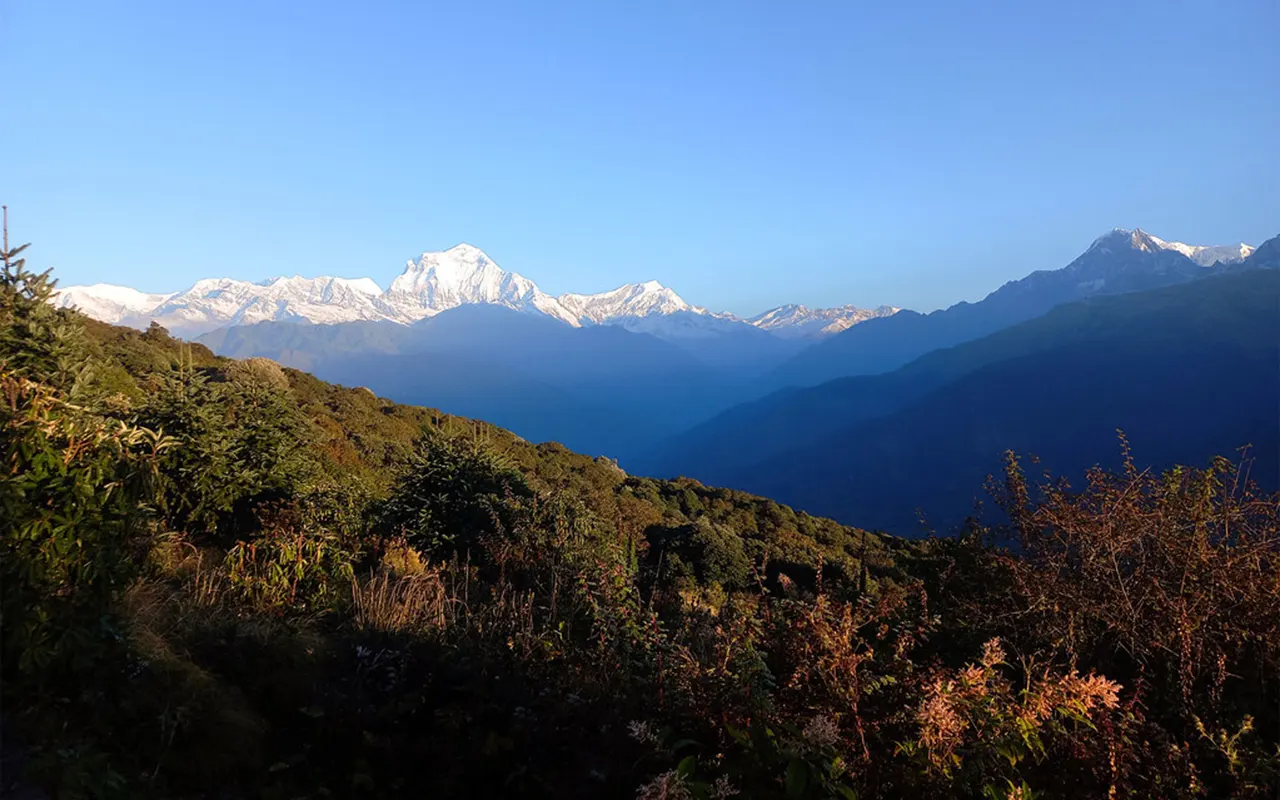
- Enjoy sunrise views over Annapurna and Dhaulagiri from Poon Hill.
- Walk through traditional villages and experience local culture.
- Trek through rhododendron forests and terraced landscapes.
- Experience quieter and less crowded mountain trails.
- Reach Mardi Himal Base Camp with close Himalayan views.
- Walk along scenic ridge trails with open mountain views.
- Complete a well-balanced journey on the Poon Hill Mardi Himal Trek.
Trip Extension
Suppose you have more time in Nepal after this trip. In that case, we can help you to extend your trip by running different treks in Nepal, tours in Bhutan and Tibet, Jungle safari tours at Chitwan, Bardia, and other National parks, Nepal luxury hotel booking, Rafting, Ultra-light flights, or any other travel-related services. You can get more information here.
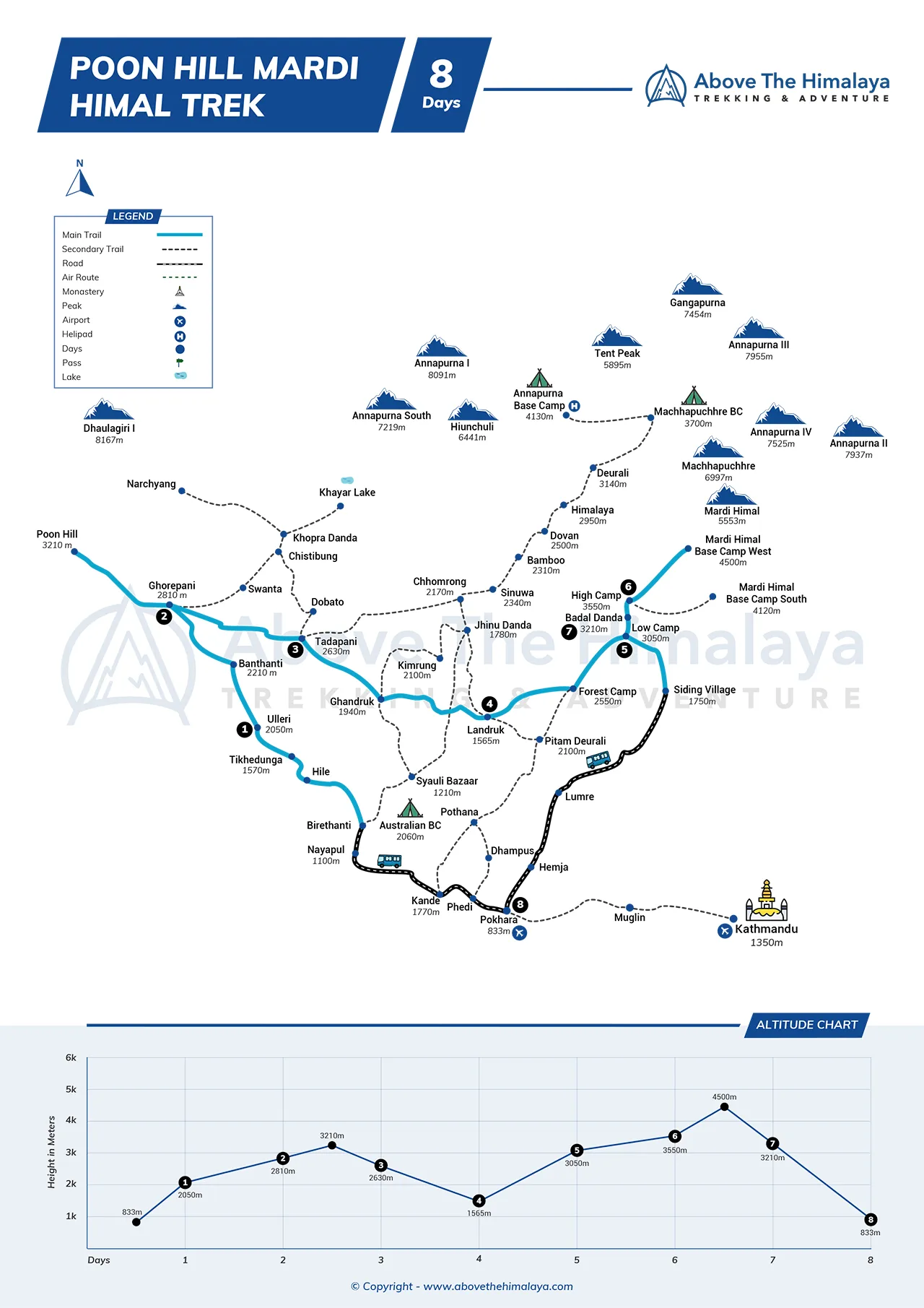
Route Map & Altitude Chart
Most Asked Questions by Travellers
 General
This trek combines a popular viewpoint with more quiet ridge trails for a cultural, as well as scenic, diversity. It gives you a chance to go through busy and peaceful sections within a brief period of time.
The whole journey will take 8 days (both trekking and transportation). It is designed to fit easily into a short travel plan.
You will trek for about 6 to 7 days depending upon the itinerary. The rest of the days are spent travelling on and off the trail.
The trek begins from Birethanti after a short drive from Pokhara. It ends at Siding followed by a return drive back to Pokhara.
The Poon Hill section can be busy, especially during the peak seasons. However, Mardi Himal section is not hectic and more peaceful.
According to the existing Nepal trekking regulations, A licensed guide is strongly recommended for safety, navigation, and a smoother trekking experience, although this trek is not a restricted area.This is why it is preferred to organize this trek by an authorized trekking agency through a licensed guide.
Mardi Himal Base Camp is the highest a height of about 4,500 meters. This is reached on one of the last days of trek.
Yes, beginners with good fitness can complete this trek successfully. Proper preparation and a slow pace make the experience easier.
 Preparation & Fitness
It is recommended that you walk 5 to 7 hours a day on mixed terrain. Basic fitness and stamina is important to an enjoyable experience.
Activities like walking, jogging and hiking help in the building of endurance. Light strength training can also influence stability on uneven trails.
Previous experience is helpful but not necessary on this trek. With preparation and guidance, it is possible for first time trekkers to accomplish it.
Altitude training is not necessary for most trekkers. For this route, it is more important to have a general fitness.
Yes, it is possible for beginners to complete the trek with the proper preparation. The key to managing the journey is to walk at a constant pace.
The speed of the trekking is adaptable and is adjusted to the group. Guides make sure everyone is at ease and safe during movement.
It is beneficial to be patient and concentrate on the progress made daily instead of being able to see the entire picture. Positive attitude will make the trek enjoyable.
No, it does not have any age restriction provided you are healthy and fit. Visiting a doctor is recommendable in case you have some concerns.
 Permits
You must have the Annapurna Conservation Area Permit (ACAP). The Mardi Himal trail is also mentioned under the current TIMS provision as trekking routes that must be registered on a TIMS card and have a licensed guide arranged via a registered trekking agency.
Yes, permits are usually arranged by the trekking company. This makes the process easy and stress free.
No, the trekking company usually takes care of all the arrangements regarding the permits. You only have to provide the details of the passport.
Permits are checked at a number of checkpoints along the trail. These include entry and exit points to the region.
Yes, permits are to be carried on the trek. Guides are generally responsible for keeping them safe and accessible.
Should a permit be lost you should immediately inform your guide. They will assist with the process that will be required.
Permits are not usually refundable once they are issued. It is important you prove your plans before processing.
Yes, the children requires permits for a trek also. The process is the same that it is for adults.
 Insurance and Visa
Yes, travel insurance is highly suggested to travel safely. It should include high altitude trekking and emergency evacuation.
Your policy should include medical treatment and helicopter rescue. Coverage at least up to 4,500 – 5,000 meters is recommended.
It is better if you take insurance before going on a trip. In the local options may not include high altitude trekking properly.
Most travelers can receive a visa at the airport of Kathmandu. Must have valid passport & visa fee.
Your passport should be good for at least 6 months from the date of entry. It should also contain at least one blank page.
Yes, it is possible to extend visas at the immigration offices in Nepal. The process is relatively simple and is usually done in a day.
It is better to carry a photocopy and not the original. The original you can safely keep in your hotel.
Yes, even trekking for a short period does not come without risks such as altitude and weather. Insurance is one of the sources of financial protection in the period of emergency.
 Guides & Support Staff
Yes, there is a licensed guide for safety and smooth coordination purposes. They also help with navigation and information for a specific area.
Yes, the guides are trained in first aid and high altitude safety. They are experienced while dealing with trekking conditions.
Yes, there are porters to carry your main luggage. This means that you can go walking with a light daypack.
A porter normally carries the luggage of 2 trekkers till a safe limit. This is according to a set of porter welfare guidelines.
Yes, all the staffs are insured as per the government standards. Their safety and welfare is a serious subject.
Yes, private guides are available upon request, at an earlier date. This is a more flexible trekking experience.
Yes, most guides speak good English for our communication purpose. They can also help them explain culture and local details.
Tipping is not expected but appreciated to provide good service. It is usually administered at the end of the trek.
 Accommodation and Facilities
You will be staying in local tea houses along the trail. These are in the form of simple lodges which are run by local families.
Rooms are normally twin-shared in 2 single beds. Private rooms might be available for lower villages on request.
Bedrooms usually are not heated, especially at the higher altitudes. Heating is usually available in the dining area in the evening.
Most of the tea houses have basic blankets. It is still recommended to bring alongside a sleeping bag for extra heat.
Toilets are often shared and are sometimes in the form of squat toilets, and sometimes in western style. Facilities more primitive on higher elevations.
Hot showers are available in some villages at an extra fee. At higher altitudes, there may be little hot water.
Yes, electricity is available at many places and many times it is driven by the power of the sun. Charging devices are typically another cost.
Wi-fi is available in some villages but it can be slow and not very reliable. It is typically provided at an additional cost.
 Food and Drinks
You will get simple and fresh meals such as dal bhat, noodles, soups, rice dishes etc. These meals are made to give the amount of energy to walk daily.
Yes, food is relatively safe for the most part when made at tea houses along the trail. It is recommended to eat freshly cooked food and avoid eating raw food.
Vegetarian options are extremely easy to find and available. There are vegan meals possible with clear instructions to stay away from dairy and eggs.
Meat is available in the lower spaces but less recommended in the higher altitude. Many trekkers prefer to have vegetarian meals as it is easy to digest.
Tea, coffee and soft drink are usually available in tea houses. Hot beverages are especially popular in colder areas along the trail.
Not recommended to drink any tap water. Boiled or purified water is the safest.
Yes, there are snacks such as biscuits, chocolate and noodles which are available in villages. As you go up you get more and more expensive.
Breakfast generally comprises porridge, eggs, bread or pancakes. It is taken early in the day in preparation for the walk the day.
 Weather & Seasons
Spring and autumn are the perfect seasons to witness the clear weather and the mountain views. These are the stable months of the year for trekking.
Spring: Temperatures are pleasant and forests are in bloom. It is one of the most comfortable times to trek.
Autumn brings clear skies and dry paths with no monsoon. It is the most popular time of the year for trekking.
Yes but it can be very cold at the higher altitudes. In some sections, there can be snow impacting trails.
Monsoon provides rain, muddy trails and not too much visibility. Trekking is not impossible but not so ideal at this time.
Nights can be very cold, particularly over 3000 meters. Proper warm clothing is necessary.
Yes, the weather in the mountains can change in a short time (within a day). It is important to be prepared in different conditions.
The less crowding in early spring and late autumn. These are the times which offer a quiet experience for trekking.
 Health & Safety
Yes, the trek is generally safe provided it is planned correctly. Following guide instructions makes you safer
Altitude sickness and fatigue are the biggest issues. Proper pacing and hydration help to reduce risks.
The program is designed with consideration of gradual ascending: Guides to check your state and make the pace slower or faster, when necessary.
In extreme cases instantaneous descent is made. Helicopter evacuation is provided where necessary.
In some of the villages there are some simple health posts.For serious problems, treatment is done at Pokhara or Kathmandu.
Yes, it is important to take your own medication. Inform your guide of any medical conditions.
Water isn’t safe to drink in its untreated state. It is recommended that water be boiled or purified.
Eating right, drinking water and walking at a constant clip are important. Proper rest is also important to keep up energy.
 Packing & Gear
Bring layered clothing that will be effective in warm and cold weather. Include a down jacket and waterproof layer.
Yes, good trekking shoes with a good grip are important. Proper footwear is helpful in avoiding injuries.
Yes, and particularly higher altitudes, where the nights are cold. It provides extra warmth other than blankets.
A daypack of approximately 25-35 liters is sufficient. Porters will carry your main luggage with them.
yes, trekking poles are useful in achieving balancing and also to reduce strain on knees. They are especially useful on descents.
Sunglasses, sunscreen, lip balm and a headlamp are a must. Basic toiletries are also recommended.
Yes, power bank is very useful as the charging is restricted. Cold temperatures can discharge batteries quickly.
Yes, gear can be rented or purchased at Pokhara or Kathmandu. This is a good solution for short trips.
 Booking & Payment
You can book by email, website forms or travel agencies. Confirmation upon booking.
Yes, it is usually required to have a deposit in order to confirm your booking. The balance is paid for on arrival.
The payments can be made through bank transfer or online payment or via cash. Card payments come with extra charges.
Typically the remaining amount is paid in advance of the trek start. Details are given on booking.
Yes and cancellation policies are time dependent. Some costs might not be refundable.
Date changes are possible according to the availability. It is best to inform early.
Yes, after it is confirmed the price is set in stone. Additional services may have their own costs.
Yes you will receive confirmation and trip details by email. This includes itinerary and preparation instruction.
 Transportation & Flight
The trek is initiated by a drive from Pokhara to Birethanti. This is laid out as part of the package.
Yes, all transportation on the itinerary is included. This includes start and end transfer.
Private vehicles or jeeps are used depending upon the condition of road. Mountain roads can be bumpy in places.
It typically takes about 1.5 to 2 hours to drive. The times may change in connection to traffic and road conditions.
After getting to Siding you will go back to Pokhara by road This is a symbol of the end of the journey.
There are no flights required on the itinerary. All travel is done by road and on foot.
Yes, experienced drivers are careful while driving on the mountain roads. Safety is always a first consideration.
Alternative arrangements in case of delays are made. Flexibility is a major factor in the mountains.
Reviews on Poon Hill Mardi Himal Trek – 8 Days
Be first to post a review in this trip.




Best Price Guaranteed, Easy to change Date, Instant Confirmation
Book This TripBook with Confidence
- Flexible bookings and easy trip date changes
- Personalized service and customized group sizes
- Safe travels with owner-operated services and highly experienced guides
- Best price guarantee for the most value for your money
- Secure & easy online booking
Your Trek Leader
 Enjoy Himalayan scenery with the help of Nepal’s best guides with Government license holders and got training in first-aid, our Trip Leaders, know where you’ll find the best photos, most fascinating wildlife, and the best stream crossings.
Have Questions?Talk to Expert
Meet Mr. Purushotam Timalsena (Puru), Nepal's best trek and tour organizer, who has been working in the Himalayas for more than 24 years.
WhatsApp/Viber +977 98510 95 800



You May Like



Trips for All
Private Trip
Peaceful tour with your travel buddy and guide
Small Group Travel
Travel with people having similar adventure dreams
Trips for Kids
Calling all young adventurers - join us for a journey of a lifetime!
Trips for Adventurers
Climbing & mountaineering adventures for thrill-seekers